





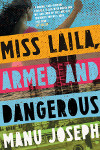
Manu Joseph – Miss Laila, Armed And Dangerous
Posted 16th May 2018
Category: Reviews Genres: 2010s, Commentary, Political, Social, Thriller
Comments Off on Manu Joseph – Miss Laila, Armed And Dangerous
Or is she?
Publisher: Myriad Editions
Pages: 211
Type: Fiction
Age: Adult
ISBN: 978-1-912-40810-8
First Published: 19th September 2017
Date Reviewed: 16th May 2018
Rating: 3.5/5
The day Hindu nationalists win the elections, a building collapses; Akhila arrives as teams are trying to find survivors and she offers to crawl through a tunnel to help a man who is still alive. The man is muttering about a person on his way to commit a terror attack. A member of the two groups chasing the man and the girl sat in the passenger seat next to him, Mukundan isn’t sure what they’re doing is right, and is sure there’s a better way of extracting the girl, but his boss bids him to wait.
Miss Laila, Armed And Dangerous is a work of fiction which switches back and forth between a number of narratives as the author seeks to explore social injustice in its various forms.
This is a book that is at once an easy read, an uncomfortable read, and a hard-hitting read that requires your attention. Joseph’s use of satire and general slight humour often lures you into thinking it’s a fun novel. That may be part of the point – Joseph gets his thoughts across through via an easy writing style that’s nevertheless full of report-like phrasing.
Sometimes, the style and structure makes the book hard to follow – Joseph, a journalist away from his novel writing, has chosen to write his book in a similar style, and adds to it many different points of view. As an example, you might think that Akhila Iyer, the medical student and social media prankster who targets people in or close to the political sphere, will be moonlighting as this Miss Laila, and it takes a while for Joseph to get to Miss Laila herself wherein you have to get your head around the fact they are two different people.
Joseph’s major commentary apart from the controversies surrounding Mukundan’s story is the difference between rich and poor, high caste and low caste, Hindu and Muslim, and in the context of politics, and due to the basis of fact underlining the book. There is lots to consider here, with Joseph’s bold dialogue looking at both past and near present, holding nothing back. One person named outright is the author Arundhati Roy, who Joseph speaks of in the context of the female author’s visit to the house of a very wealthy person and her views about how much money this person had compared to those nearby; Joseph takes his Akhila Iyer to Roy’s own apartment building where she conducts an interview with a woman who says similarly of Roy’s house. (Whether this is truth or fiction this reviewer cannot say.)
So, to the narratives, you have the man trapped inside a fallen building. You have the narrative of Akhila Iyer, often told in the chapters focused on Professor Vaid as her own narrative is taken up by the collapsed building; occasionally you hear from Akhila about her family, the mother that was often away helping other people as an activist, leaving her daughter to grow up without her. (A lot of Joseph’s commentary is about activism and the way it can simply just switch people’s situations until another wave of activism is required, the once powerful becoming the powerless and then powerful again.) You have the narrative of Mukundan, who tails Laila and Jamal, and the narrative Laila’s sister tells of the days before Laila left with Jamal. And you have the narrative of election winner, Damodarhabi.
A revelation comes towards the end that may lessen the impact of what you’ve read. It’s a good idea going into this book, to consider that the non-linear timeline might expand.
Miss Laila, Armed And Dangerous is a difficult book to make a call on. Some of it is excellent – compelling points, good writing – but it does come across more as an essay or piece of reporting rather than a story or study.
I received this book for review.
Related Books
None yet
Yaa Gyasi – Homegoing
Posted 14th May 2018
Category: Reviews Genres: 2010s, Commentary, Historical, Political, Social, Spiritual
3 Comments
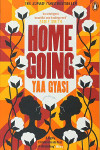
Homegoing was on the British Book Award shortlist for the Debut Book of the Year 2018.
History is not always confined.
Publisher: Penguin
Pages: 298
Type: Fiction
Age: Adult
ISBN: 978-0-241-97523-7
First Published: 7th June 2016
Date Reviewed: 14th May 2018
Rating: 5/5
Effia’s mother tells her to keep the beginning of her menstruation a secret. It’s long been known that Effia would marry the man next in line to be Chief but Baaba has something else in mind and Effia is traded in marriage to the white governor of the Castle. As she moves away with James, Baaba tells her daughter that she is not related to her and that her mother abandoned them. As Effia’s new life begins, her unknown half-sister is taken prisoner, held with hundreds of other women, about to be sold into slavery overseas. The sisters’ situations will reverberate down the ages.
Homegoing is a superb mainly-historical novel that starts in 1700s Ghana and continues into our present century. Spanning many generations, it spends a number of pages on each character in turn, nevertheless retaining the sense that it is a novel of one story.
Gyasi has created something rather remarkable. Within moments she sucks you into the story, her use of history in all contexts – the writing of it, the knowledge included, the bringing to life – starts it off, and then her masterful characterisation ensures you don’t let go. In terms of the history, there’s a fair amount of information that often gets looked over, as well as the horrors that continue.
The writing is wonderfully descriptive and Gyasi creates the perfect balance of narrative and dialogue. It flows very well; indeed the only negative aspect of the book is the use of ‘off of’, the only thing that stunts the flow.
But at its heart, beyond the subject matter that we’ll go on to in a minute, is that characterisation. There are few books in which multiple narratives are considered to be equally fine. Gyasi’s is one of those few. No matter how invested you are in any one story (which read almost as vignettes despite the time they span; there are no complete endings within a character’s chapter, the only closure is in the descendant’s chapter) you never once feel that sense of loss so often caused by other multi-narrative novels. Would it be nice if there was more of each character’s story? Of course. But the novel does not suffer for the lack of it. The progression is natural and easy to follow; Gyasi includes hints early on and you soon get used to the flicking back and forth between bloodlines. If you do fall behind – and you will when it comes to working out which generation you’re on to – there’s a family tree in the opening pages.
As it’s pretty obvious from the start – or at least from the moment you realise how Gyasi has plotted the book – that somewhere it’s highly likely the two bloodlines will meet in some way, it’s pertinent here to say that the book isn’t predictable on that count. This isn’t your usual ‘and magic happened and they found out who each other was’. There is indeed ‘magic’ in the book – to use the phrase that people down the ages start to refer to traditional spirituality as – and yes there is a meeting of the bloodlines, but there are no unbelieveable discoveries.
On the subject of symbolism is Gyasi’s use of fire and water, with fire particularly pronounced because water is more obviously associated with the beginning. It’s a gentle, weaving sort of symbolism, that takes you through the various generations, creating an impact – the history of a people on their descendants – as well as a sort of coming-of-age, cycling, taking back ownership.
Apart from symbolism, Gyasi explores the slave trade, particularly, as said, in terms of the beginnings and early impact in Ghana. She explores the affects of the difference between the Northern and Southern states and the impact of Southern laws on free men of the North. She explores segregation, the concept of passing, and tensions and social and political problems still occurring today. These explorations are interlaced with the chapters so that black history in America as a whole is explored in depth. Again, Gyasi’s writing makes everything flow together, showing how they are both separate subjects and part of a whole, and as with everything else the author does it with aplomb.
Homegoing is the sort of novel that stays with you, that you want to return to. In the second to last chapter, Marjorie is asked by her teacher if she feels the book she is reading inside of her. I think we all know that feeling, the one that makes reading so worth it.
You may well find it in this book.
I received this book for review.
Related Books
Reading Life: 11th May 2018
Posted 11th May 2018
Category: Reading Life Genres: N/A
5 Comments

You may have seen on Twitter that I was away over the last week. For the first time I took only my Kobo and one very thin book, Valeria Luiselli’s Faces In The Crowd, which I found on a library shelf, the last date it had been borrowed suggesting to me I’d better take it out soon. I’ve learned a lot about library use the past few months.
Luiselli isn’t an author who has been on my list, but I recognised her name from a panel at Hay two years ago and knew that if she was there along with other well-known authors, her books were likely worth picking up. Faces In The Crowd, translated from the Spanish by Christina MacSweeney (Luiselli is Mexican) is about a woman who works as a translator, going around her city’s libraries to find more Latin American authors to add to her small company’s list. It’s a clever book-in-a-book, the novel she’s writing interspersed with dialogue and questions from, for example, her husband – on one page there is a paragraph about how the character shares a bed with another woman, and the couple of sentences that follow after a pause are composed of her husband asking her if it’s true she’s slept with women. It’s sometimes difficult to tell when or where any one vignette is set and whether it’s fiction within the fiction or simply the first level of it, as it were, but that becomes part of the charm and is undoubtedly a part of the point of it all.
I didn’t consciously borrow this book thinking I’d take it to Spain, but for the language it ended up being a good choice. As it turned out, my plans to read outside early each morning weren’t realised – the weather wasn’t very good – so I’ve still a fair amount of the book to read.
In other bookish news, I recently received Claire Fuller’s upcoming Bitter Orange and Yaa Gyasi’s Homegoing; the latter is set in the 1700s and already at page nine I’m loving it. With my event now less than a week away I’ll be switching between these two books, leaving others aside until the end of next week; the Gyasi is set for review on Monday, and I plan to have a good chunk of Fuller’s book behind me by Thursday. The remaining portion of The Female Quixote will have to wait a little longer.
At some point in the near future I’ll be reading Patrick Gale’s A Place Called Winter. I’ve wanted to read it for a while and found a library copy to browse through. The opening pages took me straight back to the fantastic literary atmosphere Anna Hope created in Wake; I want to go back to that particular combination of writing and setting.
What was the last translated book you read?
The Bookshops Of Hay-On-Wye
Posted 9th May 2018
Category: Chit-Chat Genres: N/A
Comments Off on The Bookshops Of Hay-On-Wye
Hay-on-Wye is called the town of books for good reason – there are more bookshops than you can possibly visit unless you don’t intend on browsing and haven’t come for the festival. Considering the amount of choice there is, it makes sense to go in with a plan. During my downtime at last year’s festival, I had a mooch around the streets to see what was on offer. Here are five of the best stores:
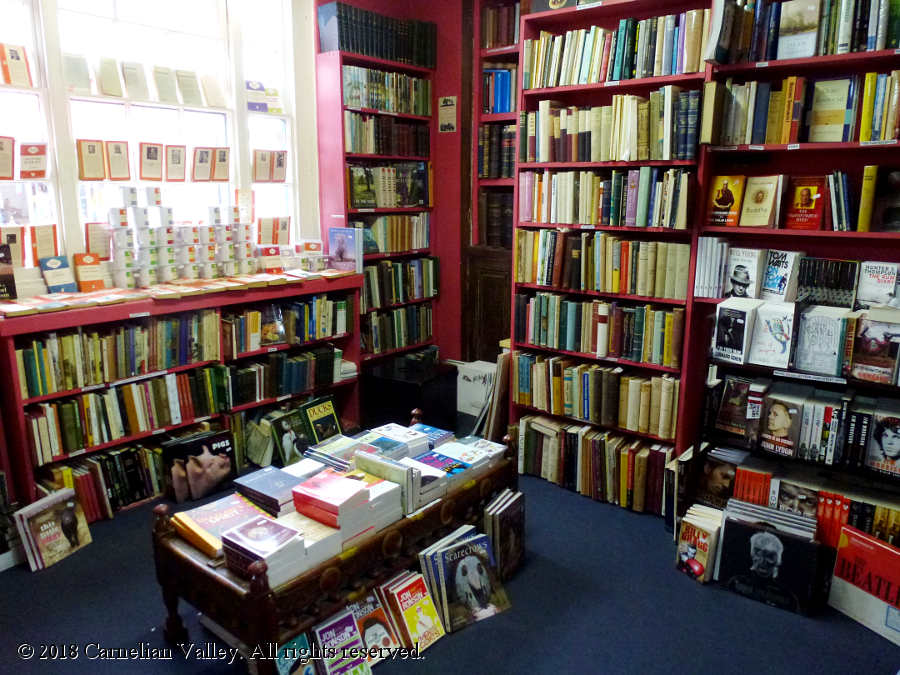
The Addyman Annexe: 27 Castle Street
Monday – Saturday: 10:00-17:30
Sunday: 10:30-17:30
There are two Addyman locations; this is the largest and stands on the main street you walk down from the festival site. The Annexe sells a lot of literary-related items; last year Taffywood Books mugs jostled for space on a windowsill with old orange Penguin Classics. A special festival section for children’s books took a little space. The shop sells a good range of both new and second hand books and is vibrant in its colour. Don’t miss the upper floor; the stairs are against the wall by the tall yellow shelves in the back room.

Broad Street Book Centre: 6 Broad Street
Open all week: 10:30-17:00
Situated across the street and a little further down the road from The Granary (a cafe you will come most definitely come across or hear about), is the Broad Street Book Centre. A fantastic rabbit warren of a store, just when you think you’ve reached the end it goes on further, with more books than you’d ever have thought possible from outside. The books are solely second hand and the variety spans all ages and categories, older books and new, from fiction, non-fiction, and poetry. Stacked away in a tiny space towards the back is a pretty marvelous selection of very old books, some popular selections, others you may never have heard of but want to buy nonetheless.
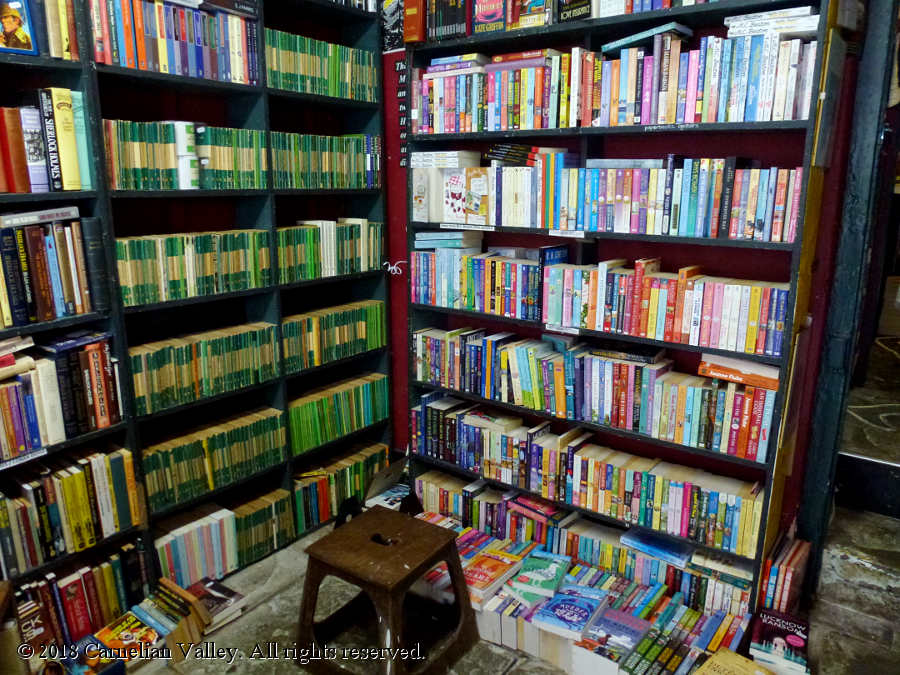
Murder And Mayhem: 5 Lion Street
Monday-Saturday: 10:30-17:30
Open some Sundays
This shop does what it says on the tin, except for the murder part! Whilst other shops have books on various surfaces, Murder And Mayhem takes it a literal step further with piles of glorious Allison & Busby mystery classics sat against the walls of the stairs. It’s worth the careful journey north as the room at the top is rather beautiful in its extreme bookish messiness. Back on the ground floor and the room you first enter into is full of wonderful publisher-specific piles. A great many Penguin Classics fight for space along the left wall, hoping you won’t miss them in this unusual arrangement where there are so many more books equally capable of grabbing the collector’s attention.

The Poetry Bookshop: The Pavement, Lion Street
Monday-Saturday: 11:00-17:00
Open some Sundays from 12:00
At the end of a tiny street away from the hustle and bustle of the town (at least when the festival is on) sits The Poetry Bookshop, in a detached building. A fair space, there are lots of shelves here and everything is carefully categorised. There are also lots of biographies of poets, compilations of literary magazines content, and books full of interviews. A selection of second-hand fiction rounds it off.
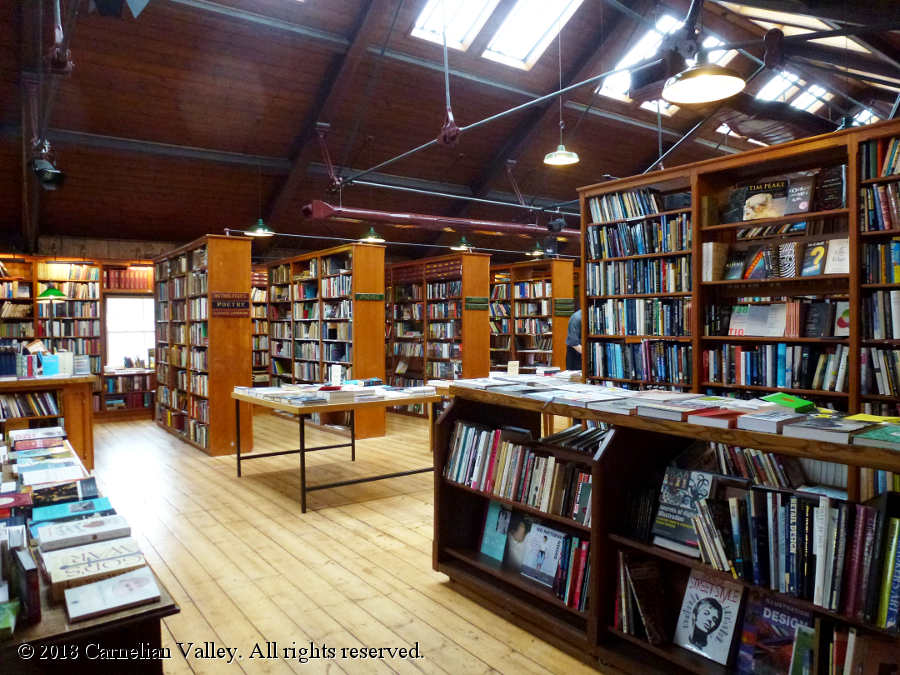
Richard Booth’s: 44 Lion Street
Monday-Saturday: 9:30-17:30
Sunday: 10:30-17:00
Cafe
Tuesday-Saturday: 9:30-4:30
Sunday: 10:30-3:30
Last orders are 30 minutes before closing
Richard Booth’s is one you can’t miss: nestled between others in its terrace, the exterior nevertheless stands out, its design ensuring your interest. At its entrance – very grand, all wood and lovely low ceilings, is the fiction, with a lot of books by authors in attendance at the festival. Awesome stationary – on this occasion sheets of wrapping paper with recipes printed on them – sat beside the counter. It’s worth walking on towards the back – a stunning staircase runs from the centre of the floor up to the new level where a large number of shelves are arranged much like a library. The selection is extensive. Sofas at the end of the main aisle, with plenty of light from the back and above in the roof make for an atmosphere place to read your new purchases. Crime books can be found in the basement.
In addition to a bookshop, Richard Booth’s own a cinema on Brook Street that shows a range of films – many based on books (the new adaptation of The Guernsey Literary and Potato Peel Pie Society is currently one of those on offer. I’m so glad they kept the full title!)
When I first walked round the bookshops and took my notes, I envisaged writing about them soon afterwards, partly because of the current climate of closures. I wasn’t able to write in time and, deciding to keep it back until the festival tents were up once again, I am delighted to say that all of the shops I visited – ten in total – are still there. Long may it remain the case.
Claire Fuller – Swimming Lessons
Posted 4th May 2018
Category: Reviews Genres: 2010s, Books About Books, Domestic, Mystery, Psychological
Comments Off on Claire Fuller – Swimming Lessons

Only go with the flow to a certain extent.
Publisher: Fig Tree (Penguin)
Pages: 294
Type: Fiction
Age: Adult
ISBN: 978-0-241-25215-4
First Published: 26th January 2017
Date Reviewed: 1st May 2018
Rating: 5/5
When Gil sees his wife standing outside the bookshop, he runs after her, causing himself a fair injury in the process. Daughter Nan isn’t amused – Ingrid disappeared many years ago when she and her sister were children – and she’s very likely dead. But Flora sides with his father and as Gil returns home from hospital the sisters look after him, together with Richard, the man Flora had been sleeping with but had split up with, in not so many words, before she left to meet Nan. The family house is full of books which are stacked on every surface, a few layers deep – Gil has an obsession with finding secondhand books that hold receipts, letters, and marginalia. Mixed in with this story is that of Ingrid’s version of her marriage to Gil, told in letters, that she had slipped in between the pages of various relevant titles.
Swimming Lessons is an utterly sensational novel of truths and lies, mystery and a spot of magical realism, and regret, all held together by the theme of literature and writing. Ingrid’s tale begins at university where she studied English and met Gil, her lecturer. Their story moves on from there, with Gil’s friends warning Ingrid about Gil’s personality and the university putting its foot down. The chapters set in the present abound with literary ideas, criticism, and general conversation.
“Writing does not exist unless there is someone to read it, and each reader will take something different from a novel, from a chapter, from a line. A book becomes a living thing only when it interacts with a reader.”
“…often the only way to see what a reader thought, how they lived when they were reading, is to examine what they left behind. All these words… are about the reader. The specific individual – man, woman, or child – who left something of themselves behind.”
This means that whilst the subject of the book, or, rather, subjects, can get pretty dark, the wonders of the text keep you in a positive state. The darker side of the novel – Ingrid’s revelations, which are effectively revelations to the reader, and the question as to what happened to Ingrid – are written superbly; Fuller’s writing style, plotting, and subsequent literary execution are absolutely marvelous to the point that the book is just as good to read for its prose as it is for the way it unravels its subjects. A good use of the present day setting and decades past round out the writing.
As for the characters they are very well drawn and feel far from fictional. Fuller references I Capture The Castle, and there are, in Ingrid’s love of the beach and writing of it, potential allusions to The Awakening (‘potential’ due to the book not being referenced). In the idea of Ingrid having been lost to the sea there is a minor reference to Virginia Woolf. The inter-textual nature of the book enhances both the atmosphere and the characterisation and also leading you to think that situations may match those in the older novels (which can be the case but not always). Gil has a writing room to which no one else is allowed entry. Flora is often naked. Ingrid found her changed life difficult. Like Fuller’s previous book, Our Endless Numbered Days, Swimming Lessons looks a little at neglectful parenting and favouritism.
This book pairs joyous reader escapism with some uncomfortable subjects. It is a good idea to go in prepared for a blunt look at what can be hidden under the surface, of parenting, of marriage, and then give your all to it. Because it’s a triumph; not the sort of characters you might want to spend real time with but the book itself, everything about it, oh heck yes.
Related Books


