





Are Classic Book Introductions Misplaced?
Posted 15th February 2016
Category: Chit-Chat Genres: N/A
9 Comments
I suppose this is obvious given what I’ve said about my preference for starting classics with ignorance, but I only ever read an Introduction of a book I’ve already read. This of course refers only to introductions written as a literary commentary (rather than your regular author-penned story introduction), those that are largely limited to classics, that discuss the plot.
In the general scheme of things I don’t understand their placement. Unless perhaps you are a teenager about to study a text inappropriate for your age that the curriculum doesn’t acknowledge needs more life experience to appreciate, where is the use of such an introduction?
Introductions spoil plots. They tell you all about the themes, the main events. The contextual information in regards to the comparison between book and author can be interesting, but as you can’t separate it from the spoilers it’s somewhat wasted placed where it is.
This is not to say I think they shouldn’t be written, but I do think that in most cases, introductions would work as afterwords. Of course you can choose not to read an introduction, but its placement suggests you read it first. If introductions were conclusions you’d have your own knowledge of the book to help you appreciate what had been written, there would be nothing to spoil, and you could enjoy it in hindsight. Instead of reading the commentary with limited comprehension, you’d be on a level playing field with its writer, and able to decide whether you liked or agreed with the comments. (For the reality being the reverse of this last point, one could almost say that the introduction is an attempt to teach what is the ‘correct’ reading or take-away from the book.)
What is your view of introductions – are they misplaced?
Where Scarlett O’Hara And Anna Karenina Meet
Posted 12th February 2016
Category: Further Thoughts Genres: N/A
3 Comments
“No, I can’t think about it now; later when I’m more calm.”
So says Scarlett O’Hara, most notably at the end of the book; only this line isn’t from Gone With The Wind, this is Anna Karenina as per Pevear and Volokhonsky’s translation.
The rather striking line which, though undoubtedly older, is so like Mitchell’s, comes from the second section of Tolstoy’s epic, roughly one fifth of the way through; it finishes off the chapter in which Anna and Vronsky sleep together for the first time.
Both heroines, if indeed we can call them that, especially in Scarlett’s case, end their stories in downfall. Scarlett sees her life fall to pieces when her up-until-then-unrealised love of her life leaves her, presumably kicking her out of their garishly decorated home at a later date. Anna commits suicide.
Both heroines live their lives in ways their respective societies do not appreciate. Anna’s is more straight-forward; society condones her affair but not the way she displays it fairly openly and leaves the family home. It can be discussed but not seen. Scarlett has done a lot more to offend. She steals her sister’s husband, tries to take her friend’s husband, is too attractive and social, and she’s independent. She likes the glamour, doesn’t share the values of her community, and flaunts her wealth in ways that are not approved. Both characters end up losing their men – Scarlett her Rhett and Anna her Vronsky.
The characters are quite different. Scarlett’s often referred to as an anti-heroine. Hard to love, the reader gets to see both her actions and the resulting pain of the victims. Scarlett’s out for herself. Anna’s a lot more thoughtful. Still selfish enough to go ahead with her affair and put her family in bad standing, she nevertheless cares somewhat for her children and cares about her husband. Hers is a tale of a person falling in love outside a marriage of convenience and is thus for both the other characters and the reader, more understandable. And, unlike Scarlett, there is a lot more to like about her.
What Anna and Scarlett have in common is their independence. Whilst neither had anything close to the independence more women experience today, a lot of their freedom is due to their mindset. It’s easier to see in Scarlett who goes off on her own, has her own business and employees, and Rhett supports her. (Scarlett’s other husbands also let her do her own thing but that was down to her manipulation of them rather than the relative equality of Scarlett and Rhett’s relationship.) Scarlett doesn’t care what people think and of course she has her money to back her up.
Anna shares Scarlett’s mindset to a degree and has the support of her husband, Karenin, to an extent. Anna, loved, adored, moves freely away from her husband when other women might be called to obey – Karenin is a forgiving character whenever society is not involved. Anna has the power in a marriage wherein she’s the stronger of mind though she does hold the advantage of having a husband who states he does not like the idea of jealousy.
Anna and Scarlett are independent by nature but also by society, as it were. Society looks up to them – Anna adored, Scarlett tolerated by women, loved by men. Each could only go so far but neither are at the whim of others. Even when Anna is telling Vronsky they can’t continue it comes from a place of morals and worry over reputation of her family rather than herself.
The whole concept of leaving the thinking until later – something that Anna eventually does, to a point, but something the jury is still out on in regards to Scarlett – is a coping method. For Anna it’s more straight-forward: at the time she was stressed, she’d just consummated her affair, she needs to calm down and think straight. For Scarlett it’s coping with reality and with the difference between what she does and what’s expected – it’s better to be happy, perhaps to live in ignorance, than face up to what she’s done. It shows a certain lack of care for the husband she’s just realised she loves, but it suits the way she is. If she let reality in it would force her to change and by putting the thinking off she delays the inevitable. Perhaps she delays thinking about Rhett’s departure enough that she never deals with it at all and just stays at Tara whilst he dismantles their home. We’ll never know, but out of sight is out of mind.
Leaving things until later gives Anna and Scarlett a permission, if only self-sanctioned, to keep on doing what they’re doing. If they thought about it at once their stories would likely be very different. One thing’s for certain, though – Karenin will always give a damn.
Why Do We Spend So Long Deciding What To Read Instead Of Just Picking Something Up?
Posted 10th February 2016
Category: Chit-Chat Genres: N/A
6 Comments

I’m in a reading slump at the moment, mostly because I’m overwhelmed by choice (high expectations rather than numbers in this case). It seemed the perfect time to ask why we don’t just get on with reading. It’s a deceptively simple question, I think, because it’s very first-world-problem whilst also pointing to something important – wasting time. We waste time choosing in general, not just reading time but spending time looking at our books – the problem is we look at them over and over again.
Why do we do this? We do it because we want a good book. We want this every time and so we try to work out which books wouldn’t be so good – a hard thing to do when we haven’t read them because the blurb can only say so much. Thinking on this begs the question: what are we doing trying to choose the right book in this context? If we need to choose then surely that means we’ve some bad books in the bunch and we’re due a culling session rather than a ponder. I do think that’s likely sometimes but it’s a bit utopian because if we culled for that reason alone we’d still be stuck; this time it would be choosing between extremely high-rated books that would quite possibly be similar in subject.
The thing is we’re planning, or at least hoping, to read all the choices at some point, what does choosing matter?
But we like to match books to moods. Of course we can ask how we know if it’ll fit but a better question is if it’s a book we think we’d like anyway is perfect timing really that important? All those times we say we read a book at the right time, might we have disliked it otherwise? In the case of mood probably not, unless it was in some way triggering at a certain moment, so why think so much? The case for reading a book at the ‘right’ time is surely that we might find more meaning in it, more value, and that is important, but we can get too invested in this idea when it’s a rare occurrence compared to the general good reading experience. It’d be pretty difficult to find the ‘right’ book every time.
I dislike wasting time choosing but thinking about that in itself holds me back. It makes it easier to fall into a slump as opposed to being strict with myself and just picking something. This is where more variety works in my favour, even a variety that includes very average, even bad, reads.
I’d like to think this procrastination, which is a good word for it because there’s an element of worry involved, can be worked out, but would it result in less joy? I’m not sure we should worry about every day items bringing us joy as Marie Kondo suggests because throwing out dirty laundry and ugly heirlooms would be a setback, but we should be concerned that our reading brings us joy. Reading becomes a chore when you’ve a list you want to deviate from but can’t.
Do you spend time deciding what to read?
Xiaolu Guo – I Am China
Posted 8th February 2016
Category: Reviews Genres: 2010s, Commentary, Domestic, Political, Spiritual
2 Comments
When politics force people apart.
Publisher: Chatto & Windus (Random House)
Pages: 369
Type: Fiction
Age: Adult
ISBN: 978-0-701-18819-1
First Published: 5th June 2014
Date Reviewed: 8th February 2016
Rating: 1/5
Iona is tasked with translating a set of letters and diary entries handed to a publisher by a Chinese woman. The publisher has a mind to release the work but first they have to know what it’s all about.
I Am China is a semi-literary novel about personal/political problems in China. It promises much but delivers little.
There are major issues with the book, namely the way the story is told. The set up is all very convenient, contrived; the story of Jian and Mu is told through the letters but it would’ve been much better had we heard directly from the characters themselves. The translator, Iona, is nothing but a plot device inserted to allow the story to come to fruition, as are the other few characters – the publisher, for instance. The problem becomes two-fold when Guo starts to try and make more of Iona. Guo is all about telling, never showing, and it’s far too obvious that she’s trying to insert some meaning into Iona’s own story – you can practically see the thought process as the author realises her readers are going to see through Iona as nothing but a device and she doesn’t want you to see her as a device.
Amongst all this telling, then, is repetition and a distinct lack of emotion and character development beyond Iona. Guo is relating a very important subject but that subject never becomes important because of the lack of anything to pull the reader in and make them care. The author tacks on various statements about Iona’s emotional state whilst reading these letters but it never rings true. And a publisher planning to publish work without any idea what it’s about or permission from the owner of the text… one of those, possibly, but both?
Unfortunately the writing itself is also problematic. English is Guo’s second language so it’s understandable there would be errors but it seems the author was left completely alone when it came to the copy-editing stages.
I Am China is a fair idea gone horribly wrong. Look elsewhere for books on the aftermath of Mao.
Related Books
New Book-Related Furnishings
Posted 5th February 2016
Category: Life But Maybe Not As We Know It Genres: N/A
4 Comments
I’d like to share with you a few things I’ve received and bought related to books, a sort of reading life help, if you will. I’ve been quite excited about these items, two in particular have been a long time coming, and as we all like books here I thought you might be interested in them too.

At Christmas I received two framed pictures. At first glance they seemed nice enough – scenes inspired by classics, in this case Pride And Prejudice and Wuthering Heights, but then I looked at them more closely…
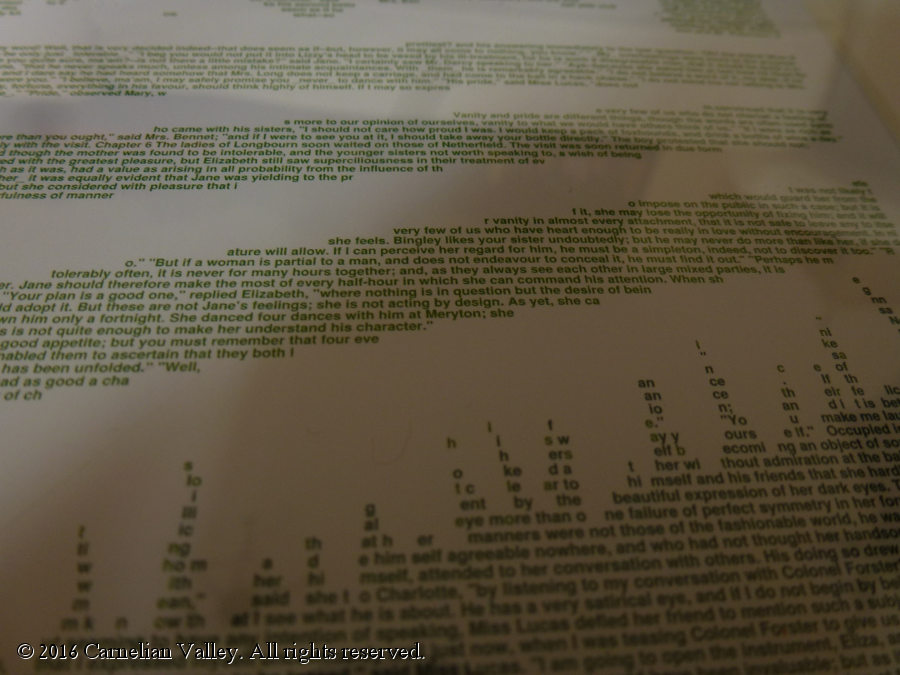
That’s the first chapter of the book, in a tiny font and acting as the background to the image. I’m not sure yet where I’ll be putting them, nevertheless I’ll find a home for them sometime and I know they’ll look great.
Moving on from artwork I’ve wanted a magazine rack for over a year – my parents had one at home, bamboo, that I always liked (don’t ask me why, it’s an odd thing, I know) and I wanted something on which to display some magazines I’ve kept over the years. Magazines in Hindi I like to pretend I’ll be able to read fluently someday. Persephone Bi-annuals I reckon would be nice to share and flick through. In all about 10 items.

Enter the charity shop. I don’t know why it hadn’t occurred to me to look for one there, especially as magazine racks were more popular in years gone by, but I visited a couple with a friend who’s moving house and found one that’s pretty near perfect. £3. Sold.

Something else I’ve wanted is a small standing shelf for my review copies and other books on my to-be-read. The only one I could find was a metal one from Ikea, a curled steel design for £25 that says ‘princess room’. The charity shop had an equivalent in bamboo for £2. The back sticks out into the shelf space but after some experimenting I’ve realised that one book per opening works fine and if I keep to that then I’ll be forced to think even more before accepting review copies because there’s only room for seven books. I intend to put review copies on the bottom and my own books on the top. For now it’s on my desk and I’m feeling rather organised and very happy.
What furnishings have you recently acquired?


