




Megan Nolan – Acts Of Desperation
Posted 22nd August 2022
Category: Reviews Genres: 2020s, Angst, Domestic, Drama, Psychological
Comments Off on Megan Nolan – Acts Of Desperation
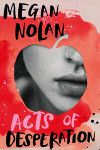
Publisher: Jonathan Cape (PRH)
Pages: 279
Type: Fiction
Age: Adult
ISBN: 978-1-787-33249-2
First Published: 4th March 2021
Date Reviewed: 21st June 2022
Our unnamed narrator recounts the time of her long-term toxic relationship a short while previously, showing us exactly why things happened and what happened, whether or not she fully understands it yet herself.
Acts Of Desperation is a compelling tale; the plot is scant and not much actually happens, however it is in the telling of the story that the interest lies – Nolan’s writing, both the literal words and the way she imparts meaning and uses subtext to very often show more to the reader than the narrator may even know herself, takes this far beyond the simple plot and character development it has (character development’s scant also) and elevates it to something unique, different, and of page-turning quality.
Others have produced a similar effect before but on a different ‘pathway’; the book that most reminded this reviewer of what she was reading in Nolan’s prose was Rebecca, the comparisons being in the extremely self-minded narrative (I hate to say ‘self-concerned’ because that’s not quite right) and the way the background context is so important. (There are no ‘ghosts’ in Nolan’s book and whilst there’s the equivalent of a first wife, it’s not something to be used in a comparison. Indeed liking the du Maurier is in no way a factor in how much you may or may not enjoy Acts Of Desperation no matter my comparing them.)
The book at hand is, then, the story of a young woman who is obsessed with the initial feelings of falling in love – or what she misinterprets her feelings of addictive ‘romance’ to be – who falls for a toxic older man who she thinks is a catch (unnecessary spoiler alert: he isn’t) and finds herself at the mercy of his whims. The ending that you hope for from very early on is the one Nolan delivers – that the plot is predictable may indeed be part of the author’s point.
On points, the predictability shows that women and people in general are apt to fall for the personality that we see in Ciaran (he is graced with a name when the narrator is not – likely another point), and arguably the biggest point of the novel is to show how often it happens, that it’s understandable, and to present the reasons why young people in particular get caught up in it, as well as showing hope for the future, even if that hope is tempered by the fact that true healing and personal growth away from the mindset that allows that kind of thing to happen (and its been noted many times that women are taught by society to expect certain things for a relationship to be true, so I won’t continue there) can take a while, much like this sentence. The narrator is not a completely new person at the end. She may make mistakes again – it’s likely. But they won’t be the same mistakes and it’s unlikely that she will fall for the same personality in future. We hope.
So our narrator is annoying, childish, ruminating, and utterly hard to enjoy reading about. She’s also someone to root for, understandably immature, and ‘writes’ well enough that you will speed through the book.
Is this story a thinly-veiled memoir? It’s difficult to say that it could be; unlike other novels that are situated in thoughts, there is a study here that suggests a lot of planning and research, a lot of consideration of many stories. It also doesn’t really matter.
The shortness of this review is owing to the plot and character development which, as said, by design is contained. Which is, especially considering a book tends to at least have one or the other if not both, a testament to Nolan’s talent. Is Acts Of Desperation actively enjoyable in that escapist way? No. Is it a stunning example of the literary fiction genre and enjoyable in that vein? Absolutely. This is a particular book for a particular mood and time, and you have to match those correctly. But do that and you’ll have an exceptionally literary experience.
I received this book during the promotion of the Young Writer of the Year Award.
Sylvia Mercedes – Daughter Of Shades
Posted 19th August 2022
Category: Reviews Genres: 2010s, Fantasy, Theological
Comments Off on Sylvia Mercedes – Daughter Of Shades

Defying her destiny.
Publisher: Self-published
Pages: 408
Type: Fiction
Age: Young Adult
ISBN: 978-1-942-37925-6
First Published: 28th July 2019
Date Reviewed: 21st June 2022
Ayleth is a Venatrix who hunts Shades – a woman of the Evandarian Order, her soul, in keeping with the needs of her Order but at odds with the rest of humanity, is intrinsically linked, inside her body, to that of a being from the Haunts. She and her Shade, Laranta, hunt other Shade-taken bodies to rid the earth of the evil beings. Ayleth’s worked with Hollis for a long time; until one day she finds out about an opening in another borough, a job requiring a lot of experience to keep the Crimson Devils and Witchwood from gaining further power, and she decides to travel to petition the Golden Prince for the role. That she’ll be up against more experienced Evandarians doesn’t phase her – she wants this. And when she comes across a wandering servant of the prince and saves his life, he spurs her on.
Daughter Of Shades is the first in a seven-book Young Adult fantasy series about hosts of so-thought (and maybe actually, who knows yet) evil beings, the personal journeys of our young heroes, and questions of religious truth. An easy, fast-paced read, it has echoes of successful previous publications such as Stephenie Meyer’s The Host in terms of its basic concept and, for its questions of religion, a slight resemblance to Northern Lights dealt with in a new way.
We’ll start with the pacing – it’s quick. Mercedes uses easy language that ensures a swift read-through and, however much Ayleth is the be-all-end-all in this book, the plot is a determining factor. It helps that Mercedes sticks to this plot – there are no extraneous scenes and little in the way of banter or anything that would keep the book going just to keep it going. There are moments when the previously seemingly very mature heroine gets a little silly, however this is coming from a reviewer that is an adult; whilst many readers of this book will likely also be adults, the recommended age is teenage so these ‘blips’ make sense. (This is in fact a compliment to the author – the book is heaps of fun for the older audience too.) There is a good balance between showing and necessary telling.
Most things are introduced in this book to get us started on the right foot ready for the continuation later – the religious questions we know are going to follow Ayleth are included here in a matter of sentences to give you an idea of where the series might go, as are the other factors of romance and general development. (That the religion has similarities with Christianity but sports a goddess is intriguing in itself.)
The romance is worth noting – for this book at least (because it’s obvious by the end) there is a fair amount of time wherein the reader isn’t sure who will be the love interest and it’s done with aplomb, Mercedes managing to make a relatively simple question into a compelling element whilst also assuring you there will be no stereotypical triangle as per Young Adult in years past.
The characters are well-developed for the scope of the book, there aren’t too many and secondary characters are nicely few and far between.
It’s worth noting that whilst there is an ending to this book, the second is effectively recommended by the text – the first part of what may or may not be the defining element of the series reaches a half-closed half-open point, leaning heavily on open. It’s also worth noting that book two starts immediately where book one finishes, which will be a welcome change for many (there are few repetitions) but do indeed mean that if you enjoy this book you’re going to want to buy the other six in the series and likely sign up to the author’s newsletter to get the prequel.
Daughter Of Shades is an incredibly strong beginning, a fantasy tale with a small journey but mostly personal development, and a good example of progression in a genre as a whole.
Amanda Geard – The Midnight House
Posted 3rd June 2022
Category: Reviews Genres: 2020s, Domestic, Historical, Mystery, Social
1 Comment

It takes a village… going back to it.
Publisher: Headline Review
Pages: 418
Type: Fiction
Age: Adult
ISBN: 978-1-472-28370-2
First Published: 12th May 2022
Date Reviewed: 2nd June 2022
Ellie has moved back home to her mum’s farms in County Kerry; a ruined engagement and career have left her running for a retreat to a slower-paced location. Given a box of secondhand books by her mum’s friend, she finds an old letter hidden in one of them; a woman in the 1940s tells someone she’s able to get away and where she’ll be going. There’s an unsolved mystery to do with the family at the big house nearby and as much as Ellie’s come back to Balinn to get away from anything like this, she can’t resist it.
The Midnight House is a triple third-person narrative tale of secrets, the restrictions of class – upper, here – and, arguably, the value of community in Ireland. Told via a wholly historical war-time narrative, a not-as-historical 1950s narrative, and a contemporary narrative, the book explores its issues and questions with a careful hand, ending in a highly satisfactory conclusion with a couple of ending pages that are a wonderfully pleasant surprise and beg a literary consideration of what a happy ending can comprise of.
Geard has made an interesting and ultimately highly successful choice in the way she goes about revealing details of her mystery – the vast majority, particularly in terms of the historical mystery (I think we can call Ellie’s reason for being in Ballinn a ‘reader’s’ mystery) are given pretty freely. We’re not talking predictability here, nor red herrings that are easy to guess – Geard offers you the information on a plate, almost as though it wasn’t supposed to be a mystery. The success, then, comes in the last pieces of information, which you don’t get until a while later. I realise it may seem too open to write about it but I reckon Geard’s plans are good enough it won’t spoil it – the last pieces you are left with seem quite mundane at first but this is perhaps part of the plan; with your guard entirely down, Geard comes in with answers to pertinent questions you likely haven’t thought of before. It’s entirely thrilling and well done, effectively causing you to re-examine and consider what makes a mystery narrative and whether you might be just that bit too used to a general formula.
We’ll leave that there.
What is left out completely in these ‘easy’ servings is the raison d’etre of the contemporary plotline, Ellie’s homecoming. The details help to ‘place’ the novel but their early introduction could well have given too much away about the novel’s structure and would have spoiled the journey of Ellie’s character development. This is important because whilst Charlotte – the main character who doesn’t get a narrative – isn’t the same as Ellie, couldn’t be, due to their respective societies and time periods, there are enough similarities to mean that Ellie’s discovery of Charlotte but, more so the reader’s discovery of Charlotte (because no present day character can find out everything a reader can) affects her own plotline, the part that is informed by her ‘detective’ work but is not critical to it.
On the narratives, then, we have one from Nancy in the 1940s (beginning in 1939), Nancy’s daughter, Hattie, in 1958, and Ellie’s 2019 narrative. They’re all pretty similar in terms of narrative strength; there’s perhaps less time for Hattie but that’s simply due to her overall role, and she appears elsewhere, balancing it out. Nancy’s is perhaps the most important – it deals with particular details and is where the historical information can be found.
Through Nancy’s narrative we learn a bit about the difference in approach to WW2 – Britain’s entry into it, Ireland’s neutrality – and a bit about the elite from the regular person’s perspective. While neither are the focus, they do add to the charm of the narrative, helping it further stand out from the others.
Community is a big part of the novel. Ellie is very, very, often at the coffee shop, she’s very often seeing the same secondary characters, characters who are sometimes (not always) there purely to facilitate this. In most other novels this wouldn’t work, but with Geard’s setting and the overall idea in place of coming home to a more friendly, closer-knit location, it gives the book that added reality, especially as reality often means hanging out at the same places.
We really need to talk about Charlotte, the main character who does not get her own running narrative and only appears in the novel from others’ perspectives – Charlotte is the subject. She’s always there; the novel is effectively hers. As you’d expect, she’s got quite a personality, wants to be more ‘regular’, wants real love and to work and to do the rest that the working classes do. And to some extent she does.
A now-repeating phrase: let’s leave it there.
I can’t finish this review without mentioning the epilogue. It’s fantastic, and I don’t think it’s revealing too much (because I don’t want to spoil it here) to say it does an excellent job of asking you to consider what happiness means; it’s a happy scene for the character in it. Top marks to Geard; this and the couples of pages prior are absolutely grand, the kind of satisfying and literary ending you want.
The Midnight House, then, does some subverting, some surprising, and some questioning. With Geard unafraid to be open with her answers in order to play the long game you get a good pace – easy reading at first and great speed at the point of reveal. It has the cosy mystery as well as the thrilling whodunit all in one book and an ending to savour well beyond the last page. Great stuff.
I received this book in preparation for a podcast.
Natasha Miller (Jamie Blaine ed.) – Relentless
Posted 18th March 2022
Category: Reviews Genres: 2022, Business, Memoir, Music
2 Comments
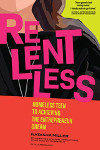
Surviving and working harder.
Publisher: Poignant Press
Pages: 212
Type: Non-Fiction
Age: Adult
ISBN: 979-8-985-60022-3
First Published: 22nd March 2022
Date Reviewed: 16th March 2022
Rating: 5/5
On Christmas Day when Natasha was 16, her mother threatened to kill her with a butcher’s knife. It was the continuation of a pattern of abuse that had been happening Natasha’s entire life and that day she called 911 and laid the first stone towards independence. Experiencing what she had and surviving, she began a young adulthood full of life and progressed to an incredibly successful adulthood that would see her in her musical element and, later, the founder of a company with a great many well-known clients and a position on the Inc. 5000 list of fastest-growing companies. This is her story.
Relentless is a wonderful tale of breaking the odds, beginning with suffering that climbs towards a glorious success that will lead to many smiles of reader happiness as you see Miller go from strength to strength and, in its turn, inspire a great many people.
Miller’s book is told in an easy conversational prose sectioned into chapters titled after her music. (If you’re an audiobook lover, this may be one for the headphones – the audiobook includes music.) It centres around her successes in the music industry as a classical violinist (and leader of a number of quartets) and jazz singer as well as her entrepreneurial self, the founder of an event production company.
(As to the editor here, it’s worth noting that Miller wrote the book herself with assistance in the editing process by Jamie Blaine later. Worth noting because of the ‘with Jamie Blaine’ included on the cover – Blaine also wrote an introduction for the start of the book.)
There are trigger warnings in the first pages – suffice it to say, this book may not always be a comfortable read but it’s an important one. Miller has experienced an amount of hardship that makes her successes all the more remarkable, and they are going to be relatable to many people. To talk of just one, the abuse Natasha suffers from her mother shows how poorly such situations were dealt with in decades past, decades that aren’t that long ago, allowing us to note how far we’ve come since then – yes, definitely – but, most importantly, the stories may well serve as a support to those who have gone through or are going through similar. Whilst the internet and more open lines of communication in general have made surviving abuse more likely, and more young people are able to identify that they are being abused earlier in life than generations past, Miller’s book adds a new voice to those testimonies that will most certainly resonate with individuals and help them on their journey, and her later successes are important examples of a person being able to move past the identity forced onto them, and getting out.
That is one of, if not the, most crucial thing about this book in terms of its value for readers.
And I say ‘one of’ because of course there is much more to this book. A music lover, obviously particularly orchestral-minded or jazz-minded but really any one, will find a great deal of enjoyment in Relentless. Miller’s career as a singer and her work as a violinist is incredibly exciting to read about – the beginnings and the way she thinks outside the box, the music itself and the events she plays (she’s sung the national anthem at a sports match and performed with Clint Eastwood in the front row) will be like music to your ears, if you’ll pardon the pun. Her journey to record and those she works with top it off.
And then of course comes her event production company, Entire Productions, in which she pivoted from music to something that encompasses music as one part of it. There is a good amount of information here, both on its beginnings (one of the best examples of thinking outside the box this reviewer has heard of) and on the runnings for the many years of its existence up to and during the Covid pandemic.
What Relentless is, then, is a tale of remarkable strength and determination in the face of catastrophic issues, and what it does is show what can be done, offers hope to people starting from similar circumstances, and provide what is a very enjoyable story of progress combined with a real grounding in the reality that is often in the background unseen. A lot of people would likely refer to Miller’s successes as ‘so lucky’, a term that all too frequently dismisses effort and time – as this book reminds us, behind success is sheer will and work.
I received this book in preparation for a potential podcast interview, which has gone ahead.
Wendy Holden – The Duchess
Posted 13th September 2021
Category: Reviews Genres: 2020s, Commentary, Drama, Historical, Political
Comments Off on Wendy Holden – The Duchess

Always Duchess, never Queen.
Publisher: Welbeck
Pages: 423
Type: Fiction
Age: Adult
ISBN: ?978-1-787-39624-1
First Published: 19th August 2021
Date Reviewed: 13th September 2021
Rating: 4.5/5
Wallis Simpson marries her second husband Ernest after a short relationship; Ernest is wonderfully caring, the complete opposite of her first, abusive, husband. The new marriage isn’t perfect – Wallis wants to move up in the world, if just a bit, whilst Ernest’s happy as they are, and Wallis still carries the metaphorical scars from her first marriage – but it’s good. But Wallis still hopes to enter a society closed off to her due to lack of wealth, a society her mother was unable to introduce her to, and due to a series of lucky events, she gradually makes the sort of acquaintances she always dreamed of. One of them is the mistress of the unwed Prince Edward, heir to the throne.
The Duchess, Holden’s second novel about figures in royalty who have been put in particular lights, puts Wallis Simpson in a more positive one than she ever was in life, at least not once she entered the life of Edward VIII.
(Nor, for that matter, since – during my research whilst I read the book I struggled to find any mention of good values or any descriptions that were particularly positive. There may well be factual accounts that are positive but they are not to be found in articles on the Internet. Most likely Wallis’ own ghost-written memoir would be positive but there are of course going to be biases in that.)
However this positivity is not constant. Holden’s story is not completely positive, indeed her descriptions of good points are balanced out by her fictional Wallis’ relentless drive to be high in society, which obviously echoes thoughts of the time. This said, as the book reaches its end it does very much move towards the idea that Wallis did not want to be Queen and did not want to marry Edward at all, at least not following his abdication, which does directly conflict with various thoughts, especially where recent research shows a possible case of abuse.
If it sounds like there’s a lot of fiction here, again, as noted above by the positivity not being constant – thus the commonly-held view of the conflicts and issues are included – the fact that Holden’s account is openly a novel allows further study and further question. It is all very well adhering to the most popular points of view when they haven’t changed since the 1930s and 1940s, particularly given the contents (see here the visit to Nazi Germany, the discourse with Hitler, the photo of smiling faces) but the fact remains that it is one based in those years in a society that was very British, against divorcees marrying into royalty, and all about tradition. And whilst things have changed – Camilla has married Charles, Meghan married Harry – they haven’t changed enough to support new viewpoints coming through into the public domain; Camilla will likely never be ‘Queen’, Meghan is seen as a big problem.
All that rambling to say that, whilst Holden’s Wallis is incredibly different to the accounts that are most easily accessible, and the presentation is that of a problematic prince who is needy and increasingly manipulative and has more say than Wallis, it’s impossible to say that this is far-fetched and too fictional. Is it quite a quiet book in its way, yes, does it break lots of new ground, no. And it’s intriguing why it ends on the note it does without going further.
But as I hope all this rambling and considering and pointing out has done, the fact that The Duchess presents such a highly different account and, possibly, interpretation, is very much in its favour. Wallis is still, today, ‘that woman’, and it’s worth looking at the information again, looking at it in terms of the time to view the biases openly, and arguably Holden has done an excellent job doing so.
Will The Duchess change minds? It could be said that it does something far more important – it pushes you to review what you thought, what you’ve heard, and what the actual truth might be.
Perhaps a couple of sentences would have sufficed: this book is brilliantly planned, written, and executed in all ways. That it provides a fair amount of historical information about real-life socialites, and detailed reasoning for the break-up of Wallis’ first marriage is more of a bonus, even though they are in fact quite extensive in terms of pages. Great stuff.
I received this book for review.


