





Elizabeth Baines – Used To Be
Posted 4th November 2015
Category: Reviews Genres: 2010s, Paranormal, Psychological, Short Story Collections, Social
1 Comment

You may be ‘seeing things’ but that’s not always a bad thing.
Publisher: Salt
Pages: 121
Type: Fiction
Age: Adult
ISBN: 978-1-784-63036-2
First Published: 15th September 2015
Date Reviewed: 3rd November 2015
Rating: 4.5/5
Used To Be is an anthology of short stories Baines has had published over the years. The general theme is choices – the impact of important decisions and the maybes that abound in what ifs.
Baines has a distinctive way of writing. The writing itself is mostly literary; the author has no qualms over colloquial language. It’s a nice mash-up of tradition and the present day, making the book very accessible. Various tenses and persons are involved; it’s a stylistically diverse experience. The stories themselves are subtle in their meaning. These are average, everyday situations, tales that anyone can draw comparisons to in their own lives. On the surface nothing is remarkable – it could be said that the collection is just okay and nothing more. But this is key to the point – the stories are often about things that we might like to discuss further but worry about mentioning because we’re taught it should be no big deal or we think it’s nothing or we think we worry too much about it – and Baines shows how we should be thinking twice in these situations, questioning this concept of keeping the seemingly silly hidden away.
This is the case, to some extent, in Falling, in which a woman falls and hurts herself, quite badly, and once healed goes about her life in much the same way but with a different mindset. When she falls again she questions whether she should have changed her mindset, whether she was wrong. The underlying issue is never questioned. Only, then, is it really happening or is she dreaming? And/or is the person who asks her if she’s alright also dreaming? – how, exactly is the woman falling, in which way is she ‘falling’?
One of the stand-outs is Possibility in which Baines looks at choices not from one person’s perspective but from three. It’s people who are the ‘choices’ here. A lecturer, a businessman, and a newly-arrived immigrant travel on a train chosen for a suicide. You see three reactions to the incident, the different effects a cause can have, and whilst you may ‘prefer’ one to another, reading between the lines shows the validity, if you will, of each reaction. It shows the continuing effects.
Other stand-outs include the titular story, in which a woman listens to her friend’s continual tale of how happy she is whilst the reader sees something else and That Turbulent Stillness wherein a girl gives up her middle-class life to live with a factory worker, seeing her future through rose-tinted, passion-tinted, glasses.
Sometimes the stories can feel repetitive – this is where it’s worth remembering they were written separately for various outlets. There are a couple of occasions you could speculate a more pressing relationship between the stories than the overarching theme, for example the two stories that look at the Brontë sisters.
Inevitably, as a book about choices and what ifs, you’ll end up questioning your own life. Baines doesn’t offer answers so much as a study, making you realise how important even trivial-looking decisions can be. (And in study comes ambiguity and hints rather than detailed endings.)
Used To Be shows the ordinary for what it is. It reminds you that everyone is in the same boat if not on the same deck, and it’s written with a meticulous eye to detail. It’ll blow you away when you least expect it.
I received this book for review from the author.
Related Books
None yet
James Rhodes – Instrumental
Posted 23rd October 2015
Category: Reviews Genres: 2010s, Angst, Commentary, Domestic, Memoir, Music, Psychological, Social, Spiritual
2 Comments

Instru, mental (health), and music.
Publisher: Canongate
Pages: 264
Type: Non-Fiction
Age: Adult
ISBN: 978-1-782-11337-9
First Published: 28th May 2015
Date Reviewed: 20th October 2015
Rating: 5/5
On paper, James Rhodes had a privileged childhood. He went to posh prep schools and later to Harrow. In reality, his first years were marred by sexual abuse. Now a fairly successful pianist, Rhodes looks back on his past, the multiple mental illnesses he developed that stifled any happiness and success for a long while and saw him hospitalised, and at the way classical music saved him.
How much can a 38 year old say that is worthy of a memoir? In this case, a lot. Rhodes’ book is one of suffering, of healing (somewhat – this book is realistic), of music, and in many ways advice, all compiled into chapters that begin with a look at the mental health of a particular composer and a suggestion for a musical interlude.
Rhodes is modest, very humble, and what makes the book so successful is that whilst he is privileged and can name drop like the best (he went to school with Benedict Cumberbatch, for example) there is a very true feeling throughout that he believes it. This is not to say that it’s good to read about someone who had everything and is suffering – do not take my meaning the wrong way – it is to say that Rhodes’ place in the world means he’s truly in the middle, having had a lot but being right on a level with your average Joe. And he has had advantages, that’s true, but his has not been a simple journey of boom, healed, and then success.
And he writes with a particular honesty. There is the frankness in what Rhodes says; he speaks openly and harshly without going into too much detail for his own piece of mind. His prose is casual and welcoming, simple yet literary. He swears as he talks, casually, often, but sometimes because it is an effective way to explain a feeling.
Rhodes gives advice on some subjects, for example his advice on relationships (which I’ll point out is short in case it sounds like this is a self-help book – it’s not) that he has learned from the way he sees and deals with his own. He offers a lot of his opinion on how the classical music industry should change (this part is a little preachy but no less worthy). What he doesn’t advise on, however, is self-harm, drug use, suicide. Rhodes, though still falling back occasionally, has made his peace with many of the things he’s done in his life but says that people need to be careful with their support. In fact what he says is that we need to stop judging and worrying about and medicating those who self-harm and think of suicide. He shows how what others saw as support hindered him from healing. As far as the book’s importance in a general sense, this information is perhaps the most compelling reason for reading it.
Rhodes writes as much for those who haven’t had his experience as for those who have. He’s showing hope whilst remaining realistic, he shows that there are amazing ways out whilst showing that some are just average. And all through it is his self-effacing view of himself that wins you over because you can see how much good he is doing and you hope that he sees it himself.
I said above that Rhodes is preachy on the subject of music. His opinions themselves aren’t but do seem so when he speaks about music being the last art to have a strict classic genre and forgets books, and one hopes he knows of a previous attempt (successful in many cases) to bring children to classical music – The Magical Music Box magazine of the 90s. Rhodes makes a strong case that is absolutely fair – one hopes he succeeds in bridging the divide between the general populous and the elitism in the genre. Just one nitpick: he rules out contemporary classical music, stating that by all means a musician should play a new piece of music but that it won’t ever rival the old masters. The issue is that in making people, young people who don’t fit the stereotype of hoity toity classical music rah rahs, interested in it, is going to result in some of those people being inspired to create some themselves. To restrict such growth would be to come full circle and limit classical music to the old posh listeners.
Instrumental is important; it should to be read, it needs to be discussed. It needs to be read all the more so because of the ridiculous law suit raised to attempt to stop it being published which led to Rhodes being unable to talk about his abuse, just as he was unable to as a child. Writing it might just be the most important thing the pianist has ever done.
Related Books

Eloisa James – When The Duke Returns
Posted 19th October 2015
Category: Reviews Genres: 2000s, Comedy, Domestic, Historical, Romance, Social
Comments Off on Eloisa James – When The Duke Returns

When baring your knees would result in people thinking you were Tarzan.
Publisher: Avon (HarperCollins)
Pages: ???
Type: Fiction
Age: Adult
ISBN: 978-0-061-24560-2
First Published: 25th November 2008
Date Reviewed: 14th October 2015
Rating: 3.5/5
…So the Duke of Cosway turned up to Lord Strange’s party and bundled Isidore away. Now he’s back, however, and looking worse for wear with his un-Georgian way of dressing and general indifference to social mores, Isidore’s not sure she wants him. Simeon agrees with her that an annulment is best, but there are things to see to in the meantime, namely the stench in his house due to his parents’ lack of care. As Isidore comes to see, Simeon’s not bad looking for his lack of wigs and hair powder, and as Simeon comes to see, Isidore may not be the docile wife he was expecting but he likes her all the same.
When The Duke Returns is the fourth book in James’ Desperate Duchesses series and continues straight on from the previous, Duchess By Night.
This is a good book, on par with the rest if not the best, pardon the rhyme, though it isn’t quite as funny. After a while of thinking I realised it’s meant to be funny, but the subplot of the sewage pipes leaking all over the house leans more on the side of icky. It’s true the start of this series saw cow pat discus, but that was simply silly and not so literally wretched.
The characters, however, are fair as I’ll be repeating later on. Isidore is a fun heroine if misguided and silly, and Simeon, whose first name I’m using regardless of the fact his society says it’s not correct, is a breath of fresh air, somewhat literally, in a world where all heroes up to now have been clad in breeches. His liking for simple clothes means he’s a bit more modern and understandable in the context of our present day. The rest of the characters, the heroes and heroines of the other books ensure we’ve something of a soap opera on our hands and round it off with a wig on top. (The secondary plot here, the lead-in for book five, is Jemma and Elijah. As such there is quite a bit of time spent on them and sidekick Villiers.) The servants also get their time, in particular butler Honeydew whose not-quite-subtle attempt to get his master and mistress sharing a bed affords a smile.
I’d like to address the views of Buddhism and the ‘exotic’ here as I expect some will wonder about what reads as offensive – James writes in context, placing the sorts of views people had in the 1700s into her fiction so the characters are racist and prejudice on occasion as befits their period.
The relationship is average but the sex scenes are well written – comparable to the previous book. The writing on the whole is excellent, a couple of info-dumps aside, and as always you can trust that most of the background context is factual with some artistic license thrown in for good comedic measure.
But the pattern established early on in the series is very noticeable here. Indeed the characters leap off the page, the sex occurs after a fair period of courting, the history is good to read and the books are hilariously funny – but all stories suffer from a lack of conflict when it comes to the conflict – a conflict-less conflict, if you will. The couples argue over… well, this is my point. They argue over nothing at all really, and it’s most pronounced here in When The Duke Returns. Isidore is angry because she wants more say, Simeon changes from being pretty free and easy to wanting some control in domestic affairs, but neither convinces. Yes, they clash a bit and get angry over things as every couple does, but the question of divorce seems more an author convenience, a ploy to keep the book going. They have sex, say it’s not working, talk of divorce, and the cycle begins again.
Ultimately the book is a good read with a pinch of ‘get to the point already’ where the previously fun Isidore becomes annoying and the previously interesting Simeon becomes insipid. The ending is fun but too silly and wrapped up as quickly as Simeon gets wrapped up in Isidore’s skirts.
When The Duke Returns is an okay addition to the series and the sex is certainly steamy, but the format is wearing.
Related Books


Tracy Rees – Amy Snow
Posted 9th October 2015
Category: Reviews Genres: 2010s, Angst, Domestic, Historical, Romance, Social, Spiritual
Comments Off on Tracy Rees – Amy Snow
Guided to change.
Publisher: Quercus
Pages: 551
Type: Fiction
Age: Adult
ISBN: 978-1-784-29145-7
First Published: 9th April 2015
Date Reviewed: 8th October 2015
Rating: 4/5
Aurelia, heiress to her parents’ fortune, finds a baby in the snow and takes her home. Her parents are furious but they love their daughter and give in to her pleas to keep the child. And so the girl grows up amongst the servants in the kitchen and later with Aurelia as a companion. Later, Aurelia becomes sick and goes travelling whilst she still can, stating she’ll be a few months but remaining away for longer. Upon her death Amy is thrown out of the house with the ten pounds left to her. Only it’s not ten pounds, it’s more, and Aurelia is sending her on a journey from beyond the grave.
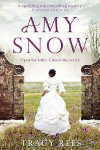
Amy Snow is a long historically-rich story of self-discovery and friendship. Written with close attention to detail it is as much about the Victorian period as it is the mystery.
Because, truly, the mystery isn’t much of one. The story is simple and the answers very predictable but this was the intention – Amy works out the most likely scenario long before she learns it officially; this leaves her able to contemplate what happened otherwise. You could call this a cosy mystery – the answer is not imperative, though of course you want to know it, and the pacing is slow. But that is the beauty of the book.
Why? Because it’s not the mystery you want to read this book for, it’s its atmosphere. Amy Snow is a blending of Jane Eyre and any work of Austen. It is a classic Victorian novel written in the 21st century. It’s not perfect – there are some anachronisms, for example – but this book is the book for any reader who has looked at their finished collection of 19th century British novels and wished those authors were still writing today. It’s quite the feat.
So it’s a slow novel, full of waiting around and going to balls and dressing up. It’s got your evil Lady and your awesome elder who defies convention. It’s got your respectable gentleman suitor and your average shopkeeper’s son suitor. It’s got letters and calling cards and upstairs downstairs and your walking around looking at bonnets in the window and exclaiming at their beauty. Rees has worked hard to get it right. Yes there are anachronisms and even more exclamation marks than the Victorians used (this is something you get used to as you settle down into it) but by and large the writing style fits beautifully. It’s obvious that Rees has spent time working through the differences between modern and Victorian speech, and it lets you get pulled back in time. Amy Snow is not as confident as Elizabeth Bennet and whilst she is in a not dissimilar situation to Miss Eyre she spends too much time on herself; but she can be placed beside these two heroines with ease as far as feelings go.
Before I leave off from the writing I want to show you an example of Rees’ metaphors. She favours a certain sort of style that is quite fun, however much it becomes noticeable later on for its repeated use:
He proceeds to grill Mr Garland as thoroughly as a fish for his views about the railway.
The mystery in this book takes second place to Amy’s self-discovery. Aurelia’s treasure hunt, as it were, is important and ought to be followed, but Amy’s journey towards acceptance and who she wants to be takes centre stage. Amy’s journey whilst journeying is of course set apart from Aurelia. It comes with the baggage of knowing she wasn’t wanted by anyone but her friend and is something Aurelia knew but would never understand completely due to their difference in station. Amy struggles with her sudden fortune. At home with the relatively wealthy but down-to-earth family who accept that she would prefer to wear more modest dresses, she finds it difficult adjusting to her next situation which requires her to mix with the upper echelons and dress accordingly. Rees’ novel is somewhat the Cinderella story but unlike Cinderella, Amy can’t simply abandon her past. She has to learn for herself that Aurelia, by giving her riches, is giving her a choice – she can live as a virtual Lady; she can be amongst the gentry; she could become a servant. Aurelia was a Lady who wanted to be independent, see the world, speak to those lower than her, but could do none of those things precisely because she was a Lady. In Amy she posthumously lives her dream.
The self-discovery is where the main flaw of the book lies, one I must discuss if I’m to be objective. (This book left me in raptures, I loved it and it’s joined my all-time favourites, but I can’t deny there are flaws.) A lot of Amy Snow is composed of naval-gazing. Amy thinks a great deal, she over-thinks, re-hashes, and whilst it’s very realistic and happens to the best of us when in a situation where we have to choose and aren’t sure, or have had a sudden change that we’re adjusting to, it doesn’t work in a book. It becomes boring, as do her moans that she doesn’t want to keep following Aurelia’s treasure hunt. If you’re enjoying the rest of what the book does, it’s not going to be enough to make you abandon it, but it does affect it.
Apart from the anachronisms and exclamation marks there are sentences that use American grammar. As the spelling is American it can be assumed the erroneous grammar is not accidental, though of course it should be.
There are some very convenient second meetings where people Amy leaves behind just happen to turn up where she travels to – absolutely understandable when she’s mixing in high society and it’s a high society person she sees as they tended to stick together across the country, but less believable when it’s your average Joe. In this way you’ll need to put on your Rochester’s-voice-echoes-all-these-miles-away hat – is it lovely or just deus ex machina?
Lastly, there are many proof reading errors, distinct from the copy editing problems.
Amy Snow is a trip to the classics section of the bookshop. It’s a dream of a book for anyone who wants their Victorian-setting 21st century novels to be wonderful. It has the sort of epic story vibes, romanticism, that tend to make half of all readers swoon and the other half label it sappy. It’s both phenomenal and flawed.
This reviewer read the epic story and swooned just as she did when she read Brontë; her opinion on whether or not one should read this book is of course going to be ‘yes’ and for that reason she’s going to suggest you decide for yourself.
Related Books
None yet
Speaking to Tracey Rees about Amy Snow, Florence Grace, The Hourglass, Darling Blue, and The House At Silvermoor (spoilers included)
Charlie and Tracy Rees discuss Richard, Judy, Dickens, Austen, and Brontë – not all at once – coffee houses in Victorian times, landslides and hourglasses, changes to the Yorkshire mines in the late 1800s to early 1900s, and the inclusion of the average person in historical fiction.
If you’re unable to use the media player above, this page has various other options for listening.
E Lockhart – We Were Liars
Posted 28th September 2015
Category: Reviews Genres: 2010s, Domestic, Social, Spiritual
2 Comments

Be aware that whilst I don’t discuss the ending here, I do talk about some of the themes. Some genre tags have been left out on purpose.
If you’re not happy or having trouble you sweep it under the rug and plaster a big ol’ smile on your face.
Publisher: Hot Key Books
Pages: 223
Type: Fiction
Age: Young Adult
ISBN: 978-1-471-40398-9
First Published: 13th May 2014
Date Reviewed: 23rd September 2015
Rating: 5/5
The Sinclair family holidays on their private island every summer. It’s a paradise where they can enjoy their time away from the world. Have fun, spend time together, not discuss anything of importance. Because the Sinclairs don’t do problems. They are normal, perfect, wealthy, and heaven forbid anyone who rocks the boat.
I knew within the first few pages of this book that it was going to be exceptional. I’ve never experienced that before – going in knowing nothing but recognising excellence straight away. The best way to describe We Are Liars is to say that it’s uniquely unique – there’s the thought that all stories have been told, all books now just variations, but this one seems far from it. The basics may have been told but the way Lockhart handles the situations makes it individual. You’ve never read a book like this.
The author favours a particular style of writing. She uses the same colloquialisms as many others but you’d be hard-pressed to be unable to tell it apart from the rest. Lockhart interweaves her prose with the concept of poetry, pieces of sentences set one line after the other without applying the same amount of effort, so to say, as your usual poet does. The poetry aspects do read as poetry but whether there’s rhyming or a steady pace is not important, rather Lockhart uses the concept of poetry to get the reader focusing their attention on the exact words, thoughts, she wants you to focus on, to emphasise her meaning. It’s amazing.
Both plot and characters are important to Lockhart, who greatly favours showing. So much does she show, in fact, that you may well miss the hints she provides as to what happened. But this is not a bad thing. The author abides by the sentiment expressed by one of her characters, who says:
“Someone once wrote that a novel should deliver a series of small astonishments.”
This well describes Lockhart’s method: draw the story out. Let the findings start small, slowly building before the crescendo. Slow it down without increasing the word count. This method means you’ll think you’ve discovered the essence of the book only to realise there’s far more to it, and far more to that and so on. Even though there’s a definite end to the book that rests on plot, mini themes abound and are important.
Most obviously there’s privilege. The whole set up, the private island with its big houses and staff and owners who have enough money to be able to call the island a summer holiday home whilst owning even more property elsewhere, is almost unbelievable. The set up is paradise for rich white people, people who don’t even know the names of the staff who’ve stocked their fridges for years. Lockhart need say little; whilst it may be fun, an escape from the reader’s own life to read about this ideal, it’s also uncomfortable.
Uncomfortable on its own and because of the way white is supreme. You could almost call this book delicious in its handling of the subject of racism. By this I mean there’s a lot of racism but it drifts out, ripples in a soft, slow, motion. It’s the subtle sort, the oh my gosh darling we must be polite but try not to shake their brown hands sort. Thus Lockhart demonstrates the sort of prejudice that can be difficult to call out because it’s deftly handled by those who own it, deniable because it’s kept under the surface. Warnings, such as the hints at what could happen to those who overstep their mark are couched in nice terms that fly over others’ heads.
“Watch yourself, young man,” said Granddad, sharp and sudden.
“Pardon me?”
“Your head. You could get hurt.”
“You’re right,” said Gat. “You’re right, I could get hurt.”
“So watch yourself,” Granddad repeated.
This deals with Gat, the only non-white family member on the island whose presence signals a new episode of sorts to this pristine family. As he says himself, he is Heathcliff, a good person, family – sort of – who is expected to become angry in time and ruin things because that’s what outsiders are supposed to do.
Along with privilege and trying to keep everyone away from the family comes the drive to be ‘normal’. You cannot show feelings, no one is an addict or a criminal, everything must be nice, normal, at all times. The media and the world must see perfection. This has a huge affect on the family. Your father leaves? No tears, pick yourself up. Don’t reference your dead grandmother. Forgetting people is a large part of keeping up appearances – taking down photographs is very important. We see the affects mostly in our narrator, Cadence, who finds it difficult to stay silent, who grieves for longer than she would if she were allowed to express her thoughts. A lot of metaphorical bleeding and falling goes on in this book.
The island is a paradise away from the world that never changes and can’t be ruined by life in general but as Cadence says in one of the many variations of a fairy tale she writes (in order to further explain situations):
If you want to live where people are not afraid of mice [Gat], you must give up living in palaces.
I can’t neglect friendship here. It’s what holds the novel together from the beginning, the emergence of a generation that sees the falsehood in the world their parents have created. The title has as much to do with the teenagers – literally the liars – as with the whole family. The false happiness shrouded by a one-upmanship as the sisters try to gain daddy’s love and property.
If you work out the truth of what happened before it’s revealed you may find it easier, if you don’t, and in a way I hope you don’t because it would lose its impact, it’s both satisfying in a literary way and emotionally draining. Lockhart provides all the answers, preferring to restrict vagueness to the middle of the story, leaving the end complete. You need to know what happened to understand a lot of this book and to appreciate what Lockhart is saying about impact.
We Were Liars is awesome. Individual, beautiful, wretched, poetic and embedded in life as much as it’s a blissful escape from it. Let the prose warm you as the story leaves you chilled. Even paradise must face reality.
Related Books
None yet


