




Chibundu Onuzo – Welcome To Lagos
Posted 17th July 2020
Category: Reviews Genres: 2010s, Commentary, Crime, Drama, Social
Comments Off on Chibundu Onuzo – Welcome To Lagos

Slice of lives.
Publisher: Faber & Faber
Pages: 368
Type: Fiction
Age: Adult
ISBN: 978-0-571-26894-8
First Published: 3rd January 2017
Date Reviewed: 26th June 2020
Rating: 4/5
As Chike’s regiment prepares to do something he wants no part in, he and Yemi break ranks and escape. In so doing they meet Isoken – a young woman who has been assaulted – Fineboy – who does this and that and nobody’s completely sure about him – and Oma, who Chike finds himself attracted to and the feeling’s mutual. Together the unlikely group travel to Lagos to look for a place to stay and jobs to make money. It’s difficult – sometimes there are buildings, sometimes there are spaces underneath a bridge – but things take extra turns when they meet Ahmed, a journalist, and later a government minister.
Welcome To Lagos is an interesting novel that looks at the coming together of five different people – two already known to each other – in a way that explores both the characters themselves and the city of Lagos.
Akin to many novels, Onuzo’s narrative almost seems too easy until you scratch the surface, but unlike other novels that are akin to this, once the surface is scratched, it almost seems too clever. That may sound against Welcome To Lagos‘ favour; it isn’t. What Onuzo presents is a novel that can be enjoyed on a variety of levels; to be sure if you want to know why there is so much talk surrounding Onuzo you have to be prepared to spend a bit of time digging deeper – that surface dressing really does look easy – but if you did happen to have a bit lesser time you would still in theory get something out of it.
As you may guess given it’s very unlike me to suggest a novel should be read at it’s surface – you could do this, but you shouldn’t.
Part of the reason for this is that it would make the articles in the book seem disjointed. Onuzo employs both a regular third person narrative and the use of fictional journalism to tell her story. You have the main bulk of the book composed of the lives and short travels of Chike and ‘co’, interspersed with articles written by a secondary character who also moonlights as a primary character: Ahmed. Where Chike and his friends move around Lagos, live in a few different places, allowing Onuzo to show you around Lagos at a grassroots level, the articles show the wider story, including the politics that run the city as a whole. These narratives intersect, both through the use of Ahmed (his in-person appearances are rare) and in the later introduction of a politcian to our characters’ lives.
So to the friends – with Chike at the effective helm, the story focuses on five runaways who have joined together; Chike and Yemi have run away from the regiment, Isoken is mentally scarred from harrassment and assault; Fineboy is along for the ride; and Oma wants to leave also. The characters are both individuals and one homogenous group – in their grouping and story progression, they become one character – Lagos. They represent different aspects of it as well as creating reasons for other aspects to show, and then Ahmed, the Chief, and the various teriary characters tie everything together. And it’s more ‘parts of its sum’ than ‘sum of its parts’.
One of the book’s strengths is in the way Onuzo slowly reveals what’s going on with Isoken – you’re told from the start but with the book’s narrative generally looking at things from Chike’s perspective, it takes a bit of time. It’s done slowly, in actions rather than words.
Two other aspects of note: the conflict at the beginning of the book, and the use of religion. As Chike and Yemi decide to break ranks we get a glimpse of what they’re leaving behind – a lot of killings; it’s an interesting look at the situation, with Onuzo paying a lot less time and attention to it than you’re expecting, showing by not showing it that it may be ‘simply’ an every day thing for the company. As for religion, it’s constant but never too much; Chike reads the Bible to his friends in the evenings and there are brief discussions. It forms part of Chike’s character and informs the others in a way that is accessible to all.
Welcome To Lagos is both deceptive and open, in different ways. With the fairly diverse cast of characters it takes a few chapters to come into its own; it’s also quite its own book. Some questions remain at the end but not many; Ahmed’s role is perhaps the one most likely to cause curiosity – he may be up to interpretation; but over all this is an enjoyable read in both the usual and literary senses.
Abubakar Adam Ibrahim – The Whispering Trees
Posted 13th July 2020
Category: Reviews Genres: 2010s, Domestic, Drama, Magical Realism, Paranormal, Short Story Collections
Comments Off on Abubakar Adam Ibrahim – The Whispering Trees

Things are not always what they seem.
Publisher: Cassava Republic
Pages: 162
Type: Fiction
Age: Adult
ISBN: 978-1-911-11587-8
First Published: 1st January 2012
Date Reviewed: 13th July 2020
Rating: 5/5
A woman becomes interested in the man who takes away the rubbish; a sudden, swift, illness, sweeps through the area and a couple of men look for the reported witch to save the lives of those who remain before it’s too late; a wife’s joke on her husband becomes a surprising reality; a man lives with his new disability and finds new concepts in life open before him.
The Whispering Trees is a stunning short story collection of tales set in Northern Nigeria, an example of how super the format can be.
As is the way with many authors, Ibrahim’s collection is partly composed on stories that had already been published elsewhere; this is worth noting because part of the brilliance of the book lies in how it has been arranged. The stories start out fairly quietly, at least in relative terms, the first three stories bearing small-ish shocks at their conclusion, the fourth – the title story – both diverting from the general idea and progressing it, and then beyond this the stories simply continue to climb in surprises, twists, and horrors.
This idea in itself is not unique – many collections hold surprises – but the content of the stories, their dark, magical realism, fantastical, plot twists make this collection stand out. It can be too dark, difficult to read, but utterly fascinating at the same time.
The title story stands out for its use of the first person – one of only a couple of stories to do so. Other standouts include One Fine Morning and Cry Of The Witch, mentioned above. The first follows a man who is accused of cheating, an elaborate joke that ends badly; the second looks at illness, suspicion, and, putting it mildly, selfish bad choices.
The concept of folklore and superstition runs riot in these stories to good effect, but the book is also steeped in reality, humanity, and social differences.
This is a collection of various value – it is excellent in terms of literature, voice, use of genre, and its studies of people in every sense of the word. As said, it’s stunning. You’ll race through it, though you might not want to – you might want to schedule a re-read in in advance. Incredibly, highly, recommended.
Speaking to Abubakar Adam Ibrahim about The Whispering Trees, and Season Of Crimson Blossoms (spoilers included)
Please note: this episode includes discussion of sexual content, and the second reading includes a sex scene.
Charlie and Abubakar Adam Ibrahim discuss Nigeria at this time, publishing a novel on a very controversial subject and reactions to it, effects of grief, and looking at cultural expectations of women as the generations change.
If you’re unable to use the media player above, this page has various other options for listening.
Isla Morley – Come Sunday
Posted 8th June 2020
Category: Reviews Genres: 2000s, Angst, Domestic, Social, Spiritual
Comments Off on Isla Morley – Come Sunday

Working through grief to acceptance and forgiveness.
Publisher: Two Roads (Hachette)
Pages: 300
Type: Fiction
Age: Adult
ISBN: 978-0-340-97651-7
First Published: 1st January 2009
Date Reviewed: 7th June 2020
Rating: 5/5
On Maunday Thursday morning, Greg is slow to get up and Cleo’s insistence on wearing unsuitable clothes is getting to her mother. Abbe has all manner of things to deal with and it’s got on top of her. So that she and Greg can get out for the evening, Abbe leaves Cleo with a friend; against perhaps better judgement, the friend chosen isn’t the one she thought of first. But it’s all good; until the couple return to pick Cleo up and find the road full of people, police, and Cleo nowhere to be seen.
Come Sunday is Morley’s superb first novel that looks at the progression of grief towards a new normal. When the revelation of the car accident reaches Abbe’s ears she begins a descent that sees her anger at the driver who couldn’t stop in time, her increased annoyance at her fellow cul-de-sac neighbours and the clique-y members of her minister husband’s church. And she begins to have an increasing number of thoughts about her childhood in South Africa.
Her book set mostly in Hawaii, Morley uses as the time frame the period of Easter – the book starts on Maunday Thursday, as noted, and ends on Ascension Day, however the narrative takes place over a year so the initial Thursday and Ascension Day are from different Easters. More than an extra aspect, the Easter period is used to line up events in the narrative, with the Thursday aligning with Abbe’s ‘betrayal’ of Cleo and the Ascension providing a resolution.
Christianity as a whole forms a fair part of the narrative; with Greg a minister and Abbe thus involved in the church (more than she’d like sometimes), the religion is often there and woven into the whole, however it should be said that this book is far from ‘inspirational’; it’s use is unlikely to turn you off if you’re not into it, however if you do appreciate faith included in books you will like it a lot.
The main themes are grief, later leading also to forgiveness. Morley looks at both carefully, closely. This is a character-driven book with Abbe’s grief front and centre. Greg’s isn’t glossed over, indeed some of Abbe’s choices stem from his own, but Abbe and her friends are more important here. There is a good element of sisterhood, largely informed by the forgiveness.
Abbe was brought up in South Africa, and her history informs a lot of her thoughts. Her grandmother had a servant who was black, so there are looks at racial issues as Abbe questions the relationship of Beauty and her family, and how her grandmother’s belief in equality fit into this. Abbe’s time in the country is brought to the fore as, together with her brother, she inherits her grandmother’s house which has since become a school for HIV-positive children.
I’ve left one of the first things you’ll notice about the story until the end – Abbe is a very negative character, aside from her grief. This is obviously difficult in a novel where a child’s death affects many, but Abbe does have her reasons for being as she is and there is redemption. The book is more about reading about her progression rather than necessarily relating to her all the time; you will relate to her on occasion and this reminds us of how normal it can be to be overwhelmed, to be a result of events, to be in the wrong place.
Come Sunday is exquisite. You’ll find many new meanings and explorations here to other books that look at the same subjects, and it’s all brought together with the use of writing elements, methods, that are very enjoyable. I highly recommend it.
Speaking to Isla Morley about Come Sunday, Above, and The Last Blue) (spoilers included)
Charlie and Isla Morley discuss growing up and travelling back to South Africa, creating a negative heroine, the 1800s medical phenomenon wherein people were literally blue, and what it’s like owning five tortoises.
If you’re unable to use the media player above, this page has various other options for listening.
Isla Morley – The Last Blue
Posted 25th May 2020
Category: Reviews Genres: 2020s, Commentary, Historical, Romance, Social
1 Comment

Far from gloomy.
Publisher: Pegasus Books
Pages: 326
Type: Fiction
Age: Adult
ISBN: 978-1-643-13418-5
First Published: 5th May 2020
Date Reviewed: 25th May 2020
Rating: 5/5
1972 – a young man has come into town and he’s asking questions, questions of the type Havens doesn’t want dragged up. We return to 1937, when Havens and Massey, photographer and journalist respectively, travelled to Chance, Kentucky, to find out about some local news and end up instead two of few witnesses to the life of an outcast family, living away from others on account of two of the children having very unusual skin. The siblings are blue.
The Last Blue is Morley’s fantastic third novel based on a real medical occurrance, and set in such a time (a century later than the factual history) that it effectively looks at further social issues, too.
The 1930s setting means that the fictional Buford family of Morley’s creation live during the time of racial discrimination; this results in a interesting aspect of the book where, as the reader, you can see a similarity between treatment of these white-blue people and black people; it can at times seem very allegorical – difference is not to be tolerated.
So there’s a lot of discrimination in the book – the Bufords are hated simply because they are different. There are times of extreme violence, and there are a number of looks at the affects and effects of violence as a whole.
Put together in terms of literature, the effect is brilliant – this book gets you thinking. And it almost creeps up on you as the story starts out fairly slowly, almost quietly. However this simply allows you to get a hold of the situation better.
Our main characters – our narrators – are the aforementioned Havens (first name Clay) and one of the ‘blues’, Jubilee. Morley uses an interesting narrative voice, far closer to first person than your usual third person, meaning that you get a number of effective sub-narratives, so to speak. The writing style, like the slowness of the book’s beginning, is deceptive – you’ll be thinking you’re in a soft fantasy novel for a while (even after reading this); at the start you do have to work at that surface to see under it, and that fact is one of the best parts of the text. And our characters are great to hear from, in fact one of the best aspects here is that one is just as intriguing as the other.
(On this note is Morley’s use of birds in the book. Birds are both a factor of life – we begin the book with Havens going to feed a pigeon -, and, in the way Morley situates them in her fiction, a symbol.)
Havens’ passion for photography informs a lot about the novel. There are two points of interest here: the first is the detailing. Morley provides a suitable amount of detail about photography in the era, which covers the role of a photographer in the media (Clay is in some ways what we’d call a photojournalist). Crucial is Clay’s ability to take colour photographs. The second is in the use of photography and imagery as a theme; as Havens comes to know Jubilee, photography becomes a way to tell not only a story in the way we know it can do, but also informs the progression of their friendship.
There is some lovely romance in this book, and it does exactly what you might think – highlight issues in its particular way as well as simply enhancing the story.
It is difficult to discuss The Last Blue in depth without revealing the story; hopefully there are enough pointers to show how successful Morley is in what she’s done. The text is both novel and study, a wonderful creation that you’ll want to keep with you for its fiction and its relation to multiple aspects of historical and contemporary reality. It is also just a very good story.
I received this book for review.
Speaking to Isla Morley about Come Sunday, Above, and The Last Blue) (spoilers included)
Charlie and Isla Morley discuss growing up and travelling back to South Africa, creating a negative heroine, the 1800s medical phenomenon wherein people were literally blue, and what it’s like owning five tortoises.
If you’re unable to use the media player above, this page has various other options for listening.
Nicholas Royle – Mother: A Memoir
Posted 13th May 2020
Category: Reviews Genres: 2020s, Books About Books, Domestic, Memoir
Comments Off on Nicholas Royle – Mother: A Memoir
A memoir and then some.
Publisher: Myriad Editions
Pages: 209
Type: Non-Fiction
Age: Adult
ISBN: 978-1-912-40857-3
First Published: 14th May 2020
Date Reviewed: 13th May 2020
Rating: 5/5
Owing to the title of this book and in addition its contents (necessarily discussed below) I’m leaving my usual synopsis paragraph to this one sentence.
Royle’s third narrative book, his first narrative non-fiction (I say ‘narrative’ because the author has also written many academic works), does both what it says on the tin and what it implies on the tin if you were to look at the tin more closely. Mother: A Memoir is a mixture of straightforward memoir about the author’s mother but also a book about the concept of a mother – particularly, of course, his mother – and the concept both of writing a memoir and of memoir as a written form. It’s about writing. What this means in brief, is that this is a highly experimental, artistic, and language and linguistics related book that is nevertheless also a standard memoir.
But ‘standard’, in any quantity, doesn’t really explain this book. The only book that this one comes anywhere close to being similar to, at least to my admittedly limited knowledge, is the Royle’s previous book, An English Guide To Birdwatching. The book succeeds in being something very special: from the title, it’s a memoir of the author’s mother, Mrs Royle. (I’ll be referring to Nicholas Royle as ‘the author’ from now on to limit any confusion.) However as you read through it you might be forgiven for thinking that it’s only half about Mrs Royle, until you’ve read enough to discover that in actual fact it may be more of a memoir and more of a tribute to her than you could have imagined.
The book is also about a love of reading and literature in general; some of the best passages discuss times when the author and Mrs Royle conversed about texts, and there’s a lot of enjoyment to be found in the many references to novels and poems that are included without further comment. It can take a few pages to get into it, with its various versions of wordplay, but it’s very easy once you’ve got the hang of it. It’s very appealing and often quite fun.
The writing style is great; there are stylistic choices deliberately chosen and accounted for. The most obvious is in punctuation; the book is devoid of commas, there are none except in quotations, because, as the author says on page 25 (bracketed text mine):
But in writing about my mother I have been compelled to respond to what was quirky and singular about her own language. I have experienced a kind of unfettering. And stumbling into a new closeness to her in the very reaching out to shape words and syntax – idioms and ironies – in the wake of her voice and her laughter. In the remembered tricks and turns of her vivacity. I discovered I had to write – for better or worse – without commas. Things linked without notifications or signposts. Continuous but broken. Making more use of dashes. In sentences sometimes lacking main verbs. Or subjects. Discandying flux. Even if at the same time I cannot write a sentence without wanting to pay homage to my father’s lifelong Maxwellian [both Royle’s and his brother’s word for their father’s passion for the English language, based on his name] vigilance as Grammaticality Enforcement Agency.
(The extract shows the other effect of the lack of commas – the book is quite often very poetic. It also quite often changes the ‘natural’ emphasis in a sentence to highlight what is truly important in it.)
Perhaps – likely? – the author’s father wouldn’t have appreciated the way the book was written, which in the context of the family and the addition of Mr Royle’s letters to newspapers, is an interesting idea in itself. But there’s also an interesting question that this reviewer found herself asking – does the author’s focus on his mother’s language, given the father’s was the language deemed more correct (and thus important), question the traditional ideas of the relative values of men and women’s work and so on? (I should point out the author never says this, it’s just something I took away with me.) It certainly questions whether Mr Royle’s use of language is necessarily better (employed in Mrs Royle’s correspondence, his corrections in the letters she wrote are shown in the author’s discussion and reproduction of one of them).
This is perhaps the time to also note that Mrs Royle was a dedicated, passionate nurse who was well loved by many. Stories of her work are many, are lovely, and are spread throughout the book. (The narrative is not linear – the content is divided into chapters each on a theme – and scenes and elements of Mrs Royle’s life are returned to.) Quite a number of the photographs show Mrs Royle at various stages of her career.
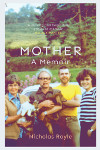
It’s also perhaps the time to note that as much as the book is about Mrs Royle, it’s also about her husband, the author’s brother, who sadly passed away at a young age, and many other members of the family. There’s a lot to be said for the cover photograph showing the nuclear family. This book covers the affects of a mother on lives – the affect of Mrs Royle on the author, his father, his brother, and inevitably somewhat the whole family on who the author is.
To be sure, despite the small number of pages – just over 200 – Mother: A Memoir is a book you will probably want to take a bit of time with; it’s a good one to savour. That’s related to the major point to make – this book is brilliant.
I received this book for review.
Related Books


