





Tender Is The Night And ‘Do You Mind If I Pull Down The Curtain?’
Posted 14th June 2017
Category: Further Thoughts Genres: N/A
1 Comment

As I’ve stated a few times recently (so I will spare you repeated details) I’ve had trouble with Tender Is The Night but I’m currently giving it another go and it’s started to ‘work’, a bit; after a few dozen pages of good, linear, writing, that started around page 100 (a lot of people say that’s when it gets better and they’re right), it has unfortunately gone backwards towards relative incoherence.
I’ve noticed a repetition of a couple of lines that I want to explore, however I’m going to keep it brief; I think it has the potential to be fascinating but in acknowledging my lack of full attention to the text I feel it’s only right for me to stay away from my usual brainstorming of ideas and reasons. Anything too detailed and I know I will be running the risk of getting it horribly wrong.
The repetition is this: about a third of the way through there are a couple of times when the following is said:
-Do you mind if I pull down the curtain?
-Please do it’s too light in here.
Leaving the question of whether this is where the spurning of quotation marks in literature first began (it seems Fitzgerald uses them to denote flashbacks), where these two lines become important is in their next repetition just after the halfway mark.
The first time the lines are used is during ‘book one’ (the ‘books’ are Fitzgerald’s designations within the ~300 page novel), when Dick is spending time with the young actress Rosemary Hoyt. Collis Clay, a friend of Rosemary’s, tells Dick a story about Rosemary’s relationship with a young man. This makes Dick jealous. (My summary was paraphrased from another’s blog post, from which the following quotation is taken.)
Throughout the novel this quote has practically haunted Dick. When he first heard the story Dick became extremely jealous because he was just beginning to fall in love with Rosemary. In the book whenever Dick is with Rosemary or thinking about her this quote is often repeated. It reveals Dick’s concealed love that he has for Rosemary. (Vanvoorhis, 2011)
The idea of haunting is a strong one. ‘Book two’ details Nicole’s time in a sanatorium – this plotline is based on Fitzgerald’s relationship with Zelda – before reverting back to the present day. It’s when Fitzgerald reverts back that we see that despite Rosemary’s moving on (in location) and Dick’s outward show of relative contentment with it, he’s been set adrift.
But whether rightly or wrongly, in the context of what I’ve said above, I saw a possible other reason for the lines being used. As I made my way along the page and the quote cropped up as a repetition, I considered it a dialogue between Nicole and Dick, with Nicole asking the question, and that it was a show of Dick’s relationships in general.
I wonder if the reality is somewhere between the two, with more weight given to the idea of haunting. I wonder if Nicole did ask and that Fitzgerald’s usage of the extract same words is to ask you to consider Dick’s time with Rosemary, both for Dick as a flashback, and for the reader as a way of making them question and consider it something literary, perhaps a device.
Dick is definitely in a situation. He became involved with Nicole whilst he was her doctor (or one of her doctors – I couldn’t quite make that out) and whilst Fitzgerald takes a peek at the questions of morality – more so simple appropriateness and Dick’s general interest – Dick feels some pressure due to the fact that Nicole’s family is openly looking for a rich suitor for her, to match her own wealth. He’s not exactly out of love with Nicole by the time he meets Rosemary, in fact in many ways he’s very loyal, but Rosemary’s fun and really likes him and so by book two we’re seeing that this new affair echoes the beginnings of his marriage and that he’s fallen in love with Rosemary, far beyond the feelings it appeared he had for her in book one.
I wonder if there isn’t a comparison we’re supposed to make; the age gap between Dick and Rosemary and the care/caregiver ‘gap’ between Dick and Nicole is obvious, but the journey of Dick’s feelings aren’t so obvious, rendering it necessary for Fitzgerald to reuse a quotation.
Speaking of obviousness, it’s obvious why I like this thought:
It’s not clear what he wants us to think when he repeats “— Do you mind if I pull down the curtain?” but it is clearly a refrain that relates to Dick’s predicament while, in Paris, he negotiates his feelings. But this unsuccessful ploy underlines, as much as the historical references that are opaque now, the period of the book’s inception. A conscious effort on the part of the author to elicit modernity. (Silva, 2006)
But I think the ‘it’s not clear’ is very much… it. To move on to my thoughts whilst reading the book in general, part of the problem with analysing the book is that you have to take into account the fact that the chapters have been re-ordered over time. Wikipedia (n.d.) says the following, unfortunately without a source, though it seems well-known:
Two versions of the novel are in print. The first version, published in 1934, uses flashbacks; the second, revised version, prepared by Fitzgerald’s friend and noted critic Malcolm Cowley on the basis of notes for a revision left by Fitzgerald, is ordered chronologically and was first published posthumously in 1948. Critics have suggested that Cowley’s revision was undertaken due to negative reviews of the temporal structure of the first version of the book.
The version I’m reading is the first edition – it says so at the end, and it also says that that is the one now in use with the caveat that some revisions have been incorporated. I expect this is one of the noted-in-a-few-places 17 versions.
Whichever it is, the chapter order is a large part of why it’s hard to concentrate on this novel. You never know where you are and sometimes you don’t know who you’re reading about. Even when you know who, you can’t form an opinion because there’s not nearly enough to work with. Perhaps this adds a literary element to the fact the novel is steeped in Fitzgerald’s own life and experiences, but it makes it difficult. The next line following the above extract is incredibly interesting, though again sadly lacks a source:
Fitzgerald considered Tender Is the Night to be his greatest work. (ibid.)
Why – personally I can only suppose the melding of true life and fiction seems very good in some contexts. Perhaps those with in depth knowledge of Scott and Zelda can appreciate the nuances, but I do wonder if the chronological version of the book works better.
Have you read this book? If so, what did you think of the structure, or, if not, are you planning to read it?
Online References
Silva, Matthew da (2006) Review: Tender is the Night, F. Scott Fitzgerald (1934), Happy Antipodean, accessed 12th June 2017.
Vanvoorhis, Xenia (2011) Do you mind if I pull down the curtain?, Reading F. Scott Fitzgerald, accessed 12th June 2017.
Wikipedia (n.d.) Tender Is The Night, Wikipedia, accessed 12th June 2017.
Kate Chopin’s The Awakening: Rings, Umbrellas, And Possession
Posted 27th March 2017
Category: Further Thoughts Genres: N/A
Comments Off on Kate Chopin’s The Awakening: Rings, Umbrellas, And Possession

They say re-reading shows you things you didn’t notice before. Whilst I was searching through The Awakening for mentions of the theme I wanted to write about, I read the following from the start of the book:
“You are burnt beyond recognition,” he added, looking at his wife as one looks at a valuable piece of personal property which has suffered some damage. She held up her hands, strong, shapely hands, and surveyed them critically, drawing up her fawn sleeves above the wrists. Looking at them reminded her of her rings, which she had given to her husband before leaving for the beach. She silently reached out to him, and he, understanding, took the rings from his vest pocket and dropped them into her open palm.
When I read the book a couple of years ago I was constantly looking at the whole; I’d heard a lot about how good it was but had avoided spoilers, so I suppose I was reasonably overwhelmed by details (as we all are when reading a new book) and focusing on what most appealed to me at that time – the ending. Now, this time, it’s the above passage that strikes me.
It was Chopin’s obvious, ‘this is what’s happening reader’, that caught me, that description of Léonce looking at Edna. It introduces the theme of the rest of the paragraph. It’s blunt. In the context of its time it’s very bold. And while it’s fiction, we know from history that it fits the social convention of the time. You get the feeling Léonce may not be able to take Edna out with him in public without cringing a little whilst she remains burned, even if it’s a normal everyday occurrence in summer and happens to everyone. But mostly it’s that idea, ‘this happens’, that’s important; the way the author is setting the tone for the rest of the book. (I find this particularly intriguing because Léonce may not be the best person but throughout the novel he’s much better than some.)
Then the passing of rings. Symbolically, in an objective sense, Edna putting her hand out for her rings, and Léonce giving them to her, suggests marriage, which it does. But it does more – Edna looks at herself in recognition of Léonce’s description of her burnt skin which turns into a transaction of rings which adds an active movement to back up Chopin’s previous sentence on property. We also have Edna ‘silently reached out to him’ and Léonce ‘understanding’ – good communication, perhaps, and it also shows the back and forth of power, almost, between them. It’s not a bad relationship and they understand each other, and Edna has power (or a semblance of such) as much as Léonce, but still, through all this, Chopin shows an aspect of social submission – at the beach, with Robert, possibly doing something she shouldn’t (and characters do suggest throughout that Léonce is too lenient), Edna did not wear her rings. Once back with Léonce, she takes them back, conforming to expectations, reverting to her role as a wife. And she did not ask or take them. And all this fits neatly into an objective and general reasoning that could be given if we were to say that it’s just a story – rings in water get rusty. (Perhaps there’s something to that, too, a saving of something, but I reckon that is veering into over-thinking.) And those hands of hers are ‘strong, shapely’ – a capable person.
Edna gets back her rings ‘which she had given to her husband before leaving for the beach’. The beach is out of bounds in their marriage. As we know from the way the sea is portrayed, Edna is herself, an individual with choices, when by the water. And Léonce kept them in his pocket, keeping them safe.
Léonce asks if Robert wants to join him at billiards and Robert says he’ll stay put, which is fine with Léonce, who suggests Edna send Robert along when she’s bored of him. Then this:
“Here, take the umbrella,” she exclaimed, holding it out to him. He accepted the sunshade, and lifting it over his head descended the steps and walked away.
This is particularly poignant because it stresses the fact that whilst the Pontelliers conform to society, there is kindness there and communication – at least where regular everyday things are concerned (of course Edna’s later independence isn’t so good in this respect). A basic show of caring that doubles as a response to the rings – this time Edna gives something to Léonce and whilst it’s not a possessive item as the rings are, and possibly shows caring that he not become burned in the way he obviously disagrees with, it effectively moves the show of possession back to Edna’s court. And it also perhaps furthers the idea of Edna’s independent, individual, self.
When I started thinking about this scene and what it meant, I saw a lot about social norms and little yet of Edna’s independence beyond her time with Robert but the more you read, the more you see Chopin laying the groundwork straight away. I wonder how the thoughts I had, the progression of them, would match a person of the time – I’m guessing the independence, the shocking independence, would’ve been clearer earlier.
Appropriate And Inappropriate Conversation In Alice’s Adventures In Wonderland
Posted 9th November 2016
Category: Further Thoughts Genres: N/A
2 Comments
I wasn’t a fan of Alice’s Adventures In Wonderland in general, personally (Disney influence? Time period differences? I think there’s another post lurking here…) but something I really loved and appreciated was Lewis Carroll’s look at a particular skill within the art of conversation – knowing when a particular item of information may or may not be appropriate to any one setting and/or group of people. It’s like a mini crash course in how to be polite, written in a way that’s understandable when you’re younger, and, actually, when you’re older, too. (You just pick up on it sooner when you’re older.)
This crash course is included a little in the second chapter but is most remarked upon in the third chapter. By remarked upon I mean by Carroll – he does not address it directly, does not say anything equivalent to ‘now see here, children, why Alice shouldn’t have said this to the birds’ but it is quite obvious in a subtext sort of way.
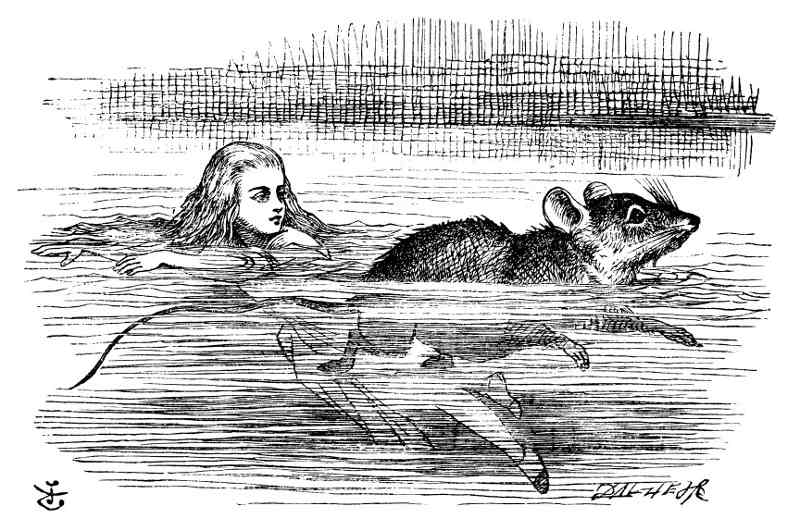
The first case comes when Alice has cried her pool of tears and finds herself, now much smaller, swimming in the pool alongside a mouse. Here she starts by saying “Où est ma chatte?” which isn’t translated in the book, presumably because the target audience would be learning French, but which we can gather regards her cat. (The translation is ‘where is my cat?’ which is a bit of an odd thing to ask in such a situation anyway but we can forgive Carroll this literary device.)
What’s interesting here is that Alice realises the offence straight away, saying, when the mouse ‘gave a sudden leap out of the water, and seemed to quiver all over with fright’ (it knows French too?) “Oh, I beg your pardon!… I quite forgot you didn’t like cats.” Of course this has a second purpose in that it informs any non-French reader as to the subject of the French sentence – so perhaps my presumption of lessons is incorrect or Carroll is simply aware of the wider, highly varied audience – but the fact of inappropriate conversation and the act of causing offence, as well as how to deal with it swiftly, is accomplished here.
Why then, in chapter three, does Carroll return to inappropriate versus appropriate and leave Alice oblivious as to the effect cat-talk has on the birds (and the mouse who has remained in her presence after a brief run-down of why cat-talk is offensive)? It’s fair to say that Carroll might be thinking it’s a good subject to look at further, to cover in depth. And, having introduced it and stated why it’s a problem, Alice’s oblivious in chapter three might be easily spotted by the attentive reader who would have a chance to feel good, triumphant, at working out the problem themselves. I reckon it’s a bit of both and I have to say as aunt to a keen learner, I love the author for it. It’s a wonderful bookish interaction that has the potential to really engage a child.
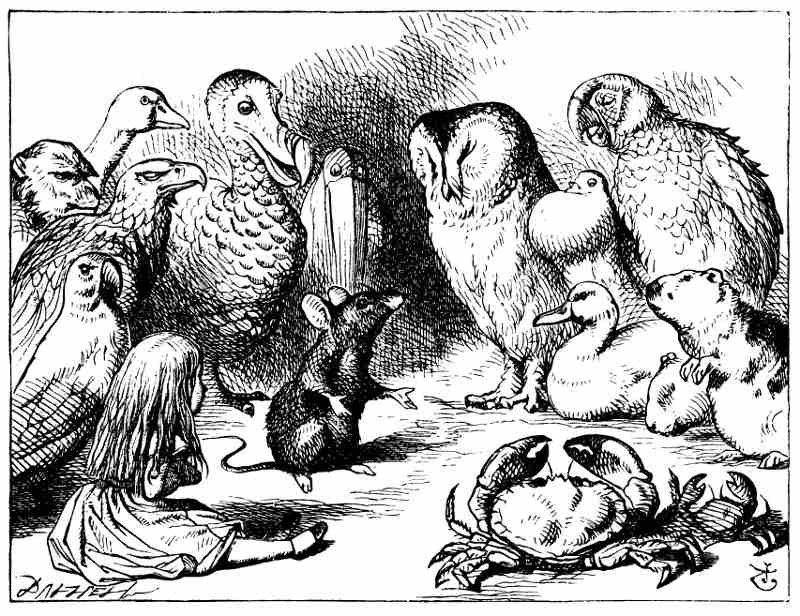
Anyway, in chapter three, Alice tells the animals – the birds and mouse – how lovely her cat is and they all ruffle their fur and feathers and make to leave. Alice is confused by this because, to paraphrase, if they could only meet Dinah, the cat, she’s sure they’d love her. This time she completely misses that instinctual lasting conflict, as it were, between birds and cats. (Thinking about this, if we consider that in some cases the situation between cats and birds reverses so that the cat is the prey, we could, although it’s obvious Carroll is considering only the most usual situation of cats as the predators, say it’s just an overall conflict. Yes, I’m now in thinking too much mode…)
In this, the second instance of this lesson, Carroll keeps Alice repeating the general notion of Dinah’s loveliness, perhaps to make the lesson stand out and be stronger, and to illustrate the extreme obliviousness that might make a child laugh and note that Alice is so silly. If he told you about it that first time when Alice said beg pardon, here he’s not saying anything at all, has effectively left it all up to the reader to work out.
Interesting is the fact that in the first instance, of just the mouse, the animal returns a couple of times throughout the uncomfortable dialogue, whereas in the second instance of birds and mouse, everybody leaves. Perhaps this is a show of people giving a second chance but only so much, that people will indeed leave completely if you don’t cotton on to what you’re saying and don’t apologise; it’s also a device, the mouse teaching Alice whilst showing discomfort. And of course in that first instance, Alice redeems herself.
None of this is included in the Disney animation, which makes a lot of sense because really it’s quite dull as far as the more bizarre and fantastical parts of the story go and it’s likely the film-makers considered the lesson wouldn’t work so well on screen. It is very much a teaching moment than a good story moment (and quite a relief to get past when you’re an adult reading it for the first time!) but for its merit, it’s very much worth reading the book rather than defaulting to the film.
The teaching of inappropriate and appropriate conversation in the book was the biggest takeaway for me, partly perhaps because it’s something not well-known overall but mostly because it’s a section where Carroll’s plans and writing really shine, where you can see him really considering how he can provide a lesson and how to explain it to his target audience.
And let’s face it, we could all do with a reminder on occasion!
Have you read this book?
Zelda Fitzgerald In Midnight In Paris
Posted 14th September 2016
Category: Further Thoughts Genres: N/A
3 Comments

Screen shot from Midnight In Paris, copyright © 2011 Warner Brothers.
I want to explore the interpretation and portrayal of Zelda in Midnight In Paris, played by Alison Pill. (I’ve previously written about the film as a whole here.) I like comparing interpretation to reality and film adaptations are in my head at the moment as I’m writing about them for a future post. Midnight In Paris, being book-led, is one that’s often in mind. This will be a bit of a ‘facts’ post.
Zelda, together with husband Scott, was an emblem of the Jazz Age. The pair are still celebrated for it, as Scott’s books have remained in print and Zelda’s work is becoming more recognised. We’re also, now, writing about her and studying her. The Zelda and Scott of the film are sociable; it’s obvious they have many friends and are part of many circles.
Zelda disliked Ernest Hemingway – Hemingway blamed her for Scott’s declining literary output. (How much we can say about this is difficult but we know they enjoyed a busy social life.) In the film, Zelda introduces Gil to Hemingway and whilst she’s perfectly polite there’s a slight coldness, an indifference. She stays for a few minutes and then wants to head out. So we’re not told about any problems between her and Hemingway but that under-the-surface atmosphere gently simmers. It’s more a suggestion – and would you notice it if you didn’t already know about her life? – but she’s not partying with him, and he seems okay, if not particularly enthused, with the idea of talking to Gil. The film’s portrayal here is one of gentle showing. The rift isn’t something to focus on.
Zelda and Scott’s marriage was plagued by drinking, affairs, and recriminations. Zelda has been portrayed in history as the victim of an overbearing husband. Diagnosed with Schizophrenia, she was increasingly confined to clinics. The film doesn’t look at any overbearing but it does look at the drinking. Zelda gets very merry and towards the end becomes suicidal. We can assume the suicide aspect here is included to show the progression of her life within that short time frame, but it does introduce us to the affairs and arguments because film Zelda, drunk, is wanting to throw herself in the river because Scott’s been seen with another woman. If anything, in the film, Zelda is shown to be overbearing; it’s not obvious that she’s mentally ill, more that she’s in anguish over her husband’s infidelity. Her fairly neutral behaviour early on isn’t linked properly because of the film’s focus on Gil.
As a child, Zelda was spoiled by her mother. Her father was strict and remote. The family was prominent, southern. Zelda liked the outdoors and enjoyed ballet. She didn’t enjoy academics so much – she was bright but didn’t like lessons. The film puts an emphasise on her regional background, her heavy accent, and there is a nod to her education when she speaks of her own work. She vastly prefers parties, it seems.
As she got older, Zelda drank, smoked, and spent time with boys. She was a leader amongst her peers, gaining an appetite for attention, for flouting social norms. Her ruin was prevented by her father’s reputation. All said, she was in a lucky situation and very privileged. What we get from the film in this case is her privilege in the literary circle; she knows many people and, if the real Zelda was like film Zelda, she was happy to share her network. Again, most of what we can tell of Zelda from the film is shown in the characterisation, direction, and in the actor’s bearing.
I was intrigued to find the interpretation of Zelda in Midnight In Paris to be pretty accurate as far as our – admittedly lacking – knowledge is concerned. (I’ll always remember my history tutor telling us to view media and documentaries made for mass consumption, when looking for evidence and opinions, but to be sceptical of the details when we didn’t know otherwise.) Midnight In Paris gets it right. The main limitation is that a film is far shorter than a life so film Zelda does a lot more things in a shorter time. The film shows the dynamics of her relationship with Scott and we could always say the film shows later stages – how problems had started to turn into troubles.
From the film we get someone who could be irrational but also intelligent, well-connected, and friendly. The film deals with the problems openly but remains respectful. You get a good picture of who the real person was.
Which portrayals of real people have you found to be quite or particularly accurate?
References
Wikipedia’s article on Zelda Fitzgerald, accessed May 2016
What Affect Does Hitchcock’s Changing Of The Ending Of Rebecca Have On The Story?
Posted 15th August 2016
Category: Further Thoughts Genres: N/A
2 Comments
Screen shot from Rebecca, copyright © 1940 Selznick International Pictures.
You can rest assured this will be the last post on this book here for a long time, if not forever.
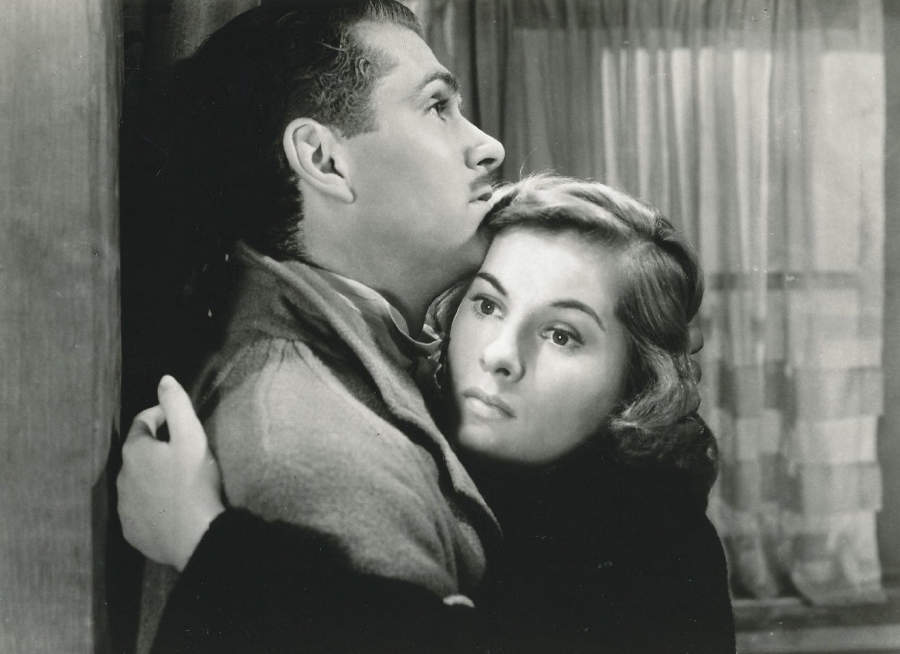
In the film adaptation of Daphne Du Maurier’s book, Max does not kill Rebecca. He talks to the heroine in the boat house but doesn’t say he did it. This difference to the book was made because at the time films could not show a criminal getting away with the crime.
You’d be forgiven for not noticing the difference, I think – this sounds weird when you consider I’m all for adaptation fidelity – but what Hitchcock does is make his film as near as possible to the original as he could.
I want to look at the affect this change has on the story. Crucially, in not having Max kill Rebecca, the film does not make him in any sense a bad person, it preserves his good name entirely. Whilst it could be said that Max, in the book, in killing Rebecca is no better than her, is worse than her, the same can’t be said for Lawrence Olivier’s Max. Of course we don’t necessarily see ‘book’ Max as bad – Du Maurier presents a man deeply upset, ashamed, and if we view Rebecca as horrible a person as Du Maurier wants us to then we can say Max killed Rebecca without really thinking it through, that he was not fully competent at the time due to what Rebecca had done. And the element of jealousy makes Max not seem so bad a person. That jealousy is very pervasive, Du Maurier good at manipulation.
To get rid of the kill as Hitchcock does is to preserve Max’s name and as only the heroine, in the book, knew of the killing, we can say it is to preserve his name for us, the readers and watchers.
As far as the film goes with its difference, Max comes across as better than Rebecca. He’s clean, done nothing wrong. He’s a proper good guy, more of a hero than book Max could ever be.
What the change does, though, away from this, is that it affects the sense of jealousy and the sense of revenge in the story. Yes, it could be considered a good thing because of what I’ve said above, but in toning it down it diffuses the pressure behind the idea that Du Maurier wanted something done to Rebecca to make up for the problems. Given what we know of the real life background – Du Maurier’s jealousy of her husband’s first fiancée – we can see a want for something to happen, for Du Maurier to want to do something to change things and the way she feels. Max killing Rebecca is over the top but, given artistic license, it works. In a way, when considering the book, and the film’s change, it changes our thoughts of Du Maurier, too.
Considering Du Maurier’s worry that her book had caused Jan Ricardo’s death we could assume the film change was welcomed by her.
In a way, the change seems a small thing, especially as it doesn’t change the general outcome, but when you think it over, it does do something to the way we perceive Max and perhaps the way we view the book’s themes, too.


