





The Influence Of The Female Quixote On Northanger Abbey
Posted 27th April 2018
Category: Further Thoughts Genres: N/A
2 Comments

In her 1989 introduction to the Oxford University Press edition of The Female Quixote, Doody proposed that, with its bookish heroine who believes women’s lives and loves should play out as they do in epic novels (the character’s sole experience of life is through reading), Lennox’s word influenced Austen when she created Northanger Abbey. I’m now several chapters into Lennox’s work and already the inspiration is very apparent; whilst Northanger Abbey speaks of Ann Radcliffe, Frances Burney, and Eliza Parsons (whose referenced works were first thought, in the context of Austen’s book, to not be real) there are a huge number of similarities between it and Lennox’s work.
It’s interesting that the book that was perhaps the biggest influence was not named by Austen in her novel1; perhaps the older work, successful during its time (and Lennox is now seen in academia as incredibly important2), wasn’t popular enough later on for her to feel a commentary was worth it. (‘Moderately popular’ has been proposed as the level of Lennox’s fame in the 1800s (Wikipedia, n.d.); the book is pretty obscure today but slowly gaining in popularity again.) It’s also possible, if we consider the subject of plagiarism that is so commented on today, that Austen was aware just how similar her work was, that she was parodying a book that is itself a parody, and, to use a modern phrase, didn’t want to go there. However, considering the way she is very open, through the character of Catherine Morland, that her book owes a lot to the Gothic fiction of decades past, that second possibility isn’t nearly as compelling.
I think we’d better have a list of the comparisons I’ve noted so far:
- Both Catherine Morland and Arabella are incredibly bookish.
- Both read books that are real works of literature.
- Both get their ideas of romance and what they should expect from that literature.
- Both expect the world to align somewhat to that literature (though Arabella expects far more).
- Both books are comedic.
- Both books break the fourth wall between author and reader.
The characters’ choices of reading material differ slightly – Catherine reads Gothic romance from the 1700s, and Arabella reads epic romances from 1600s. (Arabella’s favourites include the longest work of literature published by a mainstream publisher, Artamene Ou Le Grand Cyrus by Madeleine de Scudery – 13,000 pages. No wonder the hero of the book is shocked when he agrees to read her favourites and Arabella’s servant arrives with them!)
Exaggeration and high drama permeate both characters’ choices, but Arabella takes it further than Catherine. Where Catherine gets excited about staying in a gothic building, opens doors she shouldn’t, and accepts criticism, Arabella lives her life to the letter, so to speak, and expects people to conform to the ways of behaviour of her favourite characters which, given they are often historical and taken from ancient myths, are even more exaggerated and over the top than anything from Arabella’s own period. Catherine is a little out of touch with the reality of her world; Arabella is getting towards being a transplant from centuries past.

The reason for each character acting the way they do is different. Catherine’s reading aligns somewhat with what we know about Austen: her bookishness is ultimately her choice and she is fairly independent. Arabella has been isolated all her life, in part due to choice, but also due to her standing; she found her father’s library and that was that. Lennox was estranged from her husband for years before they separated, a man who claimed to be an Earl but likely was not. Lennox was part of the same literary scene as Samuel Johnson, Joshua Reynolds, and Samuel Richardson. The women of the circle were not fond of her. She was well known in her circles but otherwise mostly anonymous.
Two authors of relative independence who were quite successful in their times but mostly anonymous; known to a few people of standing – Lennox more than Austen; both more successful in the years since their deaths, with Austen’s fame increasing far quicker than Lennox – Austen has been famous for a long time, whilst Lennox’s fame is today still on the rise.
It’s fascinating to look at two works alongside each other, one known or suspected to be an influence on the second. It’s particularly compelling when looking at works of centuries past where close reading is required more than it is when comparing more modern texts, the lesser amount of knowledge as to the writer’s background and the genesis of the work necessitating more time spent on the fiction due to there being fewer, if any, opportunities to incorporate authorial evidence that supports the idea.
Footnotes
1 It is, however, named by Austen in a letter to Cassandra:
“Alphonsine” did not do. We were disgusted in twenty pages, as, independent of a bad translation, it has indelicacies which disgrace a pen hitherto so pure; and we changed it for the “Female Quixote,” which now makes our evening amusement; to me a very high one, as I find the work quite equal to what I remembered it. Mrs. F. A., to whom it is new, enjoys it as one could wish; the other Mary, I believe, has little pleasure from that or any other book.” (Austen 1807, cited in Woolsey, 1892)
2 In a general article about Lennox, Facer says: “Today Lennox’s careers as poet, dramatist, translator and editor have been eclipsed by her reputation as one of the most celebrated novelists of her time.” (2012)
Book References
Doody, Margaret Anne (ed.) Introduction, in Lennox, Charlotte, The Female Quixote (1989) Oxford University Press, Oxford, page unknown.
Woolsey, Sarah Chauncey (ed.) The Letters Of Jane Austen (1892), Little, Brown, And Company, Boston, p.90
Online References
Facer, Ruth (2012) ‘Charlotte (Ramsey) Lennox’, ChawtonHouse.org, accessed 27th April 2018.
Wikipedia (n.d.) ‘Charlotte Lennox’, accessed 27th April 2018.
Brief Thoughts On The Original And Revised Endings Of Great Expectations
Posted 5th February 2018
Category: Further Thoughts Genres: N/A
2 Comments

I’ve often thought about the two endings of Great Expectations, but a lot more so since watching the 2012 version over Christmas (as expected as that might sound considering how recent it was).
My initial thoughts on reaching the end of my copy – the Vintage Classics edition that features both endings – was that the original ending far surpassed the revised one in terms of quality and overall sense. That Estella spurns Pip yet one more time matches the person she had been in all the time he knew her, whilst the second ending’s happily ever after stance seemed a prime example of something worked simply to please the crowds. Or at least, in this case, Dickens’ peer, the novelist and politician Edward Bulwer-Lytton, who said it was too sad1; I think we can safely say many readers would have liked the original. That said, the revised ending doesn’t specifically say that the characters got together.
Watching the film made me think a little more. The original ending has Estella effectively behaving as she always has, continuing to be the person Miss Havisham trained her or created her to be. In the second ending we could say that Estella eschews this training; perhaps her behaviour now is more a reflection of who she is without Miss Havisham – perhaps she’s now the person, or moving towards the person, she is without Miss Havisham’s input. She’s now herself.
Taking the endings as they are without their background literary context, they both work for different reasons.
Where the film influenced my thoughts was in what I considered Holliday Grainger’s very good performance – the Estella she and, also, Helena Barlow (as the younger Estella) portrayed, was not someone I saw changing. It seemed to me quite literally out of character for Grainger’s Estella to change as she did; I suppose you could say it highlighted for me why the original ending pips the second to the post. But it did still illustrate further than the simple dialogue and other text of the book, in regards to Miss Havisham’s teaching, how much nurture has to play in our lives.
Your thoughts?
Footnotes
1 In his 1874 biography of Dickens, John Forster wrote: “One other letter throws light upon an objection taken not unfairly to the too great speed with which the heroine, after being married, reclaimed, and widowed, is in a page or two again made love to, and remarried by the hero. This summary proceeding was not originally intended. But, over and above its popular acceptance, the book had interested some whose opinions Dickens specially valued (Carlyle among them, I remember); and upon Bulwer Lytton objecting to a close that should leave Pip a solitary man, Dickens substituted what now stands. “You will be surprised” he wrote “to hear that I have changed the end of Great Expectations from and after Pip’s return to Joe’s, and finding his little likeness there. Bulwer, who has been, as I think you know, extraordinarily taken by the book, so strongly urged it upon me, after reading the proofs, and supported his view with such good reasons, that I resolved to make the change. You shall have it when you come back to town. I have put in as pretty a little piece of writing as I could, and I have no doubt the story will be more acceptable through the alteration.” This turned out to be the case; but the first ending nevertheless seems to be more consistent with the drift, as well as natural working out, of the tale, and for this reason it is preserved in a note.”
Book References
Forster, John (1874), The Life Of Charles Dickens, James R Osgood & Company, Boston, Vol. 3, p. 360.
The Trouble With Goats And Sheep: Who Started The Fire?
Posted 11th October 2017
Category: Further Thoughts Genres: N/A
1 Comment

This is a question I had right up until the end of the book, in fact in a way I was still asking it after the closing pages. Cannon is both cunningly opaque – if you’ll forgive my 7am workday phrasing – and obvious, a not unclever mix that manages to be both literarily inspiring and literally frustrating, but the ending is explained.
Firstly, it’s best to put the fire in context: why was it started? The inevitable answer is that it was to cause damage to Walter. How much damage can’t be guessed, exactly, but we can assume that whilst some people wanted harm to befall him, whether it be verbal harm enough to cause him to leave of some sort of physical injury, the person who actually caused the fire was wanting devastation.
Why Walter? Because he was different. The residents didn’t understand him – nowadays we might say he is a bit odd, and the description ‘autistic’ would probably get throw around somewhere. Due to their lack of understanding, the neighbours thought he was nefarious and a threat to their children.
Who, then started the fire? It isn’t until the very end that Cannon relents and gives you a bit to go on – Mrs Forbes tells Sheila Dakin that she knew someone was in Walter’s house when everyone thought it empty, and then comes the blackmail: the photographs might be gone, but she’ll remember what was there. Mrs Forbes has something on Sheila and if Sheila doesn’t want it widely known she’d better stay mum about Mrs Forbes’ lighting the fire. Page 450 of the paperback version; the first line refers to Mrs Forbes’ cat being scared by Walter’s taxi:
‘Nasty taxi, scaring you off like that.’
Mrs Forbes kneaded Whiskey back again.
Sheila Dakin was frowning at her. ‘What taxi was that, Dot?’
‘The one that brought Walter and his mother home.’ Mrs Forbes carried on kneading, and gave more kisses to the top of Whiskey’s head. ‘I said to Margaret, it’s no wonder he ran off. Big, scary car like that, pulling up in the avenue in the middle of the night.’
‘You knew she was in the house?’ said Mrs Dakin.
Mrs Forbes smiled, ‘I thought they both were,’ she said.
…And then Mrs Forbes talks about photographs being gone but memories staying.
We know it was Mrs Forbes, beyond the above, because of the way Walter’s tea towels are found folded up on the range – Cannon talks about tea towels a couple of times in the book, providing a hint, but at those points it’s difficult to see any relevance, particularly as everyone in the book is… particular. Walter tells Grace and Tilly about the way he keeps his tea towels, and that doesn’t involve folding them. Later on we see Mrs Forbes’ tea towels in her home, folded neatly.
Mrs Forbes knew both Walter and his mother – not all that much older, it seems, than Mrs Forbes herself, and most certainly innocent – were in the house, and was angry enough about the situation the residents had constructed to kill.
The one saving grace is that it turns out the other residents weren’t thinking that far – well, if it can be called a saving grace.
Further Thoughts On To Kill A Mockingbird
Posted 11th September 2017
Category: Further Thoughts Genres: N/A
2 Comments

Whilst reading To Kill A Mockingbird, I couldn’t help but wonder if the character of Dil was inspired by Truman Capote; Capote and Lee knew each of as children, and there is this quotation from Capote, included on the back of my addition of Lee’s book:
“Someone rare has written this very fine novel, a writer with the liveliest sense of life and the warmest, most authentic humour. A touching book; and so funny, so likeable.”
I didn’t know until halfway through reading the book, wherein I read up about the background of it – that Truman Capote was a friend of Harper Lee’s. Beforehand I’d wondered at the point of a present-day edition including that quote because Capote’s opinion here misses the point of the book and I wondered if there was something to be said of that, a conscious missing of the main point of the book, given the time it was written in and the time it was written about, but the friendship makes more sense, with Capote focusing on the style of the book and Lee’s personality, what he would have liked about her. The tone of it, whilst inevitably biased, is interesting in a literary study sense.
On a different note entirely, as I read more about Lee’s life and the way her book was influenced by her father’s involvement in a similar case to that looked at in the text, I wondered about the reasons for Lee writing it. The possibilities in the way she chose to set it with Scout at the age she had been when her father was working. Is it a novel of ‘what if’ in the sense that Lee would have liked to do more in her position, in the way she involves Scout? Is it simply that she wanted to bring her father’s work to light, to a bigger number of people to show them what happened? Lee said that her book was not autobiographical but clearly, there is something there, the comparisons to be made are too many. Does her reticence on the similarly point to her general shying from the spotlight? Did she simply want more time spent on the text than on her life, albeit that more time on her might have brought more attention to her father’s case? Maybe she wanted people to think generally, and look for commonality between her book and America in general rather than focus on one case.
I read Lee’s book around the same time as I read Kate Chopin’s Bayou Folk story collection and it’s interesting to compare the ways the writers wrote about race, Chopin’s general thoughts of equality (given her time) not being dissimilar. What struck me particularly was In Sabine for its inclusion of a free black man choosing to help a ‘Cajun woman’, married to a ‘white man’ (phrasing the white man uses) with the chores. There is nothing here of Lee’s story beyond this factor, but reading the stories together, it strikes you that, particularly given the ‘white man’s’ stereotyping something could have happened. His wife does not seem happy to be married to him and the narrator, a visitor, notes how much she has changed.
It may have been due to expectation or simply that I didn’t know the book followed a child, but I found it less involved than I thought it would be, less about the courtroom, though the added narrative of difference was a good find. I did think there would be more ‘action’ but it was enjoyable for what it was. Certainly the autobiographical nature of it impressed me. Lee involves all types of people (well, to an extent, in keeping with the time).
This post feels very me-centric, more than usual in terms of Further Thoughts, but it fits the general background context in which I approached the book; not the most concrete of expectations, but enough that it got me thinking. For all the ‘lack’ of action, though, I loved the quietness of it, the slowly unfurling nature of what is transpiring – even if it’s easier for the reader and you have to wait for Scout to understand. And I think there’s something special in the way Scout is recounting the story at an older age, with the benefit of hindsight but also the innocence of childhood mixed in.
What do you think of Lee’s book, or if you haven’t read it, do you plan to?
Further Thoughts On Kate Chopin’s Désirée’s Baby
Posted 10th July 2017
Category: Further Thoughts Genres: N/A
Comments Off on Further Thoughts On Kate Chopin’s Désirée’s Baby
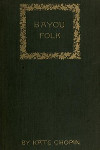
I found Désirée’s Baby rather profound, which somewhat surprises me due to the similarity between its ending and the ending of The Awakening – one would have thought it wouldn’t seem so shocking given both the similarity of the actions and the similarity between the reasons. Away from that, I think it’s fair to say that many, many people like the story.
One of the biggest questions regards Armand’s background and behaviour. The Kate Chopin International Society’s website describes the likelihood of Armand having black mistresses, quoting:
“And the way he cries,” went on Désirée, “is deafening. Armand heard him the other day as far away as La Blanche’s cabin.”
The site says that this could be evidence of Armand’s affairs with black women – La Blanche is one of the women on the estate. Significantly, however, they remind us that all we have to go by are Chopin’s words. They also quote this:
One of La Blanche’s little quadroons…
Who knows what Chopin meant exactly, but this is the point when Désirée starts to worry and it seems she is literally putting two and two together – the site suggests Désirée’s baby is also a ‘quadroon’, a person who is a quarter black, and that perhaps Désirée also spots a likeness between La Blanche’s child and her own, facially.
Beyond the site’s ideas of family connection, Désirée has seen something in her baby’s skin tone that wasn’t noticeable before and with Valmondé having already pointed out a change – we can assume this is the baby’s skin colour – it’s possible that what Désirée notices is that resemblance to La Blanche’s son. We can assume that for whatever reason at birth, it was not noticed.
Then Armand’s opinion and behaviour:
“It means,” he answered lightly, “that the child is not white; it means you are not white.”
We don’t know much about Armand, but this assumption, if we can be so kind to call it thus, fits in with the age-old idea that a woman is at fault for the sex of a baby being female – it’s Désirée’s fault the baby isn’t white; her lack of known heritage means it’s her problem.
What’s particularly interesting is how Désirée chooses death in a similar fashion to Edna Pontellier. Although for different reasons, both have been rejected. Désirée does not take the offer of moving back to her adopted parents’ home. Was her mother’s feeling that something was off, and the offer of returning home, due to knowledge of Armand that Désirée didn’t have?
And is there anything in the eeriness of Armand’s house? We can possibly see something there, a foreboding, and a metaphor for his personality, which the International Society says could have been dark, pointing to the details about his father and the difference cited between father and son.
In burning his wife and child’s possessions, Armand effectively and symbolically throws away his own heritage. We do not know if he knew about his heritage prior to this, and indeed the reading is more profound if we consider it was a revelation to him upon discovery of the letter, but it’s possible he did and that he’s doing his best to ‘pass’; a subject recently studied by Helen Oyeyemi. In wondering if Armand knew, we can look to this:
…the unconscious injury she had brought upon his home and name…
Is injury a strong enough word for Désirée has supposedly done?
Beyond this tragedy is another: when Valmondé says to return, she doesn’t refute Désirée’s fear. In terms of what Chopin was saying, it’s fair to say Valmondé didn’t think Désirée was black and that her lack of acknowledgement of that is a device that allows Chopin to create the ending. Had Valmondé addressed the question she may have saved Désirée’s life.
Désirée meets her death whilst looking angelic:
…her hair was uncovered and the sun’s rays brought a golden gleam from its brown meshes
She has feet ‘delicately shod’ and a ‘thin white garment’ that’s been torn by her journey. And she ‘disappeared among the reeds and willows’ – symbolic, perhaps, as the baby’s cradle, we learn shortly afterwards, was made of willow and that cradle also ‘dies’.
Of Armand’s possible discovery – rather than reminder – of his heritage, all Chopin says is this:
There was a remnant of one back in the drawer from which he took them. But it was not Désirée’s; it was part of an old letter from his mother to his father. He read it.
He read it – Chopin says that, and ‘dear Armand will never know that his mother, who adores him, belongs to the race that is cursed with the brand of slavery’.
The jury’s out but we can assume if it was in the back of the drawer and a remnant, it could have been there since the days of his father, because otherwise the question is what happened to the rest of the letter and why did Armand keep only that bit?


