




Thoughts On Leaving Reviews Until Later And The Results Of Your Chosen Time Slot
Posted 8th July 2019
Category: Chit-Chat Genres: N/A
2 Comments
When I originally wrote about (not) leaving reviews until later, I was roughly two and a half years into blogging. That was a long enough time to have collected some experience of the process, but I knew I had a lot left to learn.
I now find that the concept and resulting act of writing a review immediately after finishing the book is not always the best choice. (Or writing as immediately as possible – you can’t always time your reading of the last pages to match a following time slot in which to write.) If a book is simple or just straightforward, and doesn’t require too much thought, an immediate review can work, but most often I have to let ideas I want to include percolate for a while; I also sometimes need time to think back on what I’ve read to work out what I want to say or what I can say – some books’ themes are not immediately apparent.
Yet I still subscribe to the idea of writing as soon as possible in terms of getting things done. I’ve been using it consistently for a while now; done is better than perfect. It really is – you can have the best ideas in the world but if they’re only in your head and not on the page, their worth isn’t tangible. Done rather than perfect can result in the feeling that you’ve not done your best, and that’s frustrating, but better to have something rather than nothing. Certainly there’s a correlation between the numbers of notes made on a book and the time it takes to finish the review unless those notes are structured as a plan already.
Allowing thoughts to percolate works best if note-taking happens concurrent to the reading. I realised this recently; if not taken at the time of creation, as much as you might remember what the note was, you lose the context surrounding it. This context might not be important; when it is, it’s generally vital. I don’t mean references or anything like that, I mean the sort of context that involves where you were when you had the thought, what your exact feelings were – the specifics behind the note that transcend the text you were taking notes on. For example if I copy out a passage from a book with the comment ‘this shows what the weather was like’, when I come back to the note later I’ll miss my own added subtext that would have otherwise brought clarity. The comment with the subtext included might be ‘this shows what the weather was like, specifically I’m looking at the first sentence which links to…’
It’s a certain sort of thoroughness.
Something I find endlessly fascinating the thought that if you written the piece – review in my case, sometimes another type of post, but rarely – at a slightly different time, you might or probably would have written it differently. I feel this most when I’m happy with the finished piece, when I’ve been surprised by the routes my thoughts took during writing flurries, which can happen regardless of whether I was following a plan – that all makes sense. What might you have written if you’d started an hour prior to the one you did? What might you have focused on then? What might you have lost or gained in pausing as you did to get a coffee? I find I tend to feel that I wouldn’t have done so well but there’s always that thought – if I’m happy with what I did write, how much happier might have I been if I’d written it earlier or later?
(When I went back to my older post after writing this, I realise these thoughts have been with me for a very long time. It’s a shame that, except for fiction, we’ll never be able to really look into it. There’s a reason Sliding Doors is so well known.)
What is your process like in this regard, no matter what you write (or compose or paint, and so on)?
A Short Biography Of Jean Saunders And Agora Books’ Latest
Posted 26th June 2019
Category: Chit-Chat Genres:
Comments Off on A Short Biography Of Jean Saunders And Agora Books’ Latest

Agora Books, previously Ipso Books and established in 2015, is the digital-first publishing arm of literary agency Peters Fraser Dunlop. The publisher releases two sorts of work – brand new books, and the books of forgotten authors of the past decades, such as Anne Melville’s 1980s historical novel which I reviewed last month.
Their latest reprint, Taking Heart, will be released tomorrow; it’s the first book in a historical series by Rowena Summers (a pen name for Jean Saunders), originally published in 2000. It’s a book that will interest you if you like pre-war (WWII in this case) family sagas. I received a copy of the book; I’d thought I’d introduce you to the author in case she’s someone whose work you’d like to look into yourselves, and I’m posting the synopsis here in lieu of a review.
Jean Saunders, who also wrote under the names Jean Innes (her maiden name), Sally Blake, Rachel Moore, and, once, Jodi Nicols (for her solo erotic novel), became a writer in 1974. Born in 1923, she passed away after an illness in 2011. Her second novel was her first published, and following this she received several rejections. It’s a bit different to the usual story.
Saunders wrote just over 100 novels, and published approximately 600 short stories in magazines. Her 1970s début was in the gothic romance genre, in which she continued until the 1980s when she switched to regular historicals. Her books under the name Rowena Summers were the most popular.
The author was the 17th Chairman of the Romantic Novelists’ Association, holding the post for two years between 1993-1995. In later years she lectured in writing, often on cruise ships, and wrote a number of books on the craft.
Agora Books have so far published 6 of Saunders’ books; Taking Heart will be the first under a pen name. Here is the synopsis:
Imogen and her sisters are fighting to save their childhood home and remain in Bristol. Their father has announced the sale of the family business and everything is about to change.
But when a terrible tragedy tears the family apart, the Caldwell girls must forge their own paths in life. And with the Second World War looming over England, their lives begin to change more drastically than they could have imagined.
Through love and heartbreak, fear and loss, can the Caldwell girls make it out unscathed? Or will they be swept up in the chaos of the changing times?
And here’s the first line:
As the family gathered in the sitting-room of the tall Bristol house that Sunday afternoon, Quentin Caldwell looked at his three daughters with immense satisfaction and pride.
Agora’s books are available on Amazon; both ebook and paperback copies of Taking Heart are here.
When In The Reading Process Is It Best To Know About The Author?
Posted 19th June 2019
Category: Chit-Chat Genres: N/A
3 Comments

This 1947 photograph of Daphne Du Maurier is from the International Institute of Social History.
Spinning off from something I spoke about on Monday, I thought I’d look at the ‘methods’ of reading I questioned. They were:
Is it better to read the book and then find out about the author?
Is it better to find out about the author and then read the book?
Is a mix of reading and research the best way?
Each method will create different thoughts, and highlight different aspects of the book due to the added or lesser background information you have at that time.
I find working on a per-book basis best. However, I’m not sure I should say it’s always the case; there are enough occasions where the preferred method of doing something changes over time. (The ‘how’ of reading sounds like it should be an easy description, but it’s not. I think that’s interesting in itself.)
So then, is it better to read the book first and then find out about the author? Doing this will provide context and meaning after you’ve read the book. It’s the most likely method to induce those ‘aha!’ moments, where you learn something new about something you thought you understood, or you learn something new about something you did indeed understand. However, reading by this method means you’ll probably miss the little things, things so small you wouldn’t think to jot them down – words, short sentences, that might have been funny if read in context. Note taking is important in this method, particularly if the book is long and/or complex – it helps you remember the little things, but again, it won’t help you if you don’t realise that something should be noted for later research.
Is it better therefore to find out about the author and only then read the book? Doing this means you can read the book in context in real time, and all the little things you might have missed will be shown. The downside is there will potentially be a lot to keep in mind from the start; invariably you might still miss things. But also, you risk applying aspects of the author’s life and thoughts to the story that may not be relevant. (I’m thinking here of the oft-debated concept of judging a book by its author and how much we ‘should’ allow the author’s worldview to impact our reading of their books.)
So, is concurrent reading and research the best way? This will naturally slow you down as you move between book and references, but it is surely the richest choice in terms of literary enjoyment, reading for study purposes whatever that study may comprise of. By being so close, in terms of time and literal space, to both the text and the meanings behind it, you’ll learn the most. A word confuses you? The answer is right there. As such, this is not the way to read if you just want escapism; for all its studious pleasures, it can become dull, grating, as at some point you’ll almost certainly want to forget research and just read the book. You also have to be near research material, which could lead to further distractions.
And what’s the impact if you can’t find any/only a little information about the author? That in itself may be a point, like Elena Ferrante and the possible difference caused to readings of her book – those who read them before she was unmasked, and those who read them afterwards. If, however, it’s simply a case of a lesser-known writer, you do have to just read the book without knowledge of them, and this effectively forces your hand in regards to further research. In this way, the only context in which to read the book is in the context of the genre or the author’s other books. Perhaps the authors’ thoughts and background are included in the book; one could presume that any themes or aspects that are dwelt upon at length might be of importance to the author, but then again they may not be. It’s an interesting topic to consider.
I find myself choosing between the three methods by genre and popularity. When the book is a classic or otherwise older book, the reading and research tend to happen at the same time. I generally limit myself to research that seems too important to ignore because I do still like to read classics without spoilers. When the author is very famous and more modern, the author information is most often learned early on, by everyone; if I’m not in the know I’ll tend to read about them first because it can help. A lesser-known book, especially modern, will be read before any research.
How do you read in this context, and has it changed over time?
Authors And Contexts And Referenced Works Redux
Posted 17th June 2019
Category: Chit-Chat Genres: N/A
3 Comments
Several years ago, when I was in the first flush of my ‘new’ reading style, I wrote a post about the impossibility of disconnecting an author from their work. I’ve posted on it at least twice since; it’s a topic that won’t go away.
I haven’t changed my opinion on it, in fact I’ve become more firm in my opinion – you can’t always disconnect the author, no matter how much you want to. You can, of course, in literal terms, but you’d get so much less discussion, thinking, and so forth from it I’d hazard to say that in terms of certain books (a good number) the discussion might be worthless. (I’m thinking here of the books I’ve read in the past, where my initial thoughts have become irrelevant when finding out about the author.)
I find the philosophy of reading in a vacuum fascinating – how would opinions of books be if people read without any context of anything, if they had no knowledge of the world at all, or only limited knowledge? The reality of such a concept is of course awful, and you’d need information to learn to read anyway, so an idea for philosophy it must stay: we can only imagine how opinions might change or be different with different knowledge. We sometimes achieve something similar, such as the point I made above about not knowing about the author before you read, and those times when you read a review and you finish it thinking ‘that’s all very well you didn’t like it, but you missed the point of the book entirely’. (Often those sorts of reviews are so well written and considered, that you really do wish the person had got the point or had the context necessary because their review would likely have been excellent.)
I’ve missed points before, and likely will do again. It comes with the territory; we can never read everything, and we can’t remember every single aspect of every single book.
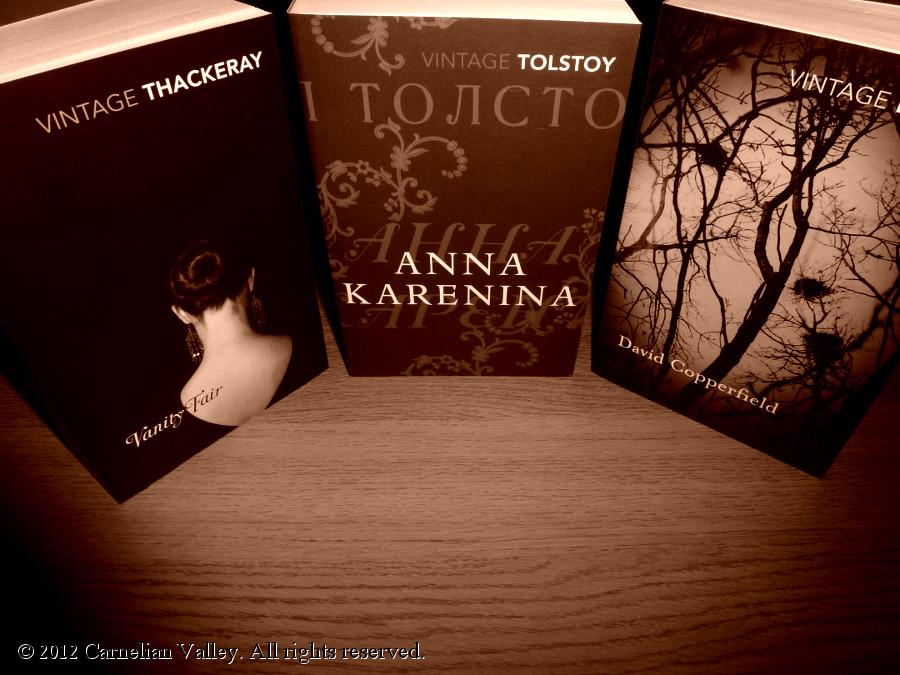
This subject of contexts came back to me recently when I was reading Lady Chatterley’s Lover and seeing a – perhaps tenuous – link with Anna Karenina, the way both writers are pining for something that’s important in their lives. Would I have enjoyed Lawrence’s musings without being able to contrast it to Tolstoy’s? Probably, but being able to do so wasn’t just interesting, it was downright fun, tenuous or not.
I’ve found it interesting that reading in context covers all kinds of books – I think what I’d consider the problematic aspects of Outlander, for example, are somewhat explained by knowing the reason Gabaldon wrote and the ‘place’ she was coming from. Without that, I’d say it’s just a good book with a bit too much sex. now, I’d say that it has a bit too much sex regardless, but knowing it was a writing project and continued because a small group of Gabaldon’s fellow readers and writers wanted to read more brings a few ‘aha’ moments1.
In contrast, I found it fascinating to read Anne Of Avonlea, the second book in L M Montgomery’s Anne series, that I thought far surpassed the first book, and then discover that the author hadn’t wanted to write it2. Perhaps Montgomery’s feelings, and the little insight you get into the mind of her publisher via her written opinion on the whole thing, shows a publisher who had a belief in their author and knew she wasn’t yet at her peak. (And so then it’s interesting that she hated writing it yet it was so good.)
With my current reading ‘theme’ of reading around the subject, I’m seeing the advantages in taking author context even further. Researching Louisa May Alcott’s literary influences (I’m reading Little Women – it’s a horrible, wet, June, and feels appropriate) leads to seeing, for example, exactly why Jo March is reading a particular book. It’s seemingly the smallest thing: in chapter three, titled ‘The Laurence Boy’, which introduces the previously off-stage Laurie, Jo reads Charlotte Mary Yonge’s The Heir Of Redclyffe, and it makes her cry. If you hadn’t already heard of Yonge’s book, it was very popular in its day. This information, in the context of Jo reading it, is something I found out a few years ago; I had been researching Yonge rather than Alcott, so the path to the discovery was different, but the result the same.
However, whilst that fact of popularity accounts for Alcott’s using it as Jo’s reading material, what I discovered yesterday when having another read-up on Yonge’s book was that there was a lot more to it than popularity. (Spoiler incoming for Alcott’s series – skip to the next paragraph if you don’t want to know.) It has been said that Alcott uses Yonge’s book in this chapter as a sort of clue as to where Jo and Laurie might end up, not together. Apparently, The Heir Of Redclyffe features a similar set up to the place Alcott takes her story. Perhaps in years gone by, when the March sisters were first introduced, people found more in Alcott’s decisions about Jo and Laurie than we can today. Yonge’s book is mostly forgotten, and we can’t relive the literary world as it would have been when she was famous.
This of course all links back to what I said recently about lost contexts and authors of yore not necessarily thinking about the potential pitfalls of dating their books.
Reading related books is obviously difficult – as I’ve said before, where should you stop, and what path should you follow? – but gaining author and background context is generally easy, what with the Internet and so on. What I’m personally yet to decide on is what order works best – is it better to read the book and then find out about the author? Is it better to find out about the author and then read the book? Or is a mix of reading and research the best way? Each method will produce different thoughts and highlight different aspects of the book; I think the biggest thing to keep in mind is that once you’ve chosen a particular method, you’re not going to be able to go back and wipe the slate clean. Any thoughts you have of a book or of a part of a book will necessarily build on top of what you’ve already thought.
That is both compelling and kind of scary – you might still miss the little things. But without that vacuum it’s going to happen.
Footnotes
1 On her page about the background to the book, Gabaldon says: “I became a member of the Compuserve Books and Writers Community (then called the Literary Forum), somewhere in late 1986. […] So – with trembling hands and pounding heart – I posted a small chunk (three or four pages, as I recall) of the book I was calling CROSS STITCH. And people liked it. They commented on it. They wanted to see more!”
2 “I’m awfully afraid if the thing takes, they’ll want me to write her through college. The idea makes me sick. I feel like the magician in the Eastern story who became the slave of the ‘jinn’ he had conjured out of the bottle.” (Montgomery to Weber, 10th September 1908)
British Book Awards 2019: Non-Fiction Narrative Book Of The Year
Posted 13th May 2019
Category: Chit-Chat Genres: N/A
Comments Off on British Book Awards 2019: Non-Fiction Narrative Book Of The Year

An update is at the bottom of this post.
Tonight, at a large awards ceremony in London, the winners of the British Book Awards (‘Nibbies’) will be announced. A set of prizes that have been given out yearly since 1990, the Nibbies are the awards of The Bookseller magazine, which has itself been around since 1858. Called ‘the BAFTAs of the book trade’, the Nibbies are comprised of eight awards which are judged by eight different panels and the idea behind them is that they champion books that are ‘well written and brilliantly published’ – honouring both author and the publishing team. There are then a variety of awards for industry people, publishers, and book shops.
The categories for books are: Debut Book of the Year; Children’s Fiction Book of the Year; Children’s Illustrated & Non-Fiction Book of the Year (new for 2019); Fiction Book of the Year; Fiction Crime & Thriller Book of the Year; Non-Fiction Lifestyle Book of the Year; Non-Fiction Narrative Book of the Year; Audiobook of the Year. It’s a lot of categories but, as I noted when writing this, it ensures books are compared with others that share a subject, whilst not being too niche.
Philip Jones, editor of the magazine and chair of the judging panel, has said that the shortlists ‘showcase the breadth of talent available to publishers in the UK, after a year in which international writers… have shown that there is a real hunger for stories, well-told, that originate elsewhere but reflect back on us… today’s books sit at the intersection between culture and politics, and between entertainment and reality’.
As the awards are tonight I thought I’d look at the six books in an ‘at a glance’ fashion; I’ll be reviewing one or two in the weeks to come.
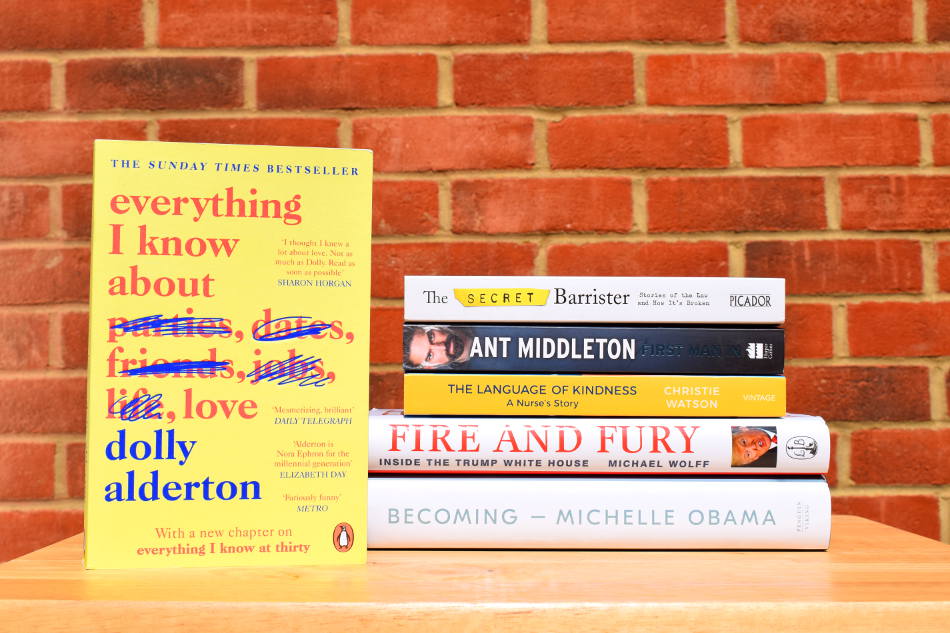
Everything I Know About Love is a memoir about Alderton’s teenage and early twenties years, told in a sort of essay fashion; it goes back and forth between various places and times, detailing Alderton’s experiences with drink, drugs, sex, and relationships both platonic and romantic, an open account of her growth as a person. Alderton is a journalist for The Sunday Times and a radio presenter; through reading her book you learn about her shorter periods of time in television and about her freelance career. The book is written in a casual, carefree, manner which suits the content, enables the humour to work very well, and means that the book is an easy read in a very good way. Speaking at the Curious Arts Festival last year, Paul Blezard, who interviewed Alderton, said the book is about ‘the honesty of growing up and learning from it’. (My post on this is here.)

The Secret Barrister by someone known only by the title of their book, this is a collection of stories of life inside the courtroom. It’s ‘both an account of the human cost of the criminal justice system and a guide to how we got into this mess’. Written in a jovial tone, it’s about the issues in the system and what needs to change; it’s won a couple of awards already. The author cites themselves as pretty average; it’s the everyday of someone who deals with things we don’t tend to consider everyday things.
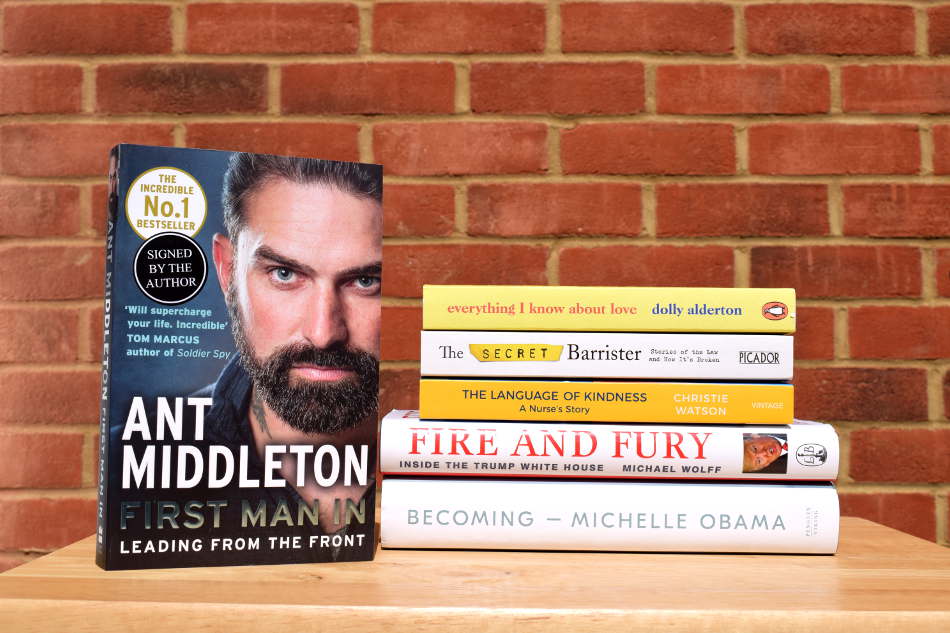
First Man In by Ant Middleton is a memoir of Middleton’s various careers and what he has learned through them. The author is a former soldier, adventurer, and is currently the ‘Chief Instructor’ for Channel 4’s show, SAS: Who Dares Wins. (This year 25 people will go to the Andes; people eat, sleep, live together, whilst completing a tough course.) Middleton has been in the Special Forces. He spent time in the Special Boat Service, the Royal Marines, and the 9 Parachute Squadron Royal – the three are the ‘Holy Trinity’ of the Elite Forces.

The Language Of Kindness is Christie Watson’s memoir of her twenty years as a nurse. The author of the Costa First Book Award winner, Tiny Sunbirds, Far Away, Watson’s prose has a particular flow; even if you’ve not read the novel, as I haven’t, you can see the writing background. Beginning with a short summary of how she came to be a nurse – a previously indecisive sixteen year old finding reward working for patients with the charity now called Scope – Watson details many periods of her career, individual stories of hospital stays, good health and happiness alongside sadness, with a close attention to privacy for those involved.
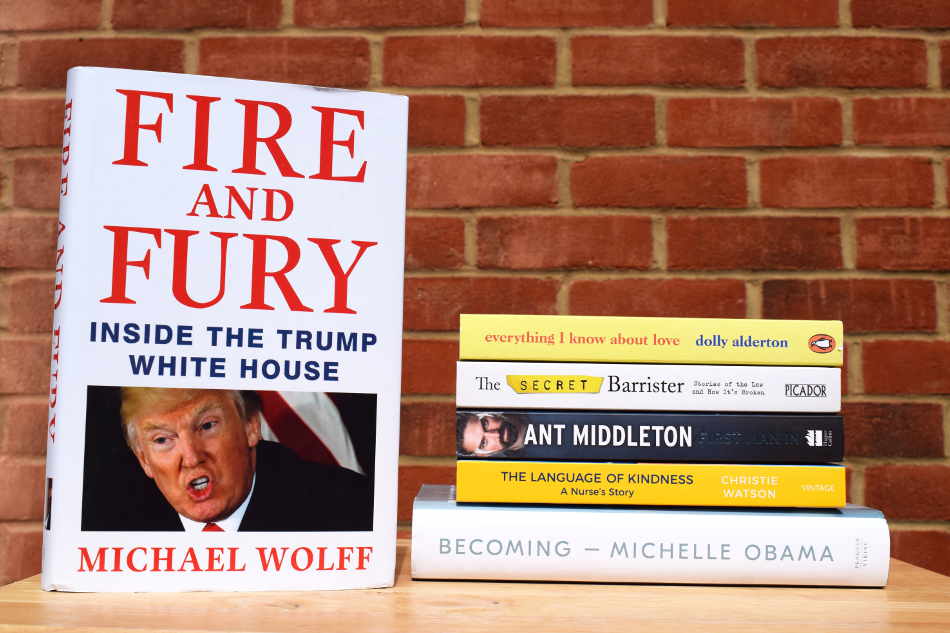
Fire And Fury is Michael Wolff’s ‘Trump era exposé’, an account of the early days of Trump’s presidency by a journalist who was afforded particularly good access to the White House in the first hundred (and more) days of the time, and also followed the campaign. As Wolff details, few on the campaign team thought that Trump would be elected, and Trump had a concession speech prepared. And as the election was very different to others, there was a lot to get used to. Told in a style that’s anything but dry, and featuring mirade interviews, it’s proved a popular book so far.
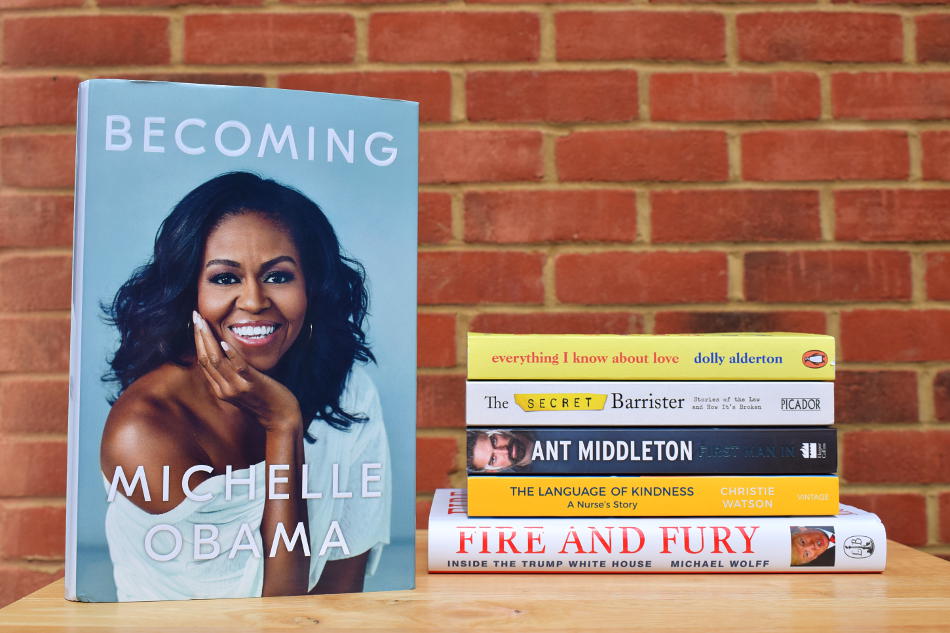
Becoming is Michelle Obama’s memoir, a hefty tome of a book that, though I’ve only read a couple of chapters so far, is surely worth every one of its pages. Told in a lovely detailed and, dare I use the word everyone else has, honest, tone, she tells the story of her early years to the present, with stories that hold particular memories – the preface contains a brief summary of life as First Lady and the return to life outside the White House; the first chapter is focused on early piano lessons in her aunt’s apartment against a background of her general family situation. The book is also on the shortlist for the Audiobook of the Year category (and it’s narrated by Obama herself). A book by and about someone well loved and respected for a great many reasons, who is incidentally also known to be a big reader – this is the book I’d be betting on and would be happy to see win.
Update at 11PM: Michelle Obama won this category as well as Audiobook of the Year. In a video message she said to those gathered at the ceremony: “This is an incredible honour. I want to thank the British Book Awards for this recognition, as well as Penguin Random House UK and everyone who helped bring this book to life – especially the readers. It’s been such an uplifting an powerful experience to share my story with everyone across the United Kingdom these past few months. I especially loved the opportunity to connect with so many bright young women, like the incredible students at the Elizabeth Garrett Anderson and Mulberry schools in London, whose stories reminded me so much of my own. Two years ago, when I started writing this memoir, I wasn’t thinking about awards; my biggest hope was simply to create something meaningful for the people who read it, something they might be able to connect to their own lives. Because I know that my story isn’t unique. It’s the story of a working class black girl learning to make music on the piano with broken keys, of a high school student who wondered if she’s good enough, of a mother trying to balance a career, two daughters and a husband with big goals, while carving out a better sense of herself. I want to thank all of you for allowing me to share my story. My greatest hope now is that each of you will share yours too.”
Have you read any of these or have any thoughts as to which might win?


