




(Very Subjective) Thoughts On Virginia Woolf’s Mrs Dalloway
Posted 18th October 2019
Category: Chit-Chat Genres: N/A
Comments Off on (Very Subjective) Thoughts On Virginia Woolf’s Mrs Dalloway

I’ve chosen to eschew my regular review/discussion format – I don’t feel I can do Mrs Dalloway justice, and I’m not sure I ‘got’ it.
I appreciated a lot about the book. So much of it was poetic – poetry in prose. The language was sometimes difficult to read – I don’t mind long sentences but my word! – but the choices made, and the rhythms, were lovely.
The portrayal of PTSD – then ‘shell shock’ – at the time when it wasn’t fully understood was very careful and caring. If Woolf’s book, albeit published several years after the war (1925), played a role in helping people to help veterans further and later, I wouldn’t be surprised. Woolf shows the symptoms well, creating a balance of flashbacks and other mental health issues that came as a result. She shows the effect of misdiagnosis and the beginnings of understanding.
I appreciated the look at love, unrequited, and same-sex.
The inclusion of suicidal thoughts and an actual suicide is interesting in its context. I wasn’t sure whether it’s ‘right’ to see anything here in items of hindsight, Woolf’s mental health and her later choices – I wonder if, perhaps, the book reflects a few of her thoughts pertaining to herself. Certainly if nothing else, she explores it all in its social context.
All these things I ‘got’ but I was left feeling that I was still missing something, hence my choice to bypass a review. All opinions are valid, but I felt too strongly about missing something – can I really evaluate something with which I struggled so much?
I struggled with the stream of consciousness. When I was able to keep my attention on the words – try as I might this was a continual problem – the moment the perspective changed I was right back at the beginning.
I didn’t ‘get’ the sudden changes in perspective. Had the book been solely from Clarissa’s point of view it would’ve been easier. I realised these extra characters might turn up at the party but still their inclusion seemed irrelevant.
I suppose I’m not sure what it was, exactly, that Woolf was trying to say overall – I’ve not a clue. Society at the time? Relationships – problems in love? Attitudes to each other, two-facedness? I did like how everything revolved around Clarissa whether the characters intended it to or not, whether they liked her or not.
Can you enlighten me? Was I somewhat right about the book or completely wrong? And how have you found Virginia Woolf yourself?
On My Old N/A Rated Books
Posted 14th October 2019
Category: Chit-Chat Genres: N/A
Comments Off on On My Old N/A Rated Books

In my 10 years of statistics post, I mentioned the books I’d decided not to rate. To recap, this happened a few months before I started blogging; when I started blogging I went back to the previous year’s books (started blogging March 2010, started keeping statistics September 2009, and noted the books I’d read in the months prior) to help me write reviews so that I had a bit of a backlog to fall back on. In doing this I decided to rate the books I was intending to review; I decided that books I wouldn’t review – which often included books I’d attempted to review and given up on – didn’t need a rating.
Hindsight is a wonderful thing, and so on. Although it’s hardly the end of the world that I don’t have those books rated, I feel a bit of a bad reader for having essentially left them out of the running. Some were books I didn’t enjoy and probably wouldn’t enjoy today. But others I loved.
My thoughts here aren’t towards the books themselves – they have all been mentioned here over time – but the general idea of having books on my list with N/A in the rating column: should I be adding ratings? I certainly like the idea – not only would it complete my log for the year, it would feel like I’m doing them justice, finally.
But is giving a rating in hindsight – 10 years’ hindsight in this case – a viable option? No matter how much I try to think back, and no matter that I do in almost every case remember my general thoughts on the books, my present reading self will surely come into play. I’ve changed, and my expectations have changed. Perhaps I could give two ratings – one in the context of today, one that I believe I would’ve given then. But isn’t today’s context irrelevant if I’m not re-reading the book? (And, unless I’m reviewing them, does a rating of any context matter beyond completion?)
This all comes back to the question of how much we remember of books read years ago, and how we change over time. By the very fact that I’m wondering how useful a rating given in hindsight might be – that is, not useful in the context of today – aren’t I saying that it doesn’t matter because I’ve moved on? It might have been a reflection of my reading then, but without a re-read – that would show change more clearly – or, indeed, a review, which these books necessarily lack, there is perhaps not much objective use in having these ratings.
How much do I remember of these books? Where the thought was particular, for example I remember one book became almost illegible, suddenly, at 3/4 the way through, and another that it was decidedly average and dry, I could give a rating more in keeping with the time. Where the thought was more about my feelings, I’m not so sure. And the subjective and objective would be mixed without my knowing.
I’m not sure if I’ll ever rate them – it might do them justice in terms of back then, but it wouldn’t be informed and thus also wouldn’t do them justice.
In what ways do you consider your opinions of your old reads relevant and irrelevant?
Exploring The Question ‘How Old Was Alice In Wonderland?’
Posted 7th October 2019
Category: Chit-Chat, Further Thoughts Genres: N/A
1 Comment
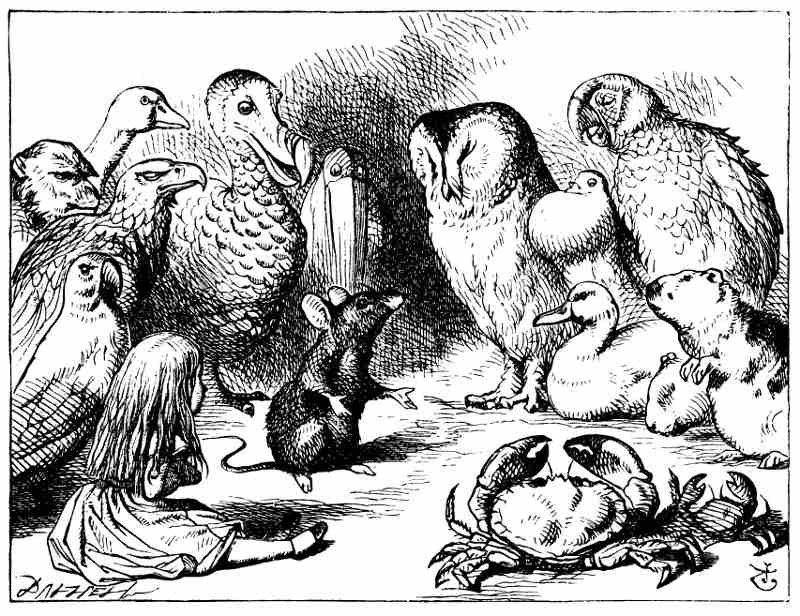
The other day I was looking through my site statistics as I sometimes do, and noted a plethora of searches to do with the aforementioned book. They were specifically to do with Alice’s age. I won’t list them because if Google happens to see value in this post it might start sending the searchers here and my writing today isn’t about answering the question (though I will answer the question later because I’ll need to).
Instead I want to explore that plethora itself. You’ll often see similar search phrases that result in the one answer; everyone words things differently. It was the sheer number of differences that struck me, the differences suggesting that the motives behind the questioned differed too. I wondered why people were asking. (There was also a bit of ‘why now?’ in there – I wrote about the reading age for the book almost a year ago and it’s only recently that numbers have swelled.)
Alice’s age is provided by Carroll in the sequel, Through The Looking-Glass – seven years old. Whilst not given in the first book, we can assume she was six or seven then because the first takes place a few months before the second, May and November respectively. So we’ve an easy answer to the question of why people are asking – the age isn’t provided in the first book and it’s safe to assume that a good number of people don’t get to the second. The question also means that it’s more likely people haven’t read either book and are perhaps looking to ascertain how appropriate it would be for their own child to read. It tends1 to be the case, after all, that in children’s literature, the character’s ages match the intended audience. One of the phrases in my stats was specifically requesting an Alice book ‘for kids’ – clearly this person (a parent?) had misgivings about the story, and I don’t blame them – after reading it myself a few years ago I decided not to buy a copy for my nephew until he was a little older than Alice herself.
(I’ll note here that there were a few searches in the same vein as our main question for Through The Looking-Glass. This could be a different, shorter, post but I think it’s best summed up as wanting to make sure the story doesn’t move too far ahead from the first as to mean that a child – likely deemed old enough for Alice by whatever metric – would have to mature in order to continue. It’s safe to assume that Carroll was looking for or was asked to provide more of the same, hence the short time frame between them.)
This leads us neatly onto the topic of context – are people asking in order to understand the Victorian context of this 1865 book? In my post about the target audience for the book, I wrote about the way the book was clearly written for children but how cultural change means that in our modern world it’s pretty violent and a bit too strange. Certainly Alice is a mix of very mature and not so, which reflects both her age and environment and suits her character’s role in the didactic book. It is interesting to look at the novel in the context of its time, to compare it to others – few have stood the passing of the centuries like Carroll’s – and see where morals and values as well as views about childhood come into play.
In this way I wonder if the secondary meaning behind asking about Alice’s age is relevant here – how old is the book that bears her name?
And on that note, therefore, somewhat, what is the reading level of the book? Does the appropriate age group of a modern child match the target reading level? When I gave it to my nephew, via grandma, I said it might be best read together; he’s a good reader but he necessarily lacks a Victorian child’s mindset. One searcher wanted to know if the book could be read by five-year-olds.
Lastly, looking at different interpretations of phrases, I think it’s possible some searchers are looking to study the content’s appropriateness in terms of Alice’s age, maybe also in terms of her social context. How appropriate is it for a child of seven to be dreaming of heads being cut off and what would her environment have been like? The law was different back then, and as we know from the information available about the progression of early children’s literature, childhood had until recently been viewed very differently to the way we view it now; the idea of childhood began in the 1600s.
I don’t think there are any conclusions to be made here; this post must remain exploratory. But certainly, wondering about the background behind these searches was interesting in a way wondering the same about other searches was not – I gave pondering other search subjects a try in order to ascertain the worth of this post.
When did you last ask ‘why’ of something in literature and what did you discover?
Footnotes
1 I say tends because we very much have to exclude Lyra and Will. On that note it’s interesting that the sales information for The Secret Commonwealth notes that it is for adults. Despite Lyra’s older age, it’s naturally going to be mistaken sometimes for a children’s book.
Formats: Comparing Novels and Short Stories
Posted 20th September 2019
Category: Chit-Chat Genres: N/A
3 Comments
How do short stories and novels compare to you?
It makes sense to first consider the question of whether or not you like short stories. And, if you do like them, what are the similarities and differences that you appreciate between them?

I enjoy short stories. I like the way the need to be succinct often results in a better, tighter, story and writing in general. But I’m undecided as to the way it can take you (me, in this case) longer to ascertain background contexts, moods and so on – the details novels have time to sprinkle over numerous pages – due to that need for everything to be concise. It takes more time, literally, in terms of mental energy, to ‘learn’ everything you need to understand in order to appreciate a short story; even though you learn throughout a novel, it’s slower. In a short story you learn more, often right up to the end, in a way you don’t when reading a novel, and the whole way through the short story the learning is both prominent and very obvious – there are more ‘aha!’ moments. A novel needs a certain amount of focus. A short story needs more and if you’re reading a collection this focus needs reigning in over and over again, starting from the start again and again – supposing the stories are short enough that you read more than one in a sitting. The foresight of knowing I’ll have to refocus forms a small part of why I don’t read many collections.

How do writer’s novels compare to their short stories? I tend to find myself looking forward to a novel after a writer debuts with a collection I’ve enjoyed; I look forward in a chronologically backwards manner to stories of writer’s whose novel I’ve read first. I’m thinking here of Maile Meloy – I started with her novella; her first publication was a collection, then she released the novella and its sequel, and returned with another collection. I read her first collection last. Likewise, though looking forward this time, I was hopeful that Jessie Greengrass would publish a novel after her collection: she did; Orlando Ortega-Medina did too, recently, following his excellent collection.

Do we expect writers to move on to novels? Is a novel more ‘real’ in terms of literature?
And what about collections of stories on one theme or stories that are linked in other ways? I’m thinking here of Helen Oyeyemi’s What Is Not Yours Is Not Yours; when looking at the collections on my shelves I almost missed this one because the characters and themes are close enough to make you think, once the text is no longer fresh in your mind, that the collection is actually a novel.
How do short stories and novels compare to you?
Adventures In The Archives
Posted 18th September 2019
Category: Chit-Chat Genres: N/A
Comments Off on Adventures In The Archives
I recently set aside a few hours to go through every post on the blog that contained a book title, checking links. It’s the sort of blog maintenance job that takes time even if you’ve done it before; regardless of the fact there will be new links to check in terms of time always moving forward, you inevitably miss links – I fully expect to find a couple of ‘old’ links next time I do it. These are the mulling-it-over results:
I found myself a bit embarrassed by some posts, the lack of experience I had at the time showing through. In addition to general content, I’d spelt a number of titles wrong.
It made me nostalgic, especially about the books I read before I started blogging, books I wish I had reviewed. It would be impossible to review them now; I may have to go back to a few that I know would make good discussions.
Despite trying my best not to repeat topics – at most I’ll write spin offs or follow-ups – I saw that I had repeated once or twice, though there was more content in the later repetitions. It’s one of the issues with headings – if you go through your posts to check whether you’ve covered a topic you won’t always find a clear answer because you may have worded it differently in the past.
I’ve written about Persuasion a fair amount but have never reviewed it. I didn’t enjoy it much either of the two times I read it but I’m not sure why I didn’t review it.
If you’re a blogger and have been for at least a few years I recommend going back to your own older posts. The potential embarrassment is worth it for the feelgood factor of learning it provides.
I would love to hear your own experiences of going back over things you’ve written, or similar – it doesn’t have to be writing – if there’s one thing that’s evident it’s that hearing about lessons others have learned can help the next person learn quicker.


