

Jeanne Ray – Calling Invisible Women
Posted 13th May 2013
Category: Reviews Genres: 2010s, Comedy, Domestic, Fantasy, Political, Social
6 Comments
No longer on the shelf.
Publisher: Broadway (Random House)
Pages: 246
Type: Fiction
Age: Adult
ISBN: 978-0-307-39506-1
First Published: 2012
Date Reviewed: 28th April 2013
Rating: 2/5
At fifty-four years old, Clover feels invisible as a woman. One day she wakes up and it’s no longer a feeling – she is literally invisible. Going unnoticed by her family, she discovers a group of women like her and starts attending meetings. The other women have worked out what’s gone wrong, but is there a way to fix it?
Calling Invisible Women is a book that starts brilliantly and has a fantastic premise, but rapidly falls to what’s most comfortable in a way that provides a negative impact. The premise, or at least the supposed premise, of a middle-aged woman feeling invisible, is fresh. The possible metaphor of literal invisibility standing in for the invisibility of middle-aged women in a society that values youth and beauty, is promising and had a lot of potential, but sadly Ray does not take the opportunity presented.
What is good in Calling Invisible Women is the laugh-out-loud humour of the first half, the fine writing, and of course the social issues referred to. But that is where it stops. In Clover there is a character who feels invisible but has done everything that will insure she’ll remain so; a woman who simply does not fit her time period. If this book had been released in the mid-twentieth century, understanding Clover would be easier.
A typical example is Clover’s relationship with her daughter. Ray’s descriptions and the dialogue show Evie to be a self-absorbed person who cares not a jot for others unless she needs something. When Evie needs clothes, Clover describes how she’ll be giving her daughter, who is 20 and hasn’t realised her mother is invisible, the money for these clothes. If Clover spoke of how she should stop and how she lets her family walk all over her, it would be okay, but she doesn’t. There is also a situation where Clover and Gilda stop their grown-up sons making their own life choices, and when Clover tells her women’s group what happened “The group let out a moan, the collective heartbreak of all suburban mothers.” Given the subject at hand, Ray affectively wipes out a great number of potential readers from her audience as well as providing an out-dated social commentary on something that is widely considered an individual’s choice.
After the initial set-up, wherein one could suppose the women have become invisible because of society and the way they themselves feel, Ray places the actual reason outside of the women’s jurisdiction in order to conduct a commentary of another subject. It means that the strength of the premise is destroyed, even if the commentary itself is an interesting one. This happens later also, in a minor way, by Clover’s changing thoughts about her family. This is a family who fails to notice that their mother and wife has become invisible, despite the fact that Clover continues a sexual relationship with her husband and affectively flies around in clothes, headless. There is also the fact that Clover’s issues really needed to be at the forefront.
For its premise this book needed strength and empowerment. The ending is little more than a summary and the action happens too late in the day. Calling Invisible Women could have been incredible, a friend to women entering middle-age and a lesson for those who are younger or who simply forget such women. Unfortunately, it is not and whilst it may be one thing to have an un-likeable character, it is another to have one who is nonsensical for no given reason.
I received this book for review from Crown Publishers.
Related Books


Beth Hoffman – Saving CeeCee Honeycutt
Posted 24th April 2013
Category: Reviews Genres: 2010s, Angst, Domestic, Historical, Political, Social, Spiritual
9 Comments
A little goes a long way.
Publisher: Abacus (Little, Brown)
Pages: 311
Type: Fiction
Age: Adult
ISBN: 978-1-408-70371-7
First Published: 12th January 2010
Date Reviewed: 1st April 2013
Rating: 5/5
CeeCee Honeycutt is the only person who cares about her mentally ill mother; her father is always away, and CeeCee has no friends except the kind elderly lady next-door. When Mrs. Honeycutt is killed in an accident, CeeCee’s neglectful father hands her over to her great aunt. Will it be worse in Savannah, the home her mother longed to return to, or will CeeCee find the regular life she’s always wanted?
Saving CeeCee Honeycutt is the gripping début by Hoffman that combines a young person’s thoughts with an adult readership to interesting and, let it be said, successful, effect. Drawing on history with all the discrimination it involved, Hoffman introduces the reader to the world of a girl on the cusp of her teenage years, who has struggled to find her place in a town where she is guilty by proxy.
Important to discuss first is the text and structure. Hoffman has produced a very special work. As previously stated, Saving CeeCee Honeycutt is gripping, yet on the surface that is something that shouldn’t be so. Hoffman’s book is slow, and there is not much action. The climaxes are minor and from the start it is obvious that there will be no great reveal. And yet yes, it is absolutely gripping. What Hoffman has achieved is that feat so beloved of many readers of literary fiction – whilst little happens in reality, this slowness allows for a great amount of detail. Hoffman’s 12 year old CeeCee is believable and partly for that reason, that the author allocated so much time to character development. The pages turn themselves and even in times of conflict, a certain calm pervades the text that suits the pace of life portrayed here. You can enjoy the proceedings without that nagging sense of wanting to get to the end of the book to discover the conclusion.
Talking of CeeCee, the prospective reader might wonder whether the thoughts and life of a 12 year old in 1960s America would be interesting enough to the mature target audience. Inevitably opinions will be divided, but Hoffman has ensured that her character is well-read, thoughtful, and mature beyond her years in many ways. CeeCee makes bad decisions of the kind any 12 year old might when they do not understand repercussions, but these choices and the way Hoffman otherwise presents the character mean that instead of being off-putting, the reader can empathise with her, will her to see the poor decision for what it is.
As said, CeeCee is far from perfect. Indeed there is a section where the previously grounded child, having grown up witnessing hatred and loneliness, takes it upon herself to inflict pain on another. It could be said that this was a bad move on Hoffman’s part and out of character for CeeCee, and yet it’s not at all easy to just accept that thought and move on. Besides the obvious element of understandable immaturity, Hoffman demonstrates how even the kindest person can turn down the wrong path sometimes, and, most importantly, she shows how CeeCee’s overwhelming love and gratitude for someone can translate as an urge to get back at the one who hurt her friend.
The history in this book is mostly subtle, though there are times when it is explored in detail. Hoffman doesn’t shy away from using the damning words and descriptions employed in the 1960s, using her characters to remind her readers of the prejudice towards Africans and, of course, the mockery of the mentally ill. Hoffman shows how despite emancipation, Africans were viewed with scorn, used as scapegoats in a world that believed an account based on whether or not you were of the right colour.
This history and the usage of it pervades the dialogues – in a way Oletta, the cook, is stereotypical. However there is this undercurrent of fact, Hoffman clearly wants to use all the appropriate and available aspects to really teach her readers what life was like, to make them feel as though the story is real and they are a part of it – because whilst it’s fiction there are many truths woven into it. What is of course wonderful, if predictable, is how the major white characters themselves treat African Americans, and how they are a part of the drive towards modernity. Their natures are explanations, and allow the author to portray the many different attitudes.
To be sure, in order to enjoy this book one needs to be happy with the idea of a young narrator, no matter how mature that narrator is. CeeCee can be a little too precious, and is headstrong in times of trouble – but then how many children are truly angels? Saving CeeCee Honeycutt is low on plot but bursting with character development and detail. And given that the plot is secondary, that is a fine thing indeed. If the idea of lazy but satisfying sunny days in a historical Savannah, mixed with some hard-hitting facts, is at all intriguing to you, then you are sure to love this book.
Related Books
John Elder Robison – Raising Cubby
Posted 19th April 2013
Category: Reviews Genres: 2010s, Commentary, Law, Memoir, Political, Social
7 Comments

Inaccessibility has never been so accessible.
Publisher: Crown (Random House)
Pages: 354
Type: Non-Fiction
Age: Adult
ISBN: 978-0-307-88484-8
First Published: 15th January 2013
Date Reviewed: 10th April 2013
Rating: 5/5
Robison recounts his time as a parent with Asperger’s, bringing up a child from birth to the teenage years. Involving stories of entrepreneurship, life when society doesn’t always understand you, and court cases when people make mountains out of molehills, Robison’s book is about himself as much as it is his son’s progression and the possibility that Cubby (Jack) might have Asperger’s, too.
Raising Cubby is a wonderful book that is successful as much for what it doesn’t say than for what it does. Robison takes the approach of organising his book by topic rather than by life stage, meaning that you read a lot more about Jack than you might have if the story had been completely linear. And whilst Robison has much to impart about Autism, he does it in a way that invites the reader into the fold. The book seems fresh, and it is, because you have the first-hand experience rather than an account by someone who knows someone with a condition, as is so often the case.
Robison balances serious statements with a lot of easy humour. His book is in the vein of that new phrase, ‘literary non-fiction’, where the story flows as well as any novel. It is an account, but it feels as though he is talking directly to you at times, and his humour invites a certain intimacy – you will finish this book feeling as though you’ve known the people in it for years.
This leads us onto the next point, because this affability and invitation seems at odds with what Robison describes of himself and of Autism in general. Taken at face value, as he says, those on the autistic spectrum can seem rude and anti-social. So the accessibility of his book knocks that notion out of the water. Which is brilliant, really, as it further backs up the truth of the matter, which, as Robison says, is that those on the spectrum wish to have friends, but happen to be oblivious to the way they come across to others.
The last point in the previous paragraph does not in turn relate to the writing in the book, however. Robison speaks naturally and has a good command of language, you would expect an English degree to be amongst his accolades. This in itself may surprise some readers, and by itself makes the book stand out as one that would be an invaluable source to schools and any organisations that struggle to understand those on the spectrum. But in addition, Robison writes honestly, he never censors himself – in other words he includes decisions he’s made that might sound strange to many, without any hint of apology or explanation. He clarifies the first few times, so that you will be able to tell where his Asperger’s has played a part in decisions, but otherwise there is nothing. Therefore when things sound odd there are no excuses – this is Robison, this is an example of Asperger’s, and as a reader you just get used to it. Robison explains the logic to some decisions so that you come to understand his mindset, but the overall approach means that not only will the uninformed reader come away knowing a lot more about Autism than they would any book by unaffected ‘experts’ but readers with autism will likely be able to relate to it, too, especially since there is no time for patronisation or misplaced sympathy. Raising Cubby is very much a book for anyone.
Due to the inclination for obsessive interests, readers who love the following topics will find in this book fodder for them: the upkeep and alteration of musical instruments, repairing and refurbishing cars, building homes, and chemistry. There is enough information about trading card games to appeal to those who may have had trouble leaving them behind with childhood. It’s not that the book is lengthy with masses of information, it’s the way that information is incorporated throughout. Robison is a geek, and the reader can rest assured that they can join him without any of the eye-rolling or sighs that often accompany responses when an attempt is made to discuss a beloved subject in person.
…the Commonwealth of Massachusetts had also charged him with one count of “possessing explosives with the intent to harm people or property”. I guess that was their backstop – if they couldn’t prove he harmed people or destroyed property, they wanted to prove he meant to.
The book is striking for many reasons, but one reason is far removed from the others. As Cubby, a child genius with no understanding for how others would view him, experimented with chemistry, the law inevitably arrived at the door. This episode gives Robison the opportunity to call into question the vast chasm that is rules made for the typical person coming up against people for whom they cannot work. Robison shows how naivety and disability are exploited for gain by others, and how the rules need to be changed. The account of Cubby’s trial inevitably calls to mind the case of Gary Mackinnon, a British man with Autism who hacked into the Pentagon computers to find evidence of aliens. Robison’s account may not refer to it, but the two events run neatly in line. Things are not black and white, especially when disability is involved.
Robison may have an epilogue that hopes for changes in the court system, further progression for acceptance, and education in society of those who do not match the expectations of society, but the strength of his book surely lies most in the overall approach and content. Raising Cubby is a brilliant book for general reading, but there is no doubt that the best future for it would be in the consumption by those who deal with people on the spectrum on a constant basis and who as yet lack the information necessary to both help their charges excel, and excel as teachers themselves.
I received this book for review from Crown Publishers.
Related Books
None yet
Andrew Blackman – A Virtual Love
Posted 15th April 2013
Category: Reviews Genres: 2010s, Commentary, Political, Social
4 Comments

Both literally and metaphorically tangled.
Publisher: Legend Press
Pages: 234
Type: Fiction
Age: Adult
ISBN: 978-1-909039-45-2
First Published: 1st April 2013
Date Reviewed: 7th April 2013
Rating: 5/5
When Jeff joins his activist friend, Marcus, at a protest, he ends up giving his name to a woman who mistakenly believes he is a famous political blogger. Interested in Marie, Jeff keeps up a pretence, saying he goes to an office to blog when he’s really at a 9-5, and moving conversation away from ‘his’ blog by saying he doesn’t want to talk about work at home. But how long can it last?
A Virtual Love is a particularly ‘current’ work that looks at a great many themes via the main premise. Narrated by everyone but the main character, the book studies issues such as old age, the affects of loneliness, and, of course, the power (or in some cases destruction) wielded through technology.
What is apparent from the start is that this book isn’t going to contain your standard narration. Many novels use multiple narrators, but Blackman presents a particular sort of second-person. Every word in the book is addressed to Jeff, but it’s apparent that Jeff is not there to hear it. The atmosphere offers up solutions such as a witness statement, or revengeful letter, the very fact of Jeff’s absence being much like the fluidity of personality on the web that Blackman examines. And as each person presents a different version of Jeff to the one previously, at least in most cases, it opens the discussion to reality. Jeff has many profiles online, but of course in real life there are differences, too.
The range of narrators inevitably means that a further reference to personality can be made. The narrators are all unique enough that it doesn’t matter in the least that on occasion Blackman takes his time before formally identifying, for the reader, whose account they are currently reading. Each character has their own voice and is strongly situated in their own contexts and backgrounds; the style of writing differs per chapter. This can be quite a shock when you’ve settled into the routine days of Jeff’s grandfather, only to turn the page to the swearing and prejudice of Jeff’s friend.
That said, the text does of course retain throughout the same basic features that signify Blackman’s own voice. Short sentences lead to a slower pace of narration, at delectable odds with the speed of broadband and the way thoughts are soon lost under the deluge of newer thoughts. And whilst the premise may be of interest in our modern times, somewhat ironically up-to-the-minute, it is perhaps the issues behind this that will remain with you in the long-term. Rather fitting, really.
And the issues are big, ranging from the moment to the eternal. Blackman studies old age and the way there is that gap of understanding between the generations. A certain thread explores the lack of understanding between the current older generation’s relative slowness when compared to today’s instant world. Blackman looks at political issues and key figures, at work-life balance and work places in general – indeed some chapters can feel monotonous until you realise that’s the point. And unsurprisingly there is love, and the identity of those who bask in the glory of others. Computer topics such as hacking and maintaining a web presence obviously play a part in the book. And there are the scary details that are always in the background – how does one react when identities are stolen, how easy is it to lose yourself in that manner, and how should we be presenting ourselves online in the first place?
Amidst all this you would expect no lasting humour, but there is some to break away from what you discover is an accurate description of most people’s lives. And you want to break away because reading the words unmasks just how boring routine can be.
There are a couple of points to contend with. Marie refers to herself as a blogger, mostly at the start, but appears to forget to write once she starts her relationship with Jeff. And one must wonder that for all the successful lying from Jeff, she would not have noticed, for example, that he had a suspect Twitter account (Marcus discusses their relationship there, openly). But then given Marie’s infatuation with the man she believes is her hero, and some words later on that suggest that Marie’s purity of intentions are in fact not at all in the ‘right’ place, these are not as important a couple of problems as they might have been. Undoubtedly there is that factor of unreliability with the narrators. The ending may also prove unexpected – what you may expect is not necessarily what Blackman wished to look into. In fact if he had it might have detracted from, and thus devalued, everything he had wanted to say.
A Virtual Love does not expose Internet issues in the world – those have been studied and discussed many times already. What it does do is look at the issues from a specific viewpoint, the very narrowness of its scope leading to unique observations that are important, ones that are often forgotten and deemed as minor. It won’t keep you up at night flipping pages for intrigue, because as the reader you know what’s been going on, but it will keep you flipping pages for what it does include. This is a book that is so relevant right now that you might be surprised at how quickly you finish it, its accessibility spanning many levels. You might not like the characters – who could? – but you might just like this book. A lot.
I know the author as a fellow book blogger.
Related Books


Speaking to Andrew Blackman about On The Holloway Road, and A Virtual Love (spoilers included)
Charlie Place and Andrew Blackman discuss life on the road, following in Jack Kerouac’s footsteps, offline and online identity, writing an entire book about a character but never giving them a voice, current climate change activism, and withholding – for very good reason – the endings your readers expect.
If you’re unable to use the media player above, this page has various other options for listening.
Anna Belfrage – Like Chaff In The Wind
Posted 27th March 2013
Category: Reviews Genres: 2010s, Domestic, Fantasy, Historical, Political, Romance, Social
4 Comments
Over the sea, once from the sky.
Publisher: (self-published)
Pages: 367
Type: Fiction
Age: Adult
ISBN: 978-1-78088-470-7
First Published: 17th December 2012
Date Reviewed: 26th March 2013
Rating: 3.5/5
So Alex chose to remain with her 1600s husband. But the tensions between Matthew and his brother Luke have not weakened – Matthew finds himself abducted and aboard a ship bound for the new world. As a slave with no rights it will be up to Alex to save him; and of course amongst this there is always the future, the time of Alex’s birth, and those she left there.
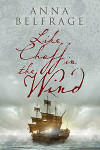
Like Chaff In The Wind is the second book in the Graham series, and, it must be said, a strong step up from the previous book. Belfrage has expanded on her topic, filling it with events and complexities that make it more gripping than A Rip In The Veil, and whilst there are still issues there’s the suggestion that any further books will continue to build on these new strengths.
One of the biggest reasons this novel succeeds is Mrs Gordon, who provides a nice balance to the main two, being less impulsive, a winner of hearts for good reason, and realistic. Indeed the character development in this book is much better overall; although Alex and Matthew are of course the same people, the reader gets a lot more information about them. It is thus a lot easier to appreciate them.
Where A Rip In The Veil spent little time in the 21st century, Like Chaff In The Wind hands the period a good portion of space. Belfrage answers questions and allows the ‘younger’ family to become important in their own right. And just when you think she might let it peter out again she dives straight back into the fantasy to produce a plot point that is welcome, fitting, and appealing. Speaking of time, more characters get to hear of Alex’s background, which inevitably makes matters more interesting and fun.
This writing, too, is better, however here we come to the negative aspects. The book suffers from many of the problems the previous book did. The characters still end questions with “no?”, when it doesn’t fit their overall usage of English, and there is a vast amount of editing and grammatical errors that detract from the story. There is also a lack of spacing between some scenes, meaning that you may need to pause for a moment so that the sudden jump in situations doesn’t feel so wrong (because with adequate spacing it wouldn’t, normally).
The plot is strong on the whole, but it does follow the basic pattern of violence, argument, sex. Again there is a lot of violence and a lot of sex, and again one must try to suspend beliefs in the way this 21st century British woman acts in a society of male domination. This copious violence and sex take precedent; the reader will have to decide whether the family feud, considering the years covered in the book, isn’t going on a bit too long given the back and forth of the vengeance.
But overall, Like Chaff In The Wind is a major progression. The characters are memorable, the time travel is exciting, and the good use of history is continued. There are problems but its hard to say that the book isn’t enjoyable. If the reader deems it possible to start with the second book that is perhaps recommended, but either way you might find here a story to love.
I received this book for review from the author for Historical Fiction Virtual Author Tours.
Related Books