




Guest Post: The Lending Conundrum, A Continuation
Posted 29th July 2013
Category: Chit-Chat Genres: N/A
6 Comments
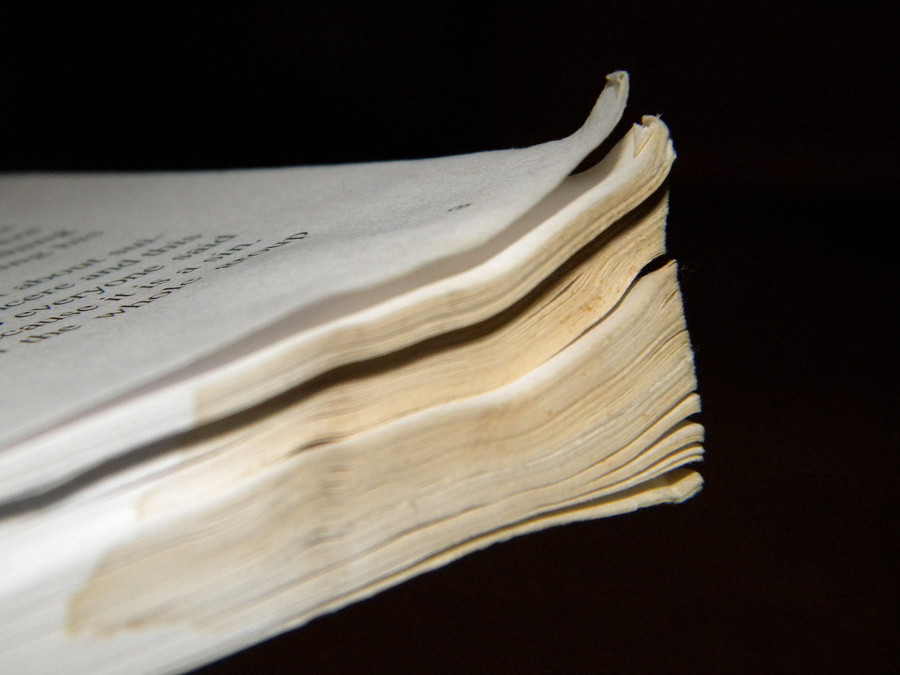
This photograph was taken by xkrissti.
Charlie posted recently on lending books, and it got me thinking about what books I would lend and what sort of state they are in.
I can be a picky lender; while I will enthuse endlessly about a novel, whether I will lend a book really depends on the person I am giving it to. I have been burnt in the past; I once lent three books to a friend and then never saw them again. Now, my lending requires a level of trust, or enthusiasm on the part of the lend-ee.
When I lend books I do not want them to be returned food stained, wrinkled, or watermarked. I would never bend the spine or fold the corners of someone else’s book, and I expect the same conditions to apply to my own lending. But, with some of my books looking particularly well read, can this standard be assumed?
It got me contemplating further, how do I treat my books?
I like a well read book; I don’t mind spine bending, folded corners, or annotated pages, as long as this is under my control. I’ll happily buy a damaged second hand book, because I feel as if I am seeing how much its previous owner enjoyed it. However, I know I am a scruffy reader, and a lot of the readers I know like their books in pristine condition.
With one standard for lending and another for myself, it appears I like to know visually how I enjoyed a book I have read. I do not need a book to be neat, rumpled pages are a sign of appreciation. I own a battered copy of Persuasion by Jane Austen that I borrowed off my mother years ago, and I adore how well loved it looks. So many people have read and enjoyed it – it tells a visual story about a shared love of reading.
Does this make me a fickle beast, difficult to understand, yes, but it is not purposeful.
Are you a book batterer, pristine reader, or somewhere in between?

Alice lives her life betwixt a daydream of books, interesting things, silliness, melodrama and a bleak, bleak reality. Blogging at ofbooks.org, she wanders literary pastures in search of the next good book. Follow her Twitter account, @nomoreparades, for further inter-silly-melo-bleak-book randomness.
Viewing Books As Separate From Their Authors: A Discussion Of Both Sides
Posted 8th July 2013
Category: Chit-Chat Genres: N/A
8 Comments

This photograph was taken by John Burke (no longer on Flickr).
I have always taken issue with the idea that you’re supposed to view a book as a single entity rather than in conjunction with the author. I do see the reasoning behind it – for example one could make some disturbing assumptions about writers of crime fiction if you focused on the connections – but I cannot, in most cases, accept the notion.
To use a rather obvious and perhaps extreme example, one cannot separate Charlotte Brontë’s work from Charlotte Brontë herself without leaving lots of questions unanswered and the reader very confused. Most apparent in Villette, the hatred of Lucy Snowe of Catholicism leaves no room for doubt no matter how much or little you know of Brontë – the author’s own hatred of Catholicism is the catalyst for Lucy’s feelings. Separating author and text here would severely limit the discussion and the study one could undertake into the work. And surely such discussions are of paramount importance in literature classes. Whole lessons revolve around themes and how they relate to the author’s background, and in this not only are you learning about literature but history and society as well.
Writers are told to write what they know. If they write what they know, then surely we should be putting two and two together. Though of course there is an issue in doing so when this ‘knowing’ comes from hours of research. Research creates a fuzzy line between knowing and not knowing. When using research, a writer is writing what they know, but they only know it because they specifically researched it in order to write the book in question. Perhaps research could be considered a crafty way of getting around the ‘know’ advice, but then there would be a whole heap of problems in literature if there was no research, no matter the works being non-fictional or fictional.
My last point is ironically the one most in opposition to viewing a book in conjunction with its author. If we view every book as part of the author then we would severely limit what the author would be comfortable writing. If we saw a work as being so important to the author in a particularly intimate way, then few would write about controversial points of view they do not actually share themselves, and there would be no fun in fiction. People would be wary of Charlaine Harris by default1, no one would ever sit down for fear they were encroaching on Aimee Bender’s personal space2, and Eloisa James would find voicemails from her doctor concerned about her bare-handed cowpat discus3. These are of course, again, extreme examples, but the idea should be clear. If everything an author wrote was looked at as the ultimate extension of themselves there would be fewer books, fewer subjects, and less to discuss. Not every author would worry, indeed maybe most would shrug their shoulders and continue writing despite the ‘silly’ readers, but there would be a shift in the literary world.
These reasons are why we cannot afford to throw a blanket over the notion – whichever way it fell. It is, I believe, impossible to view a book as separate from its author, just as much as it’s impossible to take everything as an indication of the author’s self. There must be a careful balance, a case-by-case review, every book examined to see which is appropriate.
But I cannot agree with the assertion that books should be viewed as a single separate entity each and every time.
1 Harris writes about vampires.
2 Aimee Bender’s The Particular Sadness Of Lemon Cake includes people turning into chairs.
3 Desperate Duchesses features the hero and heroine throwing cowpats in a field.
What’s your take on this subject?
My Experience With The Kobo Glo
Posted 26th June 2013
Category: Chit-Chat Genres: N/A
7 Comments

I thought it might be an idea to talk about the Kobo Glo now that I’ve been using it for a couple of months. I’ve read approximately 5 books on it so far, so I suppose you can call it a success, but in my previous post I was inevitably positive and hadn’t really used it yet.
Now I have, and I have to say that despite the fact I’ve since updated the software, it is still very slow. I believe opening books may have become quicker, however that could just be the psychological effect of assuming an update ought to have fixed issues.
A note on this update is required. Originally I hadn’t planned to update the device but was forced to a few weeks ago after signing out of my account caused the device to reset itself. This doesn’t appear to be a bug, rather it’s Kobo’s method of enabling multiple users. But it’s downright shoddy to force the user to set up the device from scratch on sign out.
One of the reasons I got the Glo was the advertised ability to read PDFs. I say ‘advertised’ because reading the format is a pain. Because you can’t resize text for PDFs, many files are impossible to use – who wants to spend their reading time squinting at minuscule text? It’s not Kobo’s fault per se, it’s the publishers who continue to use a format that was never meant for small screens, but Kobo should make it obvious that being able to use PDFs is not the same as being able to read them when it comes to their ereader. Yes, you can zoom in and switch to landscape view, but that makes reading an incredible chore. (The photo shows the contents page of a PDF, which is contrasted with the page count font size. For source reasons I ought to say the book is The Underground Witch.)
Epubs work well but bottom margins can be awful. You’ll often have a single short paragraph and then the rest of the screen will be blank. I realise this might sometimes be a case of writers using gaps to signal a scene change but when I’ve smelt a rat and checked the file on a desktop application, the text runs on smoothly. Kobo created their own format, kepub, which seems to be one of the culprits, but most of my experiences have been with proper epubs.
All said, the reading experience is okay as long as your file works. I don’t use annotations, partly because of the snail pace, but pages turn quickly enough, the device is light weight with plenty of space to hold it comfortably without covering the screen, and the light is useful for gloomy British summers. You can’t turn off the page count at the bottom which is a pity, though the good thing about the count is that it tends to provide you with the page number according to the book itself (the print edition I assume), rather than the count according to how your settings affect the text. And of course you have the percentage read on shut down (which balances out the page counting options). You can also see how much you’ve read in percentage form by opening up the book menu (via tapping the centre of the screen – the top bar shows the time followed by the percentage read).
Due to the kepub debate – I’m unconvinced Kobo isn’t still changing books they’ve received from the publishers – I wouldn’t recommend buying ebooks from them.
To summarise, the Kobo Glo is good, and certainly I like it, but it has many flaws. I would recommend it in general – especially considering it takes books from a range of sellers – but with the information that it can be frustrating at times.
Would you try the Glo? Or, if you already have one, do you like it?
Subscribe to this site via email and you’ll receive 3 posts a week. If you use Gmail, you may find the posts are stored in your ‘social’ or ‘promotions’ tab.
On The Pressure Created By Lending And Sharing Your Favourite Books
Posted 24th June 2013
Category: Chit-Chat Genres: N/A
11 Comments

When writing my general discussion post about lending, I realised there was a whole other subject involved that deserved it’s own piece.
There is just something different about lending a favourite book compared to lending a book you aren’t so keen on or are yet to read. As I said last time, it feels worse if someone doesn’t like a book you lent that you love, because it’s almost a personal affront.
There is likely more pressure on the receiver’s end, too. If you know the book you’re borrowing is your friend’s favourite, you’re more likely to make more effort to read and hopefully enjoy it. You’ll try to read as much of it as you can stand, even if you hate it. Either that or it feels easier to be dishonest and say you’re reading it, even if in actuality you speak the truth and tell them it wasn’t a good match. It’s rather like when you’re gifted your own copy. I gave Pride And Prejudice to my mother and she spent an age over three chapters. When I asked about it she said it wasn’t for her but she was keen to let me know she’d read those three chapters regardless. I know she felt pressured to try it.
And who doesn’t want to please the person who gave you the book?
Could lending your favourite book ruin a friendship? Not by itself and certainly not unless you lent an edition worth a good deal of money that the person subsequently lost. But if you lend your favourite book and your friend dislikes it, that’s a small sign of difference. And if you love books and it happens often you might find you’re not as compatible as you thought, that the discussions each of you want to have do not match often enough.
To end this post I’m going to speak of something that happened early on in my relationship.
This is a particularly personal experience to recount because my boyfriend’s favourite books are those of his ex-girlfriend. She had introduced him to them. I received the books (a series) as a gift one Christmas, something we’d already discussed, and to be honest it would have been difficult to even consider not giving them a go (in part because the genre is one I enjoy). But of course with the books being a legacy of sorts, I did feel pressure to enjoy them. I felt the want to please. I think most people see the goodness in not being negative of a partner’s past relationships, especially if there is nothing to speak of anyway. But still I did feel pressure and, good books or not, it was an awkward situation. In a way it still is, even if I’ve happily incorporated the books into my reading and do enjoy them a lot.
It’s personal, it feels a lot like you’re giving a part of yourself to the other person, and it is so different to recommending a book you’ve not read. No one’s going to stop lending because of it, but it’s a concept worth thinking about.
Over to you – how do you feel about lending favourites?
On Lending Books To Others
Posted 17th June 2013
Category: Chit-Chat Genres: N/A
13 Comments
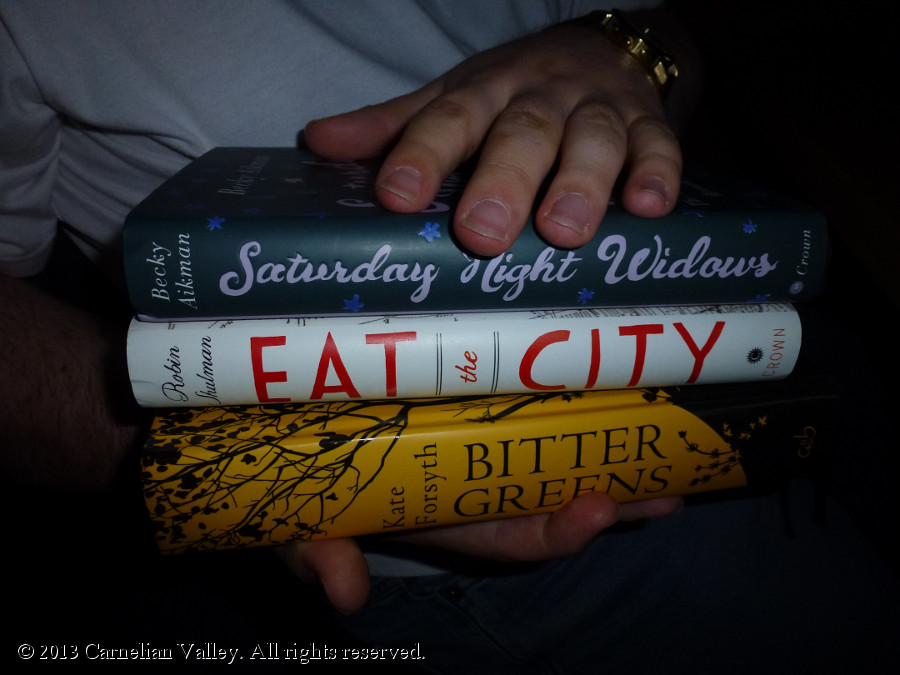
I rarely lend my books to anyone. Although I’m not overly concerned about the overall condition of books as Jamie has discussed, once I have a book, if it was new and in a fair condition, I’m loathed to lend it.
I like my books to stay in a good condition. I’m one of those people who try not to bend spines or cause those crinkles on front covers (inevitably it happens sometimes). I am less worried about hardbacks (hence the choice of books for the photograph), but then they do have dust covers.
Here I must admit that in the past I haven’t taken care of others’ books. If I’m to present myself as such a perfectionist it stands to reason that I should be honest. At school I let a friend’s book – given to her for review nonetheless – become creased, and with another book I let the edge get bent.
Yet for all this I have a second reason that is just as ‘important’ – I fear never getting the books back. Again, it may relate mostly to younger years, but I had a favourite book lost forever when I lent it to someone who lived a few hours drive away. I’ve seen them since, but the book hasn’t been returned. And likewise I am missing CDs and have a broken board game. I could make a rule only to lend books that could easily be replaced, but it’s uncomfortable asking people to pay for losses and I don’t have the money to pay for second copies unless there is a major reason.
Looking at it from an avid reader’s perspective, I can’t help but think that it feels worse when someone didn’t like your recommendation if you lent them the book, than it does if you bought them a copy or they got a copy themselves. It becomes not only an ‘affront’ to your recommendation, but to a beloved possession as well.
In the last several years I have borrowed Pride And Prejudice from my boyfriend’s mother. Reading it caused the start of my love of Austen and I am grateful to have been able to read the pretty old Penguin edition. Being that it belonged to my boyfriend’s mother I was very aware of how I was holding it and so forth, and thankfully returned it in the same condition. I was also lent a battered copy of The Alchemist by a friend who wanted me to read it. It was her favourite book, she was onto her eighth copy, and we had just reconnected. I didn’t have to worry about the condition as she was about to buy number nine, and following my reading I’ve gone on to read Eleven Minutes, Veronika Decides To Die, and Manuscript Found In Accra. Had I not borrowed my friend’s book, I likely would never have read Coelho.
I think, all things considered, I sound a hypocrite, but then I do (at least since my teenage years) treat others’ books how I’d want them to treat mine. I am as fastidious with theirs, and ‘managed’ to lend my spine-breaking boyfriend Pratchett. Being that he’s my boyfriend, it returned in perfect condition. (My copy of Mort, lent to Dad, didn’t fare so well.)
In summary I suppose I lend books to those I’ve vetted, and with reluctance.
How do you go about lending, and lending in conjunction with recommendations?
Today I’m also at Alice’s blog talking about the Relative Worthlessness of Book Lists.


