





How I Choose The Books I Read And Review: Blogging
Posted 24th July 2015
Category: Chit-Chat Genres: N/A
4 Comments

This was a question we were asked at the RNA conference and I’d like to expand and answer it here. I believe I pointed to blog tours, my mood, and expectations as to the tone of my review at the panel, but of course that’s the simple version and perhaps not particularly informative.
There are two stages when it comes to choosing what books I will read. (In this post I’m dealing with books I read purely with the intention to review – tours – and books I know I’m likely to review, rather than those I don’t plan to review. I do on occasion read knowing I won’t be reviewing, for example books that are special to the people who gave them to me.)
The two stages are what I want to read and review for me, and what I want to read and review specifically in terms of my blog. A choice is usually the result of both these stages. In the context of myself it’s about what I fancy reading at that moment or simply what I’m interested in. I won’t always follow what I fancy, books can surprise you and the concept of not knowing what you want until you’ve found it applies to literature, but it’s good to read what you fancy when you can. In the context of the blog it’s about promoting authors I like, picking books I think my readers will enjoy too, and it can also include choosing what others are reading so I can join in the discussion. As said, my choices are usually a combination of stages and for me those combined choices are the best. I love knowing a book is one I really want to read that will also do well in terms of my blog. In regards to The Worm Hole, good combination books span genres and eras. They are books I’m inclined to write a lot about and that fellow bloggers have written a lot about. And I absolutely love that classics are important in this way because they fill me with literary pleasure.
Those are the general stages: what about the questions I ask myself? I consider time: how much time will it take me to read the book – how long is it? If it’s long I may put it aside if I’ve not posted a review for a while. I don’t believe a book blog has to include reviews but I like to write a variety of posts when I can; review after review after review doesn’t work for me as a blogger and such a schedule in the past has been the result of either a mass reading session or a lack of ideas/planning time for other content. The question of time also includes how long a review might take to write – is this book full of themes I’m likely to want to cover in depth?
Does the genre and, more specifically, the story, appeal to me right now? This comes under the personal stage but I’ll also consider genre if I’ve been going through a phase of it on the blog and feel it’s time to change. I value the ‘literature in general’ vibe I’ve got here. I can’t imagine ever narrowing my blog down for the very fact that I like to read every genre.
Is a sample available? If I can tell from the outset that I’ll neither enjoy nor be able to speak well about the book at all I won’t choose it. Negative reviews here are the result of books that start well but later fall flat; I see no point in reading books I know I won’t enjoy unless it’s for a particular reason, for example I read Fifty Shades Of Grey so that I could discuss it. Similarly I’ll finish off a series I’d enjoyed in the past if I’m invested in it and want to know how it ends.
And that’s it, on a blogging and on a personal level, that’s my thought process. It’s slightly more involved when it comes to books I receive for review; I’ll be discussing that next week.
How do you choose the books you read? If you review, add this context as well.
On Impact And Remembrance
Posted 24th June 2015
Category: Chit-Chat Genres: N/A
7 Comments
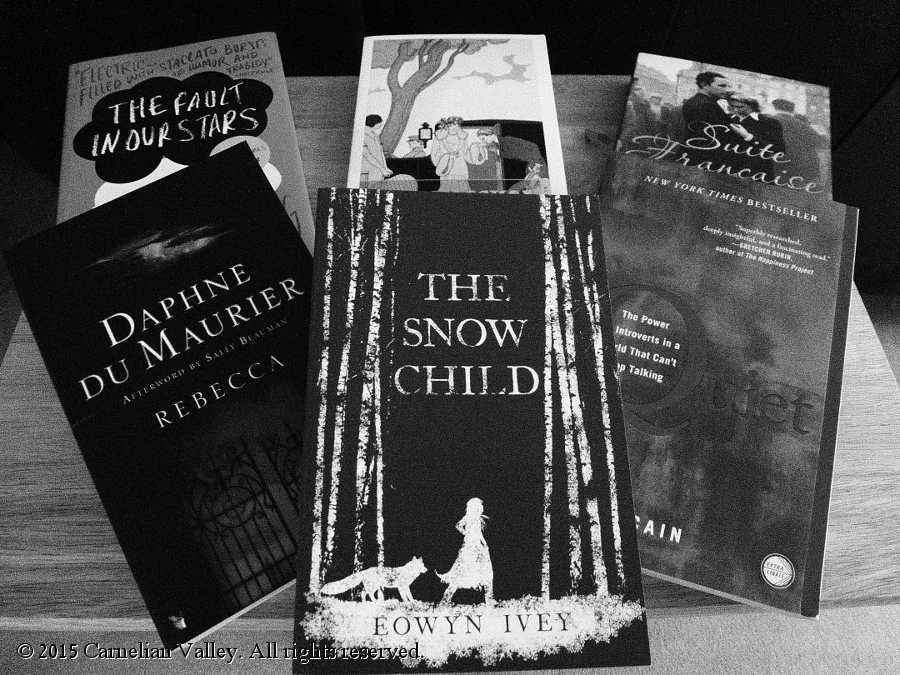
If I don’t remember a book’s impact on me any more, surely it didn’t deserve the (high) rating I gave it. I’m paraphrasing a comment Alice made here a while back – the sentiment has stayed with me. I like the thought and think it worthy of some consideration. It makes me wonder: does a book have to have a lasting impact? What about the various ‘sorts’ of impacts?
I’m of the opinion that it depends on the type of book, the point of the book. Chick-lit, for example, is often about the here and now, your enjoyment of the book as you read it. It’s predictable; that’s okay. It may not have a lasting impact so to speak; that’s okay. However enjoyment itself can be a lasting impact – it can make us want to read more by the author and to read more in the same genre; and even if we weren’t reading for studious purposes we may find something we want to research.
And the point of some books can be the ride, the fun of it. It’s that that we take away from some books, our recommendation. I’ve Taylor Stevens’ The Doll in mind. There are social issues in it but it’s the pacing you take away with you, the ride, the adrenaline. It’s rather like a thriller film.
This is the crunch of it – yes, I can remember a fair amount about Stevens’ novel but then I read it only last year. I expect it won’t be as clear in the future. What will remain will be the experience and that’ll be strong enough for me to carry on saying it’s a 5-star read.
Ambiguous endings – that is, endings that are ambiguous for good reason – almost always have a lasting impact; you mull over the contents trying to work them out. One could speculate some are created for that very purpose. You’re going to remember that ending, the sentiment. It’ll likely outlive your memory of the rest of the book. I’d say some ambiguous endings, particularly those that don’t work or make ‘writing sense’, have been written to provoke a better reaction and impact than the book may otherwise have had.
It may be more the feeling or the lesson that you remember and again, that could be the point. Having recently finished The Awakening I can say I’m likely to remember the point more than the specifics of the story. I remember the thoughts of The Secrets Of The Jin-Shei – pressure, a society where the women are the leaders – but other than a couple of scenes I don’t remember the written content. Northern Lights: the sentiment, and the way Pullman includes souls – and I’ve read it twice. On Gold Mountain: the feeling of a good book, an interesting family.
I think it does come down to impact, the type of impact. Stating that there can be various types and that some are more important or more crucial than others is, I think, key.
What do you think?
Far From The Madd(en)ing Crowd
Posted 12th June 2015
Category: Chit-Chat Genres: N/A
9 Comments

In my teens I decided I would never read Far From The Madding Crowd. We had studied it in English Lit, read only half together, and that was enough for me. It bored me greatly, as did the old TV adaptation we watched. (I’m not sure we finished that either but it was the reason for one of my most prominent memories – my teacher pausing the tape to comment on the swoon-worthy eyes of an actor.) This was a book I was uninterested in and couldn’t relate to. For years the name of it made me recall old, tattered, laminated green paperbacks.
Even when I started getting into classics on my own steam I had no mind to read it. I still remembered the boredom, the way I’ve never liked Juliet Stevenson because I remembered, wrongly, that she’d played Bathsheba (it was actually Julie Christie).
But I have a burgeoning love for Carey Mulligan; I watched the trailer for the new adaptation. I read an article which laughed at Katniss sharing Bathsheba’s surname and spoke of the latter’s agency. I read The Awakening.
So, I’m afraid, I’m going to have to disappoint my teenage self. Dear teenage me, I have a copy – nice, not laminated – of that book and I intend to read it, all of it. I’m going against your decision but with good reason.
It was the wrong time before; I’m old enough now. I’m looking forward to the book I used to hate.
Have you avoided any books due to English Lit classes? And did you give them another go later on/do you plan to?
The Balance Between Christian And Secular Romance
Posted 22nd May 2015
Category: Chit-Chat Genres: N/A
1 Comment
As you may know, I’ve been giving inspirational (Christian) romance a try. It is a genre that’s particularly prevalent online and I wanted to broaden my horizons. I was interested in seeing how they ‘work’ – the differences; it made sense to choose romance because I know a fair amount about the romance genre (ironically, as I read romance because of a previous broadening horizons project) and it’s easy to find Christian romances.
I can’t say I’ve read a lot of Christian romance; I’ve found it’s something I’d like to limit in my reading, but I’d say I’ve read enough to write this post.
This post comes from my questioning the gap between Christian and, for lack of a better word, secular romance. Secular romances have no/rare references to religion. Perhaps a historical will talk of church but not in depth. Christian romance uses religion, faith in God and Jesus, as a theme. What has struck me is the lack of fiction that fills the gap. By this I mean there are few romances wherein characters have faith but it’s just a part of their life rather than a theme of the book. Perhaps they go to church or pray before bed but it doesn’t inform many choices and isn’t written in detail. I feel romance is missing that, especially as I think it’s fair to say many people have a faith but wouldn’t consider themselves religious. To me it would seem normal to have such a book, for faith to be there but more in the background than it can be in inspirational romances.
It’s appropriate here to say I’ve noticed this partly thanks to Janet’s article on a similar theme. Janet wonders about romances that look at faith and/or values, morals. I agree with her sentiment that it would be nice to have more books wherein characters made choices based on their morals and that such books wouldn’t have to be a separate genre.
I’ve read both books where religion is included to an unnatural degree (in view of what I see in mainstream culture), and books in which it reads well, however even those that read well are of course subject to chastity. I have absolutely no problem with chastity if that’s what the author wants, but it’d be nice to see faith in a book that includes sex, too.
I have read such a book, and there is such an author. In Noelle Adams’ Married For Christmas, which the author notes is not inspirational, the characters are Christian, and there are sex scenes included in the required context of marriage. I’ll admit I wasn’t a fan of the book in general however this element was done well. But the fact that one character is a minister does mean that even if it’s getting there, it’s still not quite filling the gap.
I will readily admit that I realise part of the reason it seems, to me, religion is shoehorned in is because of the differences between American and British Christian culture, at least in the context of inspirational romance. Of course there are varying levels and sects in both places, but the devotion in American Christian fiction is not something I can relate to culturally. (I’ve not had experience of all the denominations but living in a country you obviously get a general feel for the religious culture.) Yet at the same time the extent I sometimes see religion included, and the way so many people actively avoid inspirational fiction, surely means a lot is the same across the borders. (I know my knowledge of American Christianity has been influenced by what I see and read; I’ve not witnessed it first-hand.)
To go back to my point, then, and to put my thoughts on culture into context, it seems to me that too often faith, in particularly religious faith, is included where it ‘shouldn’t’ be, at least from the perspective of the mainstream. It’s often obvious from the blurb if this will be the case, but not always. A prime example is The Butterfly And The Violin. It’s a nice story but I found the extent to which Christianity was included inappropriate for a novel set in Auschwitz. The religion overtook the Holocaust.
In contrast there is Erica Vetsch’s work (A Bride’s Portrait Of Dodge City, Kansas). I feel Vetsch is on the cusp of the balance, in a different way to Adams. Whilst there are a couple of places where religion sticks out, for example a character wanting to proclaim his faith to his boss at random, otherwise the religion is subtle. It’s included from the start but it’s in the background, the characters may discuss it but it reads as natural – people share interests so why not talk about their beliefs, too? And it of course informs the sexual content – kisses only. Vetsch is pretty good at showing you can have plenty of chemistry in a book without including sex.
So Vetsch is on the cusp but there is still that place Adams inhabits where faith in a book doesn’t rule out sex (when considering married couples if that’s what fits). There’s the place for fiction wherein people wait until marriage without faith being the backbone of the story (or being there at all), there’s the place for faith being part of a character just because it’s reality, and so forth. (I focus on sex and faith here because of the whole ‘clean read’ idea – a book doesn’t have to be clean to deal with faith.)
What I think is fascinating is that we don’t have this prevalence, at least not in English-language romance, with other religions. You’re going to see more of the traditionally western religions; I think there’s more hesitation to pick up Christian books than books that include other religions. But I can’t help but think that a Hindu romance, for example, would be better received as a whole. Perhaps it’s the ‘exotic’ factor or even the way people view a religion that isn’t theirs (thinking white perspective here) or that doesn’t come with the baggage of being something they turned away from, but there’s something. I also think, however, that it could be the way other religions have remained a part of the overall culture of those who follow them, which is something Christianity, in the main, has lost. There is also a learning factor. For many a book including Hinduism would mean a chance to broaden horizons. A Christian book would be reading what you may have been brought up with, or brought up near, and had enough of. Of course this is all from my white western perspective – I’d be interested to know how those of other ethnicities and religions view Christian fiction as well as hearing from Christians of a non-western background.
I’m likely to stay on the lookout for balanced romance and make a point of reading those I find, whilst acknowledging inspirational romance sometimes fits the bill and reading a couple of them. I would love to see more balance not just in romance and without a new genre being created – I think it’s as natural to include faith from time to time as it is to be diverse in general. Faith can be as much a part of a person’s identity as ability and sexuality.
Your thoughts are very welcome.
How To Order Surnames
Posted 15th May 2015
Category: Chit-Chat Genres: N/A
6 Comments

I thought I’d use today to compile my research on a topic I expect a few of you might appreciate – how to order surnames that aren’t your stereotypical spellings, in other words your Mcs, Vans and O’s. I know I’ve had trouble deciding where to place them and have opted to go with the flow, but here is what I’ve discovered:
- Mac and Mc are traditional patronymics; both mean ‘son of’. Mc is essentially the same as Mac and should be treated as though it has an invisible ‘a’. Both Mac and Mc should come before any surnames that start with ‘Mad’.
- Van or Von, if not capitalised by the person (look at the book cover), should not be treated as part of the surname. If they are capitalised they come before the surname and affect ordering.
- D’ – ordering depends on the next letter of the name.
- O’ – ignore the apostrophe when ordering.
- De, Le, Du – These are more open to personal interpretation. De – before surname when the surname has only one syllable. Du – under ‘du’, though most people will put ‘Du Maurier’ under M. All are usually written as lower case. The issue with ‘de’ and ‘le’ and ‘du’ is that you need to consider the person’s preference which of course may be difficult to ascertain. It also depends on the language you’re dealing with as well as the nationality. Spain may view ‘de’ differently to France, for example, and an inherently British person with a French surname may view it differently than a French person who shares it with them.
- Double barrelled surnames, if hyphenated, should go under the first of the two names. If not hyphenated they go under the second. Check the hyphens and remember that some names may actually be the middle names.
I’ll end here on that preference: if all else fails, check the Internet and opt for the most commonly used. Even if not technically correct, you’re less likely to confuse your own readers.
How do you order your shelves?


