




Starting With The ‘Right’ Book
Posted 5th August 2016
Category: Chit-Chat Genres: N/A
10 Comments

Do you ever have occasions where there’s a book you feel you should be starting with, when it comes to your first book of a particular author, and if you get another book of theirs instead you just can’t get past that feeling?
There have been times when I’ve had a deep-rooted feeling I should be starting with a certain book but then, for whatever reason (the bookshop didn’t have it and I was impatient, for example), I get another… and then I can’t start it because it’s not the ‘right’ book. Even if other readers say it’s an excellent choice. When or if I push past the feeling, I often end up disliking it. More and more I find myself just putting the second choice to the side until I get the one I really wanted; experience has taught me it’s generally best to wait.
I think personal intuition in this regard is something to trust. If, for whatever reason, a particular title has grabbed you, as long as the book isn’t difficult to get you should follow it. I often find it’s easier to finish a book I’ve read for this reason even if I end up not liking it, than it is to finish another I read in lieu of it.
Two situations got me thinking about this – the first you may well know: I questioned with which book I should begin my journey into Haruki Murakami’s work, despite very much feeling I ought to opt for Norwegian Wood. I don’t know why it’s that one – it turns out it’s not the cover (the cover’s been changed and I’m still interested). Perhaps it’s the word ‘wood’, that makes me think of nature and the countryside and beauty? All I know is I looked at Kafka On The Shore and though I could tell it was excellent, it just wasn’t happening. (This is apart from my thought that I should read Kafka himself, first, so I had any relevant context behind me.)
I picked Norwegian Wood… though I haven’t read it yet. I’m a bit daunted. It’ll happen soon.
The second situation is recent – Ben Okri’s reading at Hay was fantastic. I’d like to read his work but he’s written a lot more than I’d have guessed. In this case I asked for recommendations but that was before I looked for synopses. When I looked, it was In Arcadia all the way and when I saw it wasn’t available at that time I decided to wait. I wouldn’t be drawn to his Man Booker winner.
This is all in the same vein as that question of timing and being in the mood for certain books. I tend to say that if you can match timing and moods, awesome, but you can’t live your reading life like that constantly. This, though, this ‘correct’, personally-relevant introduction to an author? I think it’s important to get right.
When was the last time you ‘knew’ you should be starting with a certain book but read another instead?
Reading Cause And Effect: Orkney, Neolithic History, And Faroese Literature
Posted 25th July 2016
Category: Chit-Chat Genres: N/A
2 Comments

Reading Amy Liptrot’s The Outrun, I went on one of those rabbit hole reading sprees, so far that when I clicked back from a tab to one of the other many tabs I’d opened, I couldn’t remember how it was related. Then I did remember; I’m recording some of those tentatively-related findings here, too.
Orkney has a lot of Neolithic history to it. There are tombs and homes and a big tourist attraction on the ‘mainland’, Skara Brae, a settlement under the earth made of stones. A lot still remains and there are even items of stone furniture. Coastal erosion in Britain means Skara Brase is now very close to the shore (one hopes it can somehow be saved) but at the time of use it would’ve been fairly inland.
Along with a bit more astronomy, which I won’t detail as I’ve already covered the subject in another post, was fata morgana. Named after the legendary witch, fata morgana is a sort of cloud phenomenon wherein reality is reflected wrongly on the horizon. It changes the look of boats, sometimes making them look airborne, other times making them longer than they are. The blurry mirage changes over a short period of time.

My rabbit hole discovery started with a lack of geographical knowledge – I knew the Orkneys were above Scotland but where were they exactly? Once I’d read enough of Liptrot’s book to have the location to pat (below the Shetlands, not to the west – that’s Skye), and to have learned some of the names (‘mainland’ – capital: Kirkwell – Papay Westray, Stronsay, North Ronaldsay), I started to wonder about the islands more… northerly. Beyond, or above, however it should be termed, the Shetlands, come the Faroe Islands.
The Islands are more populated than the Shetlands and are considered part of Denmark. I liked the photographs of the cities and towns but what interested me most was the article on Faroese literature. The islands have been populated for centuries so stories are not new. In medieval times stories were passed down orally; traditional songs were finally written down in the 1800s.
Faroese literature, in the way we use ‘literature’ now, has been around for the last 100-200 years, which Wikipedia says is down both to the isolation of the islands and to the local language not being standardised until 1890. As with many tales of history, the ruling country’s language was promoted more. The Wikipedia page is quite something, have a look at the chronology!
Of the Danish-language contingent, famous authors include one William Heinesen who wrote a book called The Black Cauldron – from what I’ve read it seems the most likely of his works to be recognised overseas. Looking at Heinesen, who was born at the turn of the nineteenth century and lived to 91, we have someone who wrote about the capital of Faroe, Tórshavn, and placed it at the heart of his work. He wrote about destruction and creativity, about contrasts. Britannica says, ‘he combined elements of tragedy, comedy, satire, allegory, and social criticism to explore such themes as the harshness of nature and the rights of the individual as opposed to the collective good’. He rejected his nomination for the Nobel Prize as he believed it would be better to give it to a Faroese writer who wrote in the language of the islands – “If it had been given to me, it would have gone to an author who writes in Danish, and in consequence Faroese efforts to create an independent culture would have been dealt a blow”. Considering he was restricted in his language choice at the time, having to write in Danish, I think it’s a particularly awesome gesture. (The Prize went to Elias Canetti, a Bulgarian Brit who wrote in German.) Heinesen’s house on Faroe has been turned into a museum; perhaps due to his relatively recent passing it remains largely unchanged.
Bárður Oskarsson, whose name has an accent in it I’ve never seen before but I hope I’ve rendered it correctly, is a children’s writer and illustrator from our present day. He started out as the illustrator for his grandfather’s children’s book which is pretty awesome, I reckon, and kept on illustrating for a while before starting to write himself. The New York Times called a recent release “a quietly profound new picture book… about the question of how to react to the death of a stranger”. From the image included and the dollar amount at the bottom, it would seem that contrary to the Wikipedia page, Oskarsson’s work is being translated into English. Of this book, The Flat Rabbit (or Flata Kaninin) Norden says “about ethics and responsibility in a sensitive and compelling way. The subject of the book is akin to Antigone and The Iliad and the challenge is to take care of the dead body of a loved one, even though there is great risk involved”.
Oskarsson’s most famous book is Ein Hundur, Ein Ketta Og Ein Mús, A Dog, A Cat, And A Mouse.
Heðin Brú is another writer with a fair backlist. Older that Oskarsson (Brú died in 1987), this writer is considered the most important of his generation. The Old Man And His Sons (Feðgar aacute; Ferð) is his most famous work, published in 1940 and translated into English in the 70s. Brú also worked as a translator, bringing to Faroe Shakespeare, Ibsen, Dostoevsky and Lindgren amongst others.
Teacher Marianna Debes Dahl has written novels and short stories but seems not to have released any work for some years now. Marjun Syderbø Kjelnæs has been pretty prolific, publishing 17 novels, short stories, and plays since 2000. She has collaborated with musician Eivør Pálsdóttir.
So of course after that I started reading about Faroese music; it was quite a lesson overall.
What have you learned lately because of reading?
Guest Post: Antarctica – Harsh Beauty in a Fragile Landscape
Posted 22nd July 2016
Category: Chit-Chat Genres: N/A
2 Comments
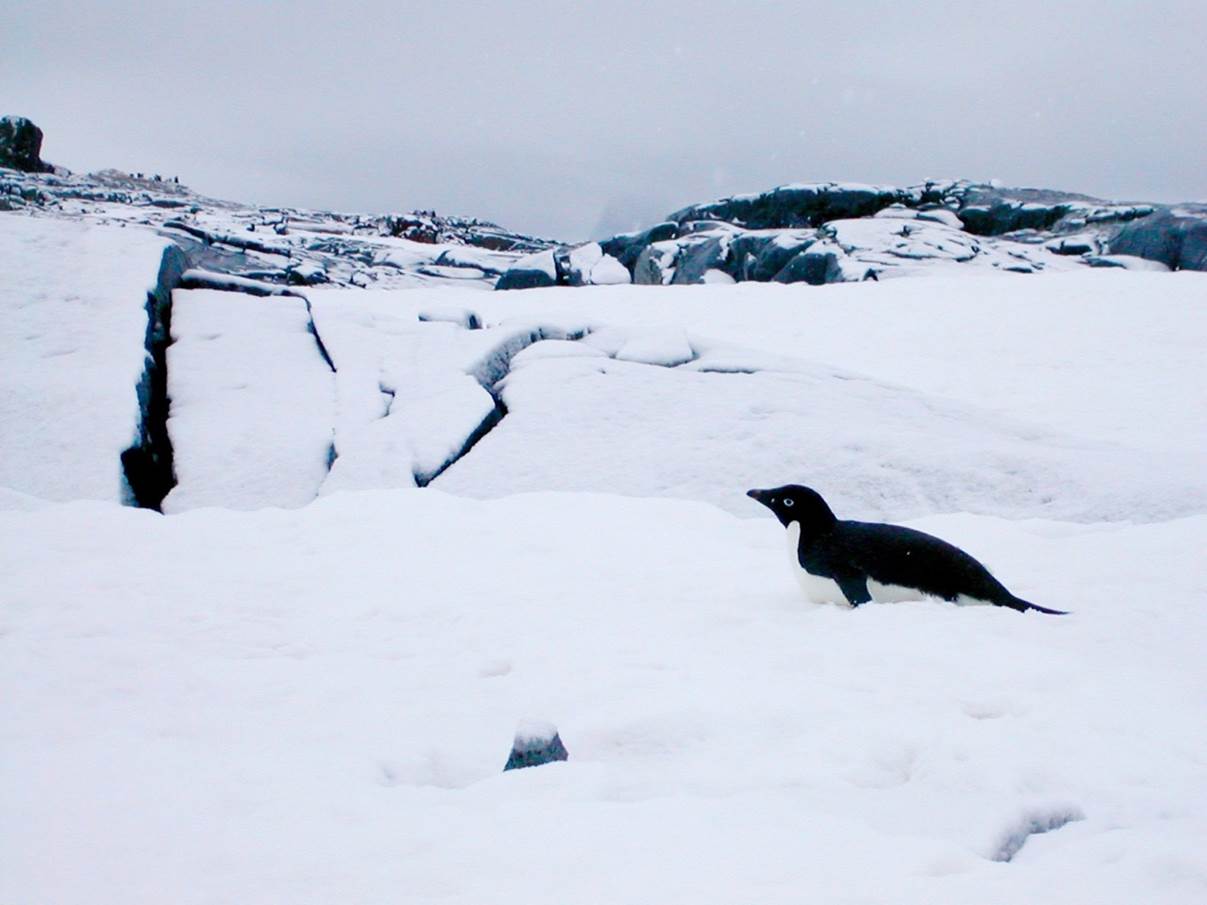
Midge Raymond’s book, The Last Continent, which I’ll be reviewing next week, is full of information about Antarctica that, reading her story as well as a couple of articles she had written (I like to research books when possible) led to questions. Chief of these is how Raymond came to know about Antarctica and why she chose to write about it. I’m happy to welcome her to talk on the subject today as an introduction before we get to the book itself. (Photographs courtesy of the author.)
The Last Continent was inspired by my own visit to Antarctica more than a decade ago, on a small expedition ship very much like the Cormorant in the novel. During the journey, two things stuck with me. One was the concern of the shipboard naturalists about the larger cruise ships, carrying thousands of passengers, that were venturing farther and farther south, which was troubling to them because if something were to happen to one of those ships, rescuers could be days away. Given the extreme weather conditions and the distance from hospitals, this is an incredible risk. So I began to wonder what a catastrophic shipwreck in this region would look like.
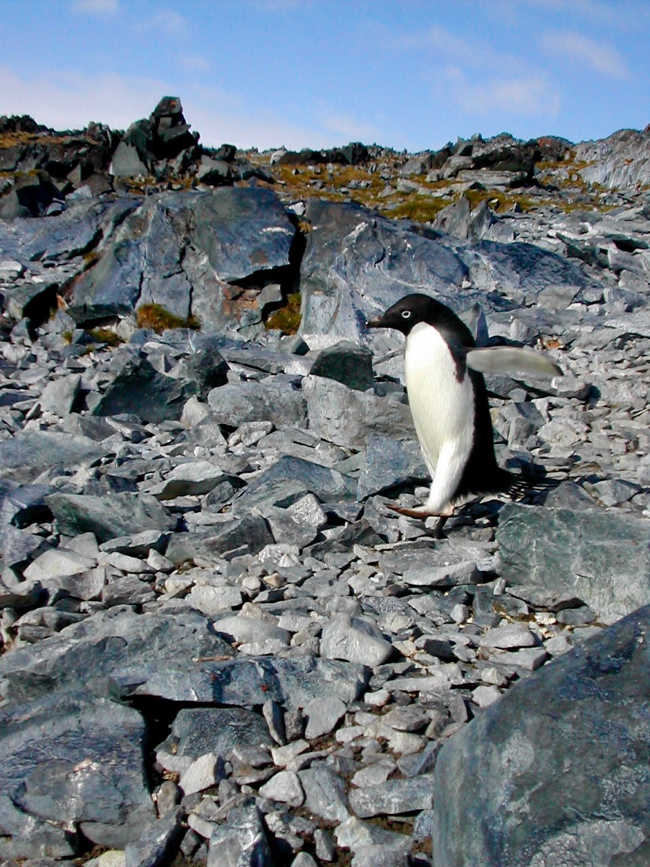
The other thing that stuck with me was seeing a fellow passenger fall on the ice near a penguin colony. He got right up and was perfectly fine – but seeing this happen reinforced the notion that, at the bottom of the world, you are at the mercy of the conditions and of the few people who are with you.
And of course, the beauty of Antarctica and its wildlife affected me deeply, especially the penguins and their fight for survival as the climate warms. Due to warming oceans as well as over-fishing, penguins have to travel farther for food, which puts them at risk and also means that, during the breeding season, they may not make it back in time to feed their hungry chicks. The storms caused by climate change can also freeze eggs or drown young chicks who don’t have the insulation adult penguins do.
Among the many reasons I wrote The Last Continent was to show how much Antarctica needs our attention and protection. It’s an icy wonderland that is unlike any place else on the planet, and it needs humans to understand its importance and to ensure it doesn’t melt away.
Have you read any books set in/about Antarctica?

Midge Raymond’s previous work includes two books about becoming an author; she has also written short stories. Her twitter handle is @MidgeRaymond.
“Anyone Who Claims Not To Like Reading Just Hasn’t Found The Right Book Yet”
Posted 20th July 2016
Category: Chit-Chat Genres: N/A
9 Comments

I found this exact phrasing here, though of course it’s a well-known thought. Slightly controversial, too. I thought we could have a discussion.
(Speaking of the particular phrasing, the word ‘claims’ suggests the person can’t believe it. This is also the case with ‘just’ and ‘yet’ – it’ll happen eventually for the hypothetical non-reader; they’ll start reading at some point.)
My thought is that it’s easy for a reader to say such a thing because it’s their (and my, your) hobby. It can be hard to see why others dislike it. Personally, whilst I do see both sides I must admit that I once found it difficult to be friends with a person who said they had never read a book. Ever. Admittedly – again – this person and I just weren’t suited overall but the idea they’d never tried to read a book was hard for me to get my head around. I’m not sure I believed they’d truly never read a book, ever, but on that occasion, at least, it proved a deal breaker. At that point in my life, my teen years, I could be friends with someone who wasn’t a reader but a person who had never read a book at all and had no plans to change that was a bit too foreign.
But, this said, as said, I see both sides. The case for it not being true – that a person just hasn’t found the right book – is simple. Reading is an activity like any other. Some like it, some don’t. And I think in the majority of cases, when a person says they don’t like reading, it’s the physical act they’re referring to. The silence, the solitude, maybe the form of the written word itself. The person on the other end of this statement, the reader, is baffled because they’re thinking more of the escape and stories. Readers like the physical act but the most pervasive part is surely the story. And the most pervasive reason to not be a reader is surely dislike of the physical act. tories are like films. Many who don’t like reading do like films, or plays, or music, or games.
A person might not be good at reading, therefore they dislike it. To read would be to slog, a chore when they could be doing something fun. This brings us to the other side of the argument, that the statement is true – there’s such a range of books out there; genre, age, reading level. We could say a person who doesn’t like reading because they find it hard just hasn’t found a book at their level… but then if the person is dyslexic, for example, that might mean a book with a story too young for their age.
Audiobooks? Not all readers listen (I rarely do), so we couldn’t exactly give credence to that as an option; same with graphic novels.
It really depends. We can’t just say ‘yes’ or ‘no’ but we can’t discount the possibility that there’s a book out there for everyone. It’s one of those per person deals – it depends on personal situations.
I disagree with the statement myself because reading, whilst lauded and important, is a hobby – at least in the context of the statement. And the fact it’s deemed unnecessary (when placed against food, water, shelter) puts some people off.
Your thoughts?
“At The End Of A Story Or Novel, You Do Not Want The Reader Thinking”
Posted 15th July 2016
Category: Chit-Chat Genres: N/A
7 Comments

This photograph was taken by aptmetaphor.
This statement can be found here. When I read it, I couldn’t but strongly disagree and whilst I tried to think whether I was wrong, if emotions are always so important in the way suggested (you want the reader feeling instead), I couldn’t say I feel it is so.
What do you think of this? To me there are too many points against it, all falling under a couple of umbrellas, so to speak. Whilst emotions are important, there are too many cases wherein making the reader think at the end is crucial to the success of the story.
Chief to me is obviously the ambiguous ending. An ambiguous ending can aid a book’s longevity and give the reader something to think about. My thought is why on earth should that be a bad thing, or at least inferior to emotions themselves? It concerns comprehension, which the writer could perhaps see as something that detracts from the story (if seen in its academic state) but moreover it gets us talking and often ensures a lasting engagement. In this case, the statements – logic is emotion’s enemy; disarm the reader of logic and make them feel – are problematic because you can have an emotional ambiguous ending that requires logical thinking.
An ending that has to be thought through does not necessarily equate to a lack of emotion. When you have to think through an ending to understand it, the process itself can deliver a series of punches or smiles. Endings about emotions are good, but they aren’t the only way.
What do you think?


