





Why You Should Definitely Not Take Only One Book On Holiday
Posted 12th December 2016
Category: Chit-Chat Genres: N/A
9 Comments

I should have taken more than the one book on holiday. That was my bookish thought as I unpacked once back home. I hadn’t read anything and although it was true I hadn’t had much time to do so – this is Hay we’re talking about, ironically – I do think I might have read more if there had been a choice. It wasn’t the book – I was enjoying Season Of Crimson Blossoms a lot and would recommend it – but something about there being no choice. There is a definite affect on mood when you go on holidays, as you kind of hope, and in these cases it pays to have a choice. And there’s something about knowing you’ve a fall-back book that gets you reading your first choice.
Not too much, but at least a choice of two. It doesn’t matter if you’re enjoying your book; there are a couple of reasons for taking a couple of books – that choice factor, and the possibility you may finish your book and need another. Because one book is a nice thought and easy on the luggage weight but if you find yourself disliking it and your accommodation doesn’t have a book shelf or, heaven forbid, there is nowhere to acquire books, you’ll be stuck. Just don’t take more than 3 at the most unless you’re in for a long haul flight and thus, likely, long holiday.
At the same time, and this is again somewhere I’ve failed, thinking that you can take your one epic-length book is no good unless you’re in a constant state of awe of it. There’s something about epic books and being far away from your bookcase, something that I’ve personally found almost always leads to regret and a sad, preventable, feeling that you want the holiday to be over because you’ve nothing you feel like reading.
I’ve taken two books and done well. I’ve taken more and read nothing. And I’ve taken one and read little.
What do you do when you go on holiday?
This Is (Not) What You Came For
Posted 7th December 2016
Category: Chit-Chat Genres: N/A
6 Comments

There have been many times when I’ve gone into a shop and left with a different book than the one I went in to buy. It’s a common situation; one of two things happen: 1) the book you went in to buy isn’t in stock and you see another book whether through browsing or because you’re looking at your wishlist items or – a reader’s personal favourite? – you’ve just seen it for the first time, right then, and make a random purchase; 2) you get the book you went in for as well as a few others you may have remembered you wanted or picked up on the fly.
It’s a situation that will happen at a library, too, but of course the library factor means it’s easier – it’s free, you’re kind of ‘meant’ to take a few books, and if you’re a bit impulsive it’s fine. You might not have ever known of the book if you hadn’t got carried away and doing so can yield gems. And add to the reading load.
However, whilst I’ve done it many times, I’ve not done it recently. I’m well aware I’ve enough books that, were I to not receive any more, would keep me going for a year and a half. (I was surprised to find my book count was at the lower end of the scale.) I’m also more focused on which books I want rather than acting on a whim, which isn’t much fun but is needed at the moment. I surprised Alice last year when I only picked up three books in the book heaven that is Brighton; it’s true I’ve not been acting like an avid reader lately!
But it’s something that can bring a lot of joy even if that’s often dependent on the random book choice being good. There’s something about picking up a random book, which I’ve spoken about before. And there’s just a different feeling when you go in to get a particular book and then leave than when you’re browsing with the idea of letting your browse show you what you can get. A feeling that incorporates the feeling that you’re using the bookshop properly, if that makes sense. The library, also – especially the library, perhaps, considering the way so many are shutting down.
This has become a musings piece – there’s not much you can go on about the initial concept without spinning away from it – so over to you: how often do you let whim affect your time in bookshops and libraries and do you ever feel you’re adding needlessly to your to-be-read pile?
November 2016 Reading Round-Up
Posted 2nd December 2016
Category: Round-Ups Genres: N/A
7 Comments
Phew! November done. Thus ends my oh-my-God-I’ve-so-much-to-read couple of months (though I’m writing this in advance so still crossing my fingers!) This month has been chocker block. When I’ve said to family and friends ‘I’m sorry but I have to read’ as much as it may have sounded like ‘I need to wash my hair’ to the non-readers, I meant every word. This month has seen our second literary event at The Notes Cafe, with nearing triple the promotion and time requirements, and included the reading and preparation for our Young Writer Of The Year award shadow judging. The short books balanced out by the tomes.
And I’ve loved every minute of it. Here’s what I crammed in but gave full attention to this month; I think this is the first time I’ve covered all three ‘types’ in one month – non-fiction, fiction, poetry:
The Books
Non-Fiction

Magda Szubanski: Reckoning – The star of Babe and Kath And Kim recounts both the story of her life and the way her Polish relatives fought back against the Nazis. Superb; Szubanski is a keen writer and there’s a lot of information about the Second World War in here that gets forgotten.

Robert Macfarlane, Stanley Donwood and Dan Richards: Holloway – Macfarlane takes a trip to visit a holloway with Roger Deakin and, after Deakin’s passing, visits the holloway again with Donwood and Richards in tribute. This is a very short book of what I can only describe as prose poetry, a love letter to nature, together with Donwood’s etchings; a lovely escape.
Fiction

Benjamin Wood: The Ecliptic – Ellie, an artist struggling to create something from the heart, lives at a creative refuge on an island off Turkey and everything is great until a much younger resident arrives with his very different ideas. A fantastic study of creativity but the ending’s a bit samey and the narrative quite anachronistic.

Elizabeth Fremantle: Watch The Lady – Penelope Devereux and her family support Scottish King James VI’s claim to the throne of England but they must go about it carefully, in the same way Penelope must go about her romantic relationships in a time when the monarch’s permission had to be sought in order to marry. The characters in this leap off the page, the plot, however complex in its political manoeuvrings, is secondary, and in this case that’s perfect.

Elizabeth Fremantle: The Girl In The Glass Tower – Lady Arbella Stuart’s life is controlled by those who would see her on the English throne and in rebellion she limits herself at meals and decides to marry who she will. This book looks at another of the possible successions; it’s a bit weaker than the above but still very compelling.

Jessie Greengrass: An Account Of The Decline Of The Great Auk, According To One Who Saw It – A collection of short stories based around the themes of intervention and choice. Super.
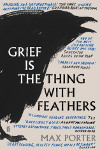
Max Porter: Grief Is The Thing With Feathers – When his wife dies, a man who is writing a book on Ted Hughes finds a Crow at his door, a bird who will help him and his sons through their grief. Poetry in prose.
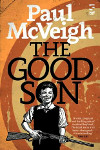
Paul McVeigh: The Good Son – Growing up during The Troubles in Northern Ireland, Michael Donnelly attempts to work out who he is whilst war wages outside in the street. Not bad – it’s a particular book with a balance of profound and your average coming-of-age.
Poetry

Andrew McMillan: Physical – A collection of pieces on the male body and sexuality. Awesome.
It would be difficult to pick a favourite this month.
Quotation Report
None this time.
I can’t quite believe it’s only two weeks until I put the blog on its 2 week Christmas hiatus. Still a couple of books to recommend to you before then and that all important award result! (Our Shadow Panel winner was announced yesterday.)
What have you been up to this month?
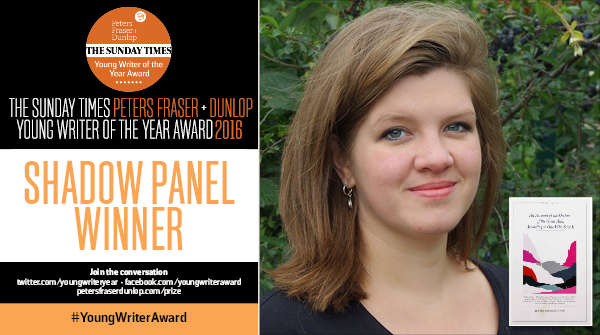
The Young Writer Of The Year Award 2016 Shadow Judges’ Winner
Posted 1st December 2016
Category: Miscellaneous Genres: N/A
Comments Off on The Young Writer Of The Year Award 2016 Shadow Judges’ Winner

After a couple of hours discussing the four shortlisted books, Eric Karl Anderson, Kim Forrester, Naomi Frisby, Simon Savidge, and I arrived at a winner on Saturday, fuelled by Eric’s fab cake, celebrating Naomi’s birthday. Buzzfeed’s Dan Dalton joined us as chair and kept us on track. It was tough; each of the books is of a high standard, in a similar way. But we got there. Here is our winner:

Jessie Greengrass for her book An Account Of The Decline Of The Great Auk, According To One Who Saw It. There was a lot of talk about the form of the short story in the context of Jessie’s collection. Winter 2058, the title story, and On Time Travel are three of those we all highlighted. We discussed the theme of cold climates that Jessie favours and how well her thoughts corresponded to the backdrop and general situation. We spoke of the writing, how the telling in this book really works.
The official winner will be announced at the award ceremony next week, Thursday 8th December.
My Event Report: In Conversation With Elizabeth Fremantle
Posted 28th November 2016
Category: Events Genres: N/A
6 Comments

© Photo:Gerry Walden/gwpics.com 2016
It’s a weird feeling shifting from the role of press to the role of host for an evening. I spent a very good few hours at our latest event but coming home without photos and notes is a strange thing. I’m glad for our photographer and the writer from Southampton University who came to cover the event for us.
Our evening with Elizabeth Fremantle last Thursday was a roaring success. We commandeered the comfy chairs. The majority of seats were taken and more people turned up than we knew were coming; a wonderful surprise.
Elizabeth told us of her journey to publication, her background in fashion writing; her research methods – visit Hardwick Hall! – and all four books which we ended up discussing in reverse chronological order because we got talking about her latest book and it seemed to make more sense to me in that moment than jumping from subject to subject (the books all stand alone but there are links).
This time we recorded it. Fathers who own camcorders are very useful when you discover that your plan to use your DSLR isn’t going to work. You’ll find the video at the end of this post.

© Photo:Gerry Walden/gwpics.com 2016
Many, many thanks to Elizabeth and her friend, Glyn, who also joined us; Rachael from The Edge and Wessex Scene – read her pre-event piece here; and our photographer, Gerry Walden. Having finished it I’m feeling rather odd without promotion to do; I’ve started the planning for January.
Here’s the video, complete with my silly bumbling. I’ve cut the introduction a bit due to microphone issues.


