




Analyses Of First Lines #4
Posted 26th February 2018
Category: Close Reading Genres: N/A
2 Comments
Time for another of these posts – I’m over a slump that, I think it’s time admit, lasted three months, and I am desperate for some literary study. It made sense to focus on those books that have helped me out the most, as well as some I’ve simply enjoyed.
I don’t know what it is about close reading but it’s very appealing. As a slow reader, the current discussions on the benefits of close reading are heartening – I may not read that slowly but the idea that in slowness there’s the chance you’re engaging more with the text makes up somewhat for my eternal dismay over not getting through books quickly; I say that in view of my opinion of myself – I’ve always wished to be able to read faster but it’s one of those things that I can change only when concentrating.
Chimamanda Ngozi Adichie’s Americanah
Princeton, in the summer, smelled of nothing, and although Ifemelu liked the tranquil greeness of the many trees, the clean streets and stately homes, the delicately overpriced shops and the quiet, abiding air of earned grace, it was this, the lack of a smell, that most appealed to her, perhaps because the other American cities she knew well all smelled distinctly.

Referring to one of the five senses without falling to the oft-used ‘look’. The use of smell here, with the author’s writing style, does a good job of setting the scene and highlighting what she wants to highlight. Would the thought of the ‘stately’ part of Princeton be as easy to imagine if she’d just ‘shown’ them? You also get the idea that Princeton is above all other American cities she’s known – perhaps the smell of nothingness is a sign that she relates it to success, to where she’s meant to be. It’s different to all the others and, as this is the start of the book, this difference is where the ‘conflict’ of the story may begin.
Edith Wharton’s The Age Of Innocence
On a January evening of the early seventies, Christine Nilsson was singing in Faust at the Academy of Music in New York.

Date, time, place, straight away. Contemporary reference that if it were written nowadays might be considered a way to ‘date’ the book. We’re also given a hint as to the society we’re about to read about – one that likes the theatre, or opera (if we know who Nilsson is, we can assume she’s singing an adaptation of the Christopher Marlowe tale).
But beyond that we’re in the dark – this book could be about anything, and as it happens, the opera will serve more as something for Wharton to use to further her story.
Jessie Greengrass’ Sight
The start of another summer, the weather uncertain but no longer sharply edged, and I am pregnant again.

I love this, because you know exactly where you are – a book about motherhood with at least two children, or a book that will concern the pregnancy itself. You can also expect to be in one of those climates with ‘uncertain’ weather (this book is set in London) and that, owing to the choice of words and writing style, it’s a literary novel. And whether about motherhood or pregnancy, it will be about the self, wistful, maybe, poignant, perhaps.
Sherry Thomas’ The Luckiest Lady In London
For as far as he could trace back in time, Felix Rivendale had spent half an hour each day with his parents before teatime.

We know rich people in the 1800s didn’t spend all that much time with their children, but this line, placed first, infers that that was the only time Felix got. We’re likely going to read further about his childhood, but as we already know the genre of this book, it’s apt to assume that one – it will be short – and two – this sentence will inform most of the rest of the text. It’s highly likely that the conflict between the main characters will revolve around Felix’s childhood.
Tony Peake’s North Facing
Sticks and stones, Paul’s mother would say, may break your bones, but words will never hurt you.
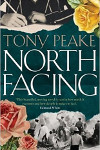
That common phrase that we’ve long since noted doesn’t mean anything good.
Away from any knowledge of the book, this ushers in a few possible storylines – a friend’s mother looking out for the character; Paul having a conversation with his mother; something said that may turn out to be otherwise irrelevant to the story. The last can often happen but given the phrase used, that isn’t likely.
Is this going to be a story involving bullying? Almost certainly. As inferred, a book doesn’t start on this with no good reason. Either there’s something to be dealt with immediately or, if you start to consider the story, a young boy in a war, something in the future, or at least sometime during the book.
In Conclusion
I think what caught my attention most whilst I was looking at these lines was Sherry Thomas’ beginning for her romance book – it doesn’t tell you where you are as some books do but it does tell you what you can expect the conflict in the book to be about, and I found that interesting. In any other genre it might be considered a spoiler – the remainder of the chapter lays out exactly how Felix feels about other people based on the treatment of this parents – but here it’s provided freely. Romance is often termed predictable – the reader is generally looking for a happy ending but for there to be a book there has to be conflict beforehand – and so there’s not really any harm in telling you upfront in this way. But it is different.
Hot on the heels of that was Peake’s first sentence – also somewhere in the realm of letting you know what will happen, but an example of the more ambiguous usage of the device. Particularly given our modern day retort that words can indeed hurt.
In reading these first lines I’m starting to sense a trend – the relative succinctness in today’s literature is apparent in general and is something most people know about, but the changes in terms of introductions are less so. It’s been an interesting journey so far – there is more to close reading the more you do it.
What is the first line of the book you are currently reading and how does it relate to the rest of the text?
Thoughts Whilst Reading The Age Of Innocence
Posted 19th February 2018
Category: Thoughts Whilst Reading Genres: N/A
1 Comment
I’m still reading the book and still enjoying it, but there’s something I’m in two minds about: Newland’s musings and inner upset – to be polite about it – over May’s personality. Expect free-writing going forward…
May Welland, Newland’s fiancée and later wife, is very much a device for Wharton to look into the way New York society women behave; by using a young woman she is also able to explain how it comes to be, the ‘creation’ of a society woman if you will.
At the beginning of the novel it’s particularly good – it’s fresh, it’s a vibrant narrative, and there is something both strange and poignant in the fact that Wharton spreads her ideas via Newland. Using a man as the person she speaks through makes for an interesting contrast to other narratives – he wants a partner with more agency and independence of thought and bearing – whilst at the same time that it is a man brings irony to the situation as Newland is obviously far freer than May would ever be.
But as the novel continues and Newland continues to think of May’s character, Wharton’s commentary starts to lose its effect. Newland’s freedom has something to do with it, but more than anything else I’m finding the fact that he is effectively complaining but doing nothing about it difficult. Of course one shouldn’t expect Newland to be actively trying to change May – that would be wrong – but in all his goings on about how she just repeats what those who brought her up taught her to say, he never really does much in the way of trying to give May space to become more independent. He has a few thoughts – particularly when he realises May may expect him to become like her hypochondriac father – but there’s never any action. To Newland, May is who she is – a dull, robotic (not that he uses that word), same-as-any-other society woman and that’s that.
Of course that Newland loves her cousin, the very different Ellen Olenska, understandably affects his lack of action in that he should really have not married May and left her when she gave him the chance. (I found that scene very interesting, the way we see that May is obviously a lot ‘more’ than Newland thinks – I wouldn’t have minded a companion book wherein May finds someone who likes her.) But it is difficult to listen to him going on about May’s limitations. And in a modern context, thinking of the way he’s treating her that likely wouldn’t be an ‘issue’ in Wharton’s time, it’s even more difficult.
I’m hoping to watch the 1993 adaptation after I finish the book and the way Wharton/Newland speaks of May I’m kind of expecting Winona Ryder’s May to be a literal robot.
I do think there’s something to be said in that Wharton keeps the theme of May’s sameness carrying on throughout; whilst the author herself likely got bored of all the limitations placed on women, nay, people full stop, in her society, at the same time that she herself was different… surely she must have thought that many women would have felt restricted, and the addition of Ellen to the cast suggests this.
I’m pinning my hopes on Wharton going for some sort of big reveal at the end wherein we see that May’s not at all boring. Particularly considering the irony of the title.
Away from that, I’ve just been surprised by Newland’s sudden wish to kill off May – sudden surprising violence that made me picture him in a dusty room in black and white a la Mrs Danvers – and I’m rooting for Ellen finding some socially appropriate way to tell her family to mind their own business.
More names would have been useful; for a while I thought Catherine the Great was indeed the Russian empress and there are lots of Mingotts to remember. The whole product is a great commentary of New York society from someone who lived it – I do wonder if that’s why Wharton decided to travel so much, to get away from it all.
Reading Life: 12th February 2018
Posted 12th February 2018
Category: Reading Life Genres: N/A
5 Comments

I’m reading three books at the moment and they are all superbly written which is rather wonderful. Chimamanda Ngozie Adichie’s Americanah, Jessie Greengrass’ Sight, and Edith Wharton’s The Age Of Innocence.
I’ve been surprised by the Wharton. I knew it would be good because I’ve heard as such before, but the slight humour and spot on commentary was a great discovery. I’m taking it slowly; with the handful of different characters and all the information proffered upfront there’s a fair amount to remember, particularly as I started the book during a lazy afternoon. I’m using my Kobo, which is almost a novelty; I put it away a while ago when I decided to concentrate on physical books (I’ve tried, but I can’t read ebooks one after the other), and found it when clearing up.
Having read the first several chapters I found myself wanting to read up about Wharton herself and spent a few hours doing so. Hers was an interesting life; she was part of the high society she wrote about and travelled extensively. When the war reached France she decided to remain there and help rather than return to America. The house in Massachusetts, that she designed, is now open to the public and in a manner that I recently found at Avebury Manor – you can sit on the furniture and interact with objects and so forth.
Americanah is less of a priority simply due to the length. I’ve a need for shorter books at the moment but don’t want to stop reading it entirely. I’m glad for my reluctance to make notes in books because if I wasn’t reluctant most of what I’ve read so far – a few chapters – would have been scribbled over.
When my Dad told me a few weeks ago that he was planning to watch Wild that evening, I remembered I hadn’t yet seen it. I bought and read Strayed’s memoir before the film’s release so that I could watch it in context but while I did read the book I forgot the second part of the plan. So I sat down to watch the film myself and got about 20 minutes in before calling it a day. It was the inner monologue that did it for me. I’ll try again at some point but I’m not sure I’ll get through it. I liked the book enough – it wasn’t great but it was far from bad – but the film’s execution of it could perhaps be better.
In non-book news I’m still knitting avidly, and finding it to be a good companion hobby to reading. I can’t listen to music when reading, for example, but I can when I’m knitting. I’m finding irony in the fact that knitting doesn’t feel anywhere near as productive as reading but there’s a lot of satisfaction in a finished piece. I’ve completed the jumper I was making for my nephew – with help at the end as trying to sew it all together was making me want to abandon it – and started something in a thicker yarn so that it’d be quicker to knit. I definitely prefer having finished to being in the midst of making.
What are you reading and, if you’ve seen Wild, what did you think of it (whether in context with the book or not)?
Reading Cause And Effect: The Early Days Of Film
Posted 7th February 2018
Category: Chit-Chat Genres: N/A
Comments Off on Reading Cause And Effect: The Early Days Of Film
My current read, Jessie Greengrass’ Sight, has two plot threads, told in one narrative by one person. In the first narrative – the main fiction, so to speak – a woman looking back at the time when she was struggling to make a decision as to whether she should have a child. The other is factual – although narrated by our fictional character – and covers the discovery of X-rays and what they could do by scientist Wilhelm Röntgen at the end of the 19th century.
Röntgen’s story is an interesting one, particularly as Greengrass includes the problems that arose due to a previous scientist having seen X-rays but not investigating – where Röntgen had seen a light and investigated it, this other scientist had seen the same light but not thought anything of it.
Most interesting to me, however, was the information that is included at the start of Greengrass’ tale of Röntgen – the author compares the beginnings of his discovery with the creation of the first motion pictures. She chooses the evening of 28th December 1895, wherein early filmmakers the Lumière brothers, Auguste and Louis, hosted the first public film screening. Ten very short films were included, and Greengrass’ nameless character speaks most of La Pêche aux Poissons Rouges (Fishing the Goldfish), which features Auguste and his daughter:
Users of IMDB have given it only 5.2/10, which kind of defeats the point…
It’s an astonishing film, really; the quality of the picture and the speed of it… when you compare it to later ‘feature’ films, it seems far ahead. (I’m thinking here of the crackly nature of black and white films, all those dots and lines, though admittedly a one shot, one angle film wouldn’t need to work with transitions.)
Greengrass moves on to X-rays from here, but I was interested in carrying on the research into film. The reputed first ever film was created in 1871. Sallie Gardner at a Gallop was the result of an experiment and technically more a precursor to film that one itself.: twenty-four photographs shown on a zoopraxiscope, creating an effect very similar to flip books.
The first copyrighted film was Fred Ott’s Sneeze, a 5 second film in which a man pretends to be feeling under the weather; Fred inhales some snuff. He breaks the fourth wall at the end. The film was shown through a Kinetoscope, a massive device created by Thomas Edison, who knew the creator of Sallie Gardner at a Gallop. When Edison exhibited his creations at the Exposition Universelle (Paris, 1889), what we would now call his stand was an acre in size and featured an entire power station.
There are a lot of very early films out there, and most of them are available to view. Thinking on why I hadn’t known about them before and why there is so much general knowledge on photography but not film, I concluded that since we are so invested in photography for the purposes of personal and societal history, it makes sense that early films – often random and very very short – would not be so well known. At least that’s my thought.
What have books taught you recently?
Brief Thoughts On The Original And Revised Endings Of Great Expectations
Posted 5th February 2018
Category: Further Thoughts Genres: N/A
2 Comments

I’ve often thought about the two endings of Great Expectations, but a lot more so since watching the 2012 version over Christmas (as expected as that might sound considering how recent it was).
My initial thoughts on reaching the end of my copy – the Vintage Classics edition that features both endings – was that the original ending far surpassed the revised one in terms of quality and overall sense. That Estella spurns Pip yet one more time matches the person she had been in all the time he knew her, whilst the second ending’s happily ever after stance seemed a prime example of something worked simply to please the crowds. Or at least, in this case, Dickens’ peer, the novelist and politician Edward Bulwer-Lytton, who said it was too sad1; I think we can safely say many readers would have liked the original. That said, the revised ending doesn’t specifically say that the characters got together.
Watching the film made me think a little more. The original ending has Estella effectively behaving as she always has, continuing to be the person Miss Havisham trained her or created her to be. In the second ending we could say that Estella eschews this training; perhaps her behaviour now is more a reflection of who she is without Miss Havisham – perhaps she’s now the person, or moving towards the person, she is without Miss Havisham’s input. She’s now herself.
Taking the endings as they are without their background literary context, they both work for different reasons.
Where the film influenced my thoughts was in what I considered Holliday Grainger’s very good performance – the Estella she and, also, Helena Barlow (as the younger Estella) portrayed, was not someone I saw changing. It seemed to me quite literally out of character for Grainger’s Estella to change as she did; I suppose you could say it highlighted for me why the original ending pips the second to the post. But it did still illustrate further than the simple dialogue and other text of the book, in regards to Miss Havisham’s teaching, how much nurture has to play in our lives.
Your thoughts?
Footnotes
1 In his 1874 biography of Dickens, John Forster wrote: “One other letter throws light upon an objection taken not unfairly to the too great speed with which the heroine, after being married, reclaimed, and widowed, is in a page or two again made love to, and remarried by the hero. This summary proceeding was not originally intended. But, over and above its popular acceptance, the book had interested some whose opinions Dickens specially valued (Carlyle among them, I remember); and upon Bulwer Lytton objecting to a close that should leave Pip a solitary man, Dickens substituted what now stands. “You will be surprised” he wrote “to hear that I have changed the end of Great Expectations from and after Pip’s return to Joe’s, and finding his little likeness there. Bulwer, who has been, as I think you know, extraordinarily taken by the book, so strongly urged it upon me, after reading the proofs, and supported his view with such good reasons, that I resolved to make the change. You shall have it when you come back to town. I have put in as pretty a little piece of writing as I could, and I have no doubt the story will be more acceptable through the alteration.” This turned out to be the case; but the first ending nevertheless seems to be more consistent with the drift, as well as natural working out, of the tale, and for this reason it is preserved in a note.”
Book References
Forster, John (1874), The Life Of Charles Dickens, James R Osgood & Company, Boston, Vol. 3, p. 360.


