





Planning For Christmas 2018
Posted 12th September 2018
Category: Chit-Chat Genres: N/A
6 Comments

Over the last month I’ve been musing over the end month of the year. Every year I say I’m going to add some seasonal books to my reading list but it doesn’t happen as well as I hope. This is partly because I leave it too late – I’m making up for it here – but it’s also because it can be difficult to find Christmas books that aren’t romance.
Finding Christmas romances are easy, they are everywhere and it makes sense that Christmas would be a priority because of the cosiness, mistletoe, and just general seasonal mood. Most of what I’ve read so far at Christmas have been romances. I like settling down beside my tree with such books but I also want to read in other genres too.

And that is difficult. I suppose with literary fiction it’s the case that most books set at Christmas may sport some good cheer but at some point in order for the literary-ness to be included, the character’s lives will be upended… and that’s not really what you want at Christmas. It’s also just hard to find such books; most often those with ‘winter’ or ‘Christmas’ in the title move swiftly on.
Historical fiction is a possibly good bet but you have to accept that any Christmas time will likely be fleeting, and quite possibly unlike the season we know. Then there are classics. A Christmas Carol, which I’ve read; The Lion, The Witch And The Wardrobe which I’ve also read and is somewhat fleeting unless you include the endless winter into the Christmas time… which wouldn’t be right because as Mr Tumnus says, it is “always winter, but never Christmas”; and finally Little Women which I’ve added.
Then there are these: L Frank Baum’s The Life And Adventures Of Santa Claus; E T A Hoffman’s The Nutcracker And The Mouse King (which, something I didn’t know, was first re-written by Dumas before being turned into a ballet – Dumas’ re-write informed Tchaikovsky); Nikolai Gogol’s The Night Before Christmas; O Henry’s The Gift Of The Magi; Hans Christian Andersen’s The Snow Queen. I believe the Henry is an adult short story; I’d not heard of it before but it sounds famous.
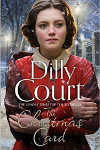
Dilly Court’s The Christmas Card looks like a possibility, but I’ve read a couple of books in that Victorian-to-early-1900s-historical-sort-of-romance-always-with-similar-set-ups-in-terms-of-family and not liked them. (Is there a specific term for books like hers? They’re a particular sort of historical but are generally placed away from ‘regular’ historical fiction, and are instantly recognisable. I’ve noticed supermarkets here have tons of them but they are rarely on display in bookshops. Historical chick-lit perhaps?) I’ll probably give the Court a go for variety’s sake.
So that’s where I am in my planning at present: Dilly Court, Alcott, a contemporary romance or two (likely by Shannon Stacey because whilst I find her work hit and miss it’s always got the escapism factor) and a few children’s fiction options. When I looked for Dilly Court’s book cover I found this list of Christmas books on GoodReads that’ll be worth looking into, especially as it’s a list of other lists.
Do you have any Christmas book favourites? And have you anything I could add to my list of classics?
Analyses Of First Lines #5
Posted 7th September 2018
Category: Close Reading Genres: N/A
2 Comments
I’ve found myself becoming incredibly picky. I started composing this post quite a few weeks ago but didn’t complete it because I didn’t have enough first lines to make it worthwhile – there were many I could choose from within the limits I set myself for this series (books that are currently in my reading life whether already read and being looked at again, in progress, or recently finished) but none struck a chord. Sometimes it was because working out exactly what the first line was could be tricky, with books sporting those sort of prologue pages that might not actually be prologue pages, and others that just didn’t intrigue in any way. Usually this sort of pickiness takes a while – my thoughts on referencing… eight years late – but in this case it’s only taken 5 posts. I suppose I’m getting used to thinking about what I want to do earlier rather than later.
Looking at what I’ve got below, I’ve noticed it’s full of doom, gloom, and hospitals, so I apologise if you’re reading this when you’ve a spring in your step. My reading hasn’t been all angst, I guess it’s just that the books that include it think more about their first lines. There may be something in that.
A Place Called Winter by Patrick Gale
The attendants came for him as a pair, as always.

He’s been there a long time, and he’s a big problem if two people are needed. We can estimate length of time but the amount of difficulty he’s causing really depends on what this is about. If historical there are a few possibilities – a simple thing of two people arriving; they may need to lift him head and foot; he may be causing them a lot of issues whether truly or in that depraved asylum fashion. If contemporary, it’s most likely to be a necessary thing but hopefully practiced with the comfort of the patient in mind in the context of a much better idea of what he is suffering from. It could be a hospital or a prison, a care home or in-home care, perhaps. Of course the cover gives you a hint as to what time we’re talking about, but on its own the line could be set in any time.
Bitter Orange by Claire Fuller
They must think I don’t have long left, because today they allow the vicar in.

Surprising open, everything is set up, and there’s something quite literary about the way this is a short sentence – the end is possibly near, and so there is little to say on that exact front. Looking at ‘they’, either ‘they’ are wrong and this will be a story in which the narrator gets better, or we’re going to be looking at the past.
The Theatre Of Dreams by Rosie Travers
I met the man who orchestrated my downfall in a Soho nightclub.

The use of alliteration, and ‘orchestrated’ when another might use a different word – the start of this story, if not the whole, is going to have quite a lot of drama in it and not necessarily anything involving acting. The use of ‘Soho’ alone, without ‘nightclub’, sets the scene: a downfall – which may well have happened in London if the narrator is there to go clubbing – and the likelihood of their residence there, points to the title – fame.
The Bell Jar by Sylvia Plath
It was a queer, sultry summer, the summer they electrocuted the Rosenbergs, and I didn’t know what I was doing in New York.

I love this line. I completely looked it over when I first read it, because nothing particularly jumps out at you during a regular read unless the Rosenbergs are a new story to you. But this line is absolutely perfect – everything is provided. You’ve got the season, mood, exact time and year, place, and even the state of mind, shown by what she chooses to focus on. You’ve also got repetition there to draw the reader to the sunny days, and the use of ‘queer’ (as a synonym for ‘odd’), and the way Plath chooses to highlight an electrocution, says straight away that the book may be a strange and/or difficult one. Of course difficult is what The Bell Jar is, but Plath’s bluntness, warning, lets you know straight away what you need to know if you’re just flicking through books and looking for something to read – unlike many books that take a while to show what they are about, Plath’s is immediate. And you’ve got to be thankful for that – her tale is morbid, dark, but she’s giving you an out if you wish to take it.
Whistle In The Dark by Emma Healey
‘This has been the worst week of my life,’ Jen said.

Interesting is the chapter heading, ‘the end’ – are we going to be reading the book back to front? And with this first line Healey shows us we’re going to look into the near past, and something that has been bad or gone wrong. Whether or not ‘of my life’ is dramatising things is something we don’t yet know, and we don’t yet know. We also don’t know how old the person is and thus whether or not it is indeed likely to be dramatic or not.
Missing Pieces by Laura Pearson
The coffin was too small.
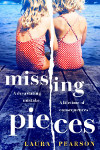
This is rather like the flash fiction piece, “For sale: baby shoes, never worn.”1 – Pearson sets a very similar scene. Though what is left out that the famous fiction piece included is a reference to time; we don’t yet know how long the child lived for, and thus we don’t know how much, if any, pages moving forward will include references to a life lived. The title of this book and certainly the cover give an idea as to what the book is about, but if you were in any doubt, there’s the first line.
Reading these through again I think there’s definitely something to be said about darker books more often (potentially more often?) having strong first lines. I suppose that when you’re writing about a difficult subject in long form and wanting to get details across to the reader, it’s second nature to start as you mean to go on.
Then there is the fact that sometimes it takes a few lines for the stage to be set, and often these are short sentences where you look at a first line like Christina Stead’s – ‘One hot night last spring, after waiting fruitlessly for a call from my then lover, with whom I had quarreled the same afternoon, and finding one of my black moods on me, I flung out of my lonely room on the ninth floor (unlucky number) in a hotel in lower Fifth Avenue and rushed into the streets of the Village, feeling bad.’ – and wonder if they couldn’t have just created a long sentence, no matter how old-fashioned they seem to now be considered. But then of course short sentences have merits of their own.
With The Bell Jar soon to be behind me I’m thinking again of the idea of close reading ending lines. I think I’d want to retrace my steps and include the books that I’d used in these first lines posts. I’ll have to ponder that undertaking for a bit!
Footnotes
1 I was intrigued to discover that this six-word story is commonly attributed to Ernest Hemingway, although there is no hard evidence to suggest it was his. O’Toole (2013) says, ‘a literary agent named Peter Miller stated that he was told the anecdote about Hemingway and baby shoes by a “well-established newspaper syndicator” circa 1974.’ He quotes Miller’s book: ‘Apparently, Ernest Hemingway was lunching at Luchow’s with a number of writers and claimed that he could write a short story that was only six words long. Of course, the other writers balked. Hemingway told each of them to put ten dollars in the middle of the table; if he was wrong, he said, he’d match it. If he was right, he would keep the entire pot. He quickly wrote six words down on a napkin and passed it around; Papa won the bet. The words were “FOR SALE, BABY SHOES, NEVER WORN.” A beginning, a middle and an end!’ (Miller 1991, p.27, cited in O’Toole 2013)
But O’Toole also cites other variations on the tale, other potential writers. Miller’s anecdote is unsubstantiated. (I think it’s also worth noting that the time scale between Hemingway’s supposed claim and his completing it, sounds incredibly far-fetched unless he had already prepared the story in advance. This surely suggests he’d seen the story elsewhere.) His article, linked to below, is worth a read.
Online References
O’Toole, Garson (2013) For Sale, Baby Shoes, Never Worn, Quote Investigator, accessed 7th September 2018.
Reading Life: 5th September 2018
Posted 5th September 2018
Category: Reading Life Genres: N/A
2 Comments

With more reading time to spend as of late, I’ve found myself reading the books I received at Christmas, novels I’d asked for upon request for a list. The Nakano Thrift Shop was one. Originally drawn in by the hype, I decided to read it when browsing my shelves and whilst I thought early on that it probably wasn’t my cup of tea I wanted to keep going, after all it was a present and I was intrigued by the author. I wonder if perhaps, looking at things with introductions in mind, I should have read Murakami first, but then one book doesn’t speak for all and to my knowledge the translators for the two authors are different.
From there I picked up Americanah – first started in January – and read it until the end, which meant from 1/3 of the way through. It’ll be on my best of list. The variety of subjects under the one umbrella topic, particularly with a main character who isn’t all that likeable, was very well done.
And then I opted for the book that sat next to the Kawakami on my higgledy-piggledy to be read shelf, also a gift – Sylvia Plath’s The Bell Jar. It hardly bears repeating that it’s difficult, but for its literary value, both in terms of Plath and in the context of literature as a whole, it’s also enjoyable. I’ve noted down a number of extracts – the story of the bellhop, Esther/Sylvia’s views on women’s lives in those years – and am also enjoying the lighter moments, elements I didn’t expect would be included. For now it’s less dark than I imagined, but I know it goes further. I’m working at a sort of 50/50 pace with research – reading a few chapters, switching to research, then going back to the book. I read about the debates surrounding Plath and Ted Hughes when I read Grief Is The Thing With Feathers, but there have been more recent reports about her father aligning with the Nazis – like this one from 2012 by Dalya Alberge – that paint a picture that gives a more rounded story to Plath’s poem, Daddy, from which the following comes:
I have always been scared of you,
With your Luftwaffe, your gobbledygoo.
And your neat mustache
And your Aryan eye, bright blue.
Panzer-man, panzer-man, O You—
I’m half thinking that after Plath I should continue on to other books received as presents, because it’s a good mix, and includes Eowyn Ivey’s To The Bright Edge Of The World. I’ll see – I’m inclined to be completely whimsical, and reading books received as gifts sets an expectation, however random.
Which difficult book have you read recently and how did you find the experience?
August 2018 Reading Round Up
Posted 3rd September 2018
Category: Round-Ups Genres: N/A
3 Comments
August was pretty good. I’ve a couple of books on the go and finished a fair number, though I’m glad to have finished most of them, to have got them out of the way.
All books are works of fiction.
The Books
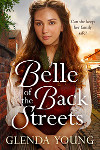
Glenda Young: Belle Of The Back Streets – A girl from a poor family in pre-wartime Britain takes to the streets as a rag and bone person and doesn’t follow the advice of others, instead spending time with the ‘wrong sort’. This was very much like a soap opera, with multiple people dying in quick succession just for plot points.
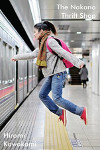
Hiromi Kawakami: The Nakano Thrift Shop – Hitomi relates various times at the second-hand shop in which she works, as she finds love with a co-worker and tries to figure out more about her employers. Good as an example of translated literature, but you have to be aware that not much happens.
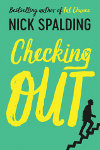
Nick Spalding: Checking Out – A childrens’ musical creator, given a few months to live, looks to provide meaning to his life. Not bad but the comedy falls flat early on.
Rosie Travers: The Theatre Of Dreams – A recently-disgraced actress moves to the coast to manage a dance school… or at least that’s what she thought she was doing – in actual fact she’s there to help save a historical pavilion from demolition. Good stuff.
My favourite this month would be the Travers; high above the others it added much needed enjoyment and the mystery element that starts about a third of the way through really raised the bar, which was a promise kept.
Quotation Report
A thought from The Nakano Thrift Shop worth mulling over:
When it comes to old things, whether buying or selling, why is it that people act so cautious?… With something brand new, they have no problem just ordering it from a catalogue, no matter how expensive.
For September the plan is literary fiction with a book or two in different genres. Over the weekend I got back to Americanah and am a fair way towards finishing; I’d like to have done so by the end of this week.
What are you reading? And do you have plans for autumn?
The Present Past: Hardy’s Cottage, And Max Gate
Posted 24th August 2018
Category: The Present Past Genres: N/A
4 Comments
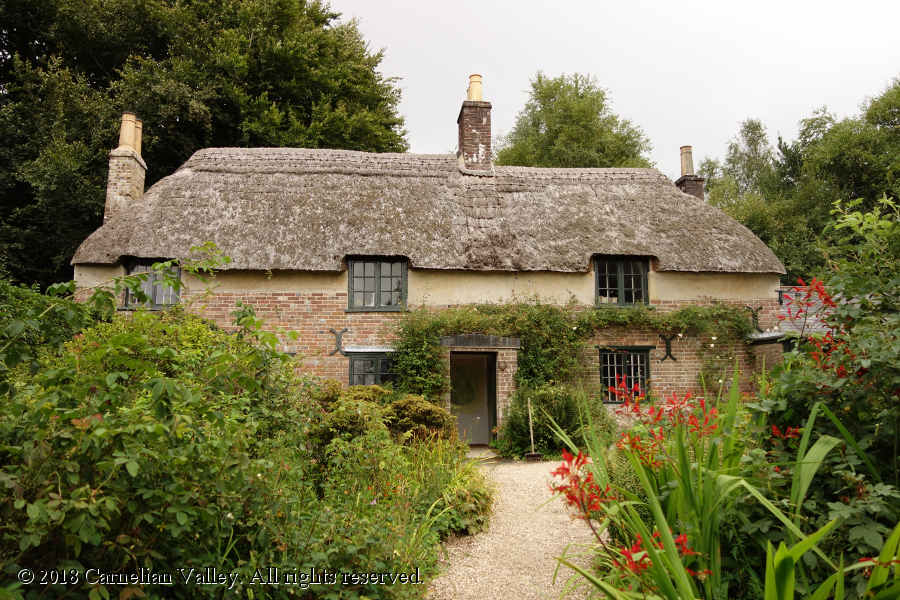
Hardy lived all his life near Dorchester, Dorset (the east end of the west side of England, 30 minutes to the coast by car). He was born in a tiny leasehold cottage where he lived with his many siblings – in a few rooms before the place was later extended in order to house his grandmother. He stayed in the cottage until he married, writing his first novels there before designing and having his father and brother build Max Gate, 10 minutes (by car) from the cottage, where he lived with his wife, Emma.
Today, due to the short travelling distance between the homes, you can visit both within a few hours, or, if you’re like me and have made an appointment elsewhere for mid afternoon, you can see both houses within the space of 45 minutes. I don’t really recommend rushing it as I did – you’ll miss the cemetery wherein lies Hardy’s family – but if you don’t have much time, the houses are small enough that you can rush it and tick another two items off your list.

Both houses are owned by the National Trust; Hardy’s youngest sister, Kate, enabled the Trust to take over one, and actively handed the other over to them so that they could be looked after. Neither home sports any of its original furniture, whether Hardy’s or otherwise; the cottage was handed back to the council in the interim of the Hardy’s time there, and Max Gate was bought by someone else. This means that there is an unfortunate lack of authenticity about the buildings, but due to this the National Trust have kitted them out with furniture that you can sit on, and at Max Gate the kitchen is a self-serve cafe – you can take your food through the house and into the garden (seeing someone carrying a tea tray through the hallway took some getting used to!)
So you may not find Hardy here, exactly, but if you want to sit in the place in which he sat and look at the gardens he would have seen when he looked up from his work, you can.
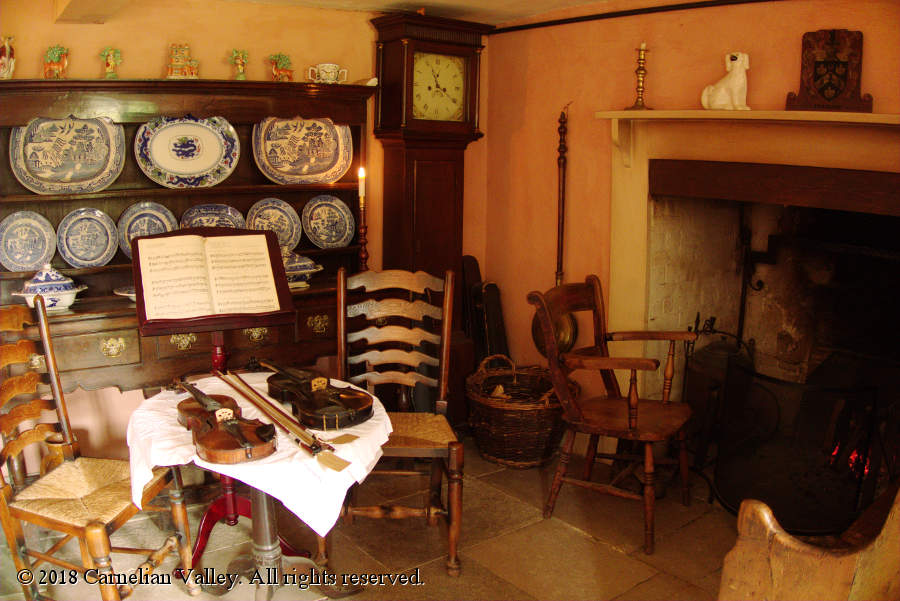
Hardy’s Cottage is an idyllic place – a traditional thatched cottage with a traditional English country garden. The original building consisted of just two rooms downstairs – the window in the parlour (behind me as I took the photograph) was where the door used to be, and the tiny room to the side, now laid out as a study. The porch and room now laid out as a kitchen, to the right as you come in, as well as another room beyond that looked to be in use as an office by Trust staff, was the extension added on later. Given how small the cottage is, that it was originally even smaller was a shock.
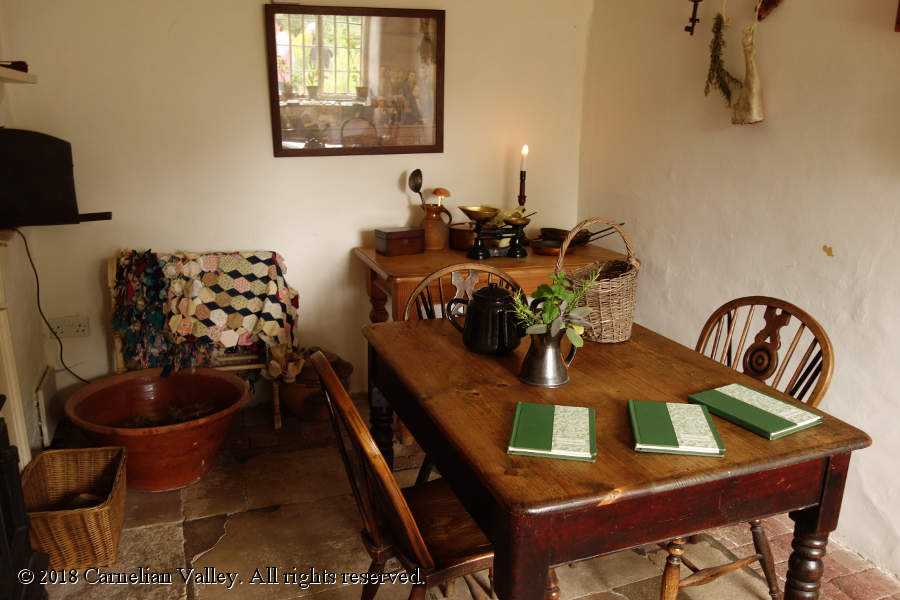
Only a small number of people are allowed upstairs at once, and the reason is obvious as soon as you start to ascend the stairs – the steps a narrow, many are slanted, and the linear layout of the three bedrooms leave little room to move. (There is another staircase at the end of the run of rooms but for whatever reason they are roped off.)

It’s not known for definite which room was Hardy’s but the Trust has made a good guess and planted a writing desk in the last. What we do know is that whichever room he chose to write in, he would have looked out onto the garden. Here he wrote Under The Greenwood Tree and Far From The Madding Crowd, and also The Poor Man And The Lady – his very first novel, which he destroyed towards the end of his life.
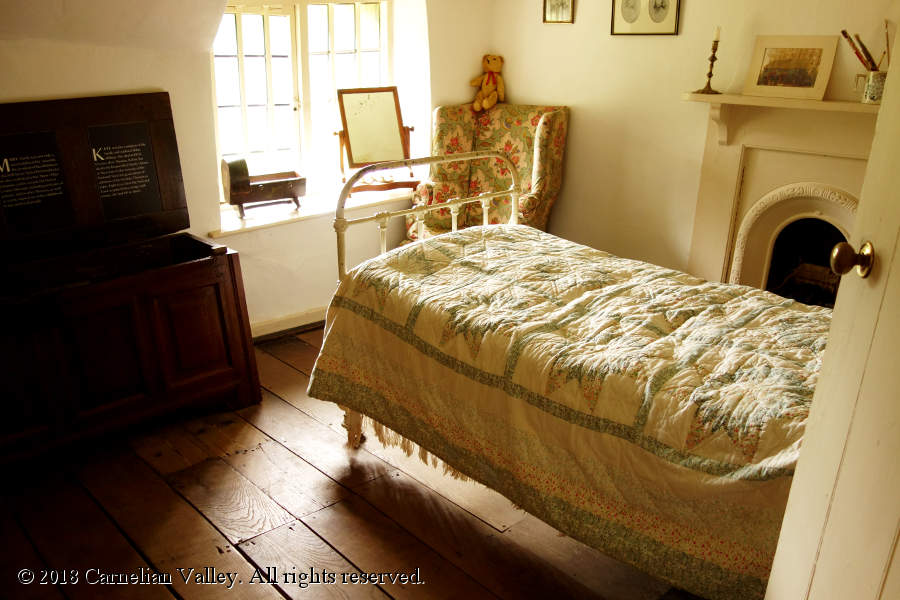
Hardy met Emma Gifford whilst on an architectural mission to restore the parish church of St Juliot in Cornwall (Gibson 1975), fell in love, and married her. According to a few volunteers at both the Cottage and Max Gate, Emma viewed herself as higher class than Hardy (factually correct – he had grown up poor and her family had had money) so whilst the relationship began well, the couple’s time together soon became emotionally distant. Although Hardy was by then a very popular writer and able to design and have built a house of their own, Emma’s distaste grew and she spent more and more of her time away from him, finally retreating into the two attic rooms except for dinnertime. She is now considered to have suffered from a mental illness. When she died, Hardy was distraught – suddenly he missed her, having got used to the distance – and whilst he married the lady he had been seeing (Florence Dugdale) he didn’t stop writing about Emma nor, as a volunteer told me, did he stop visiting Emma’s family. This naturally resulted in his second marriage becoming strained.
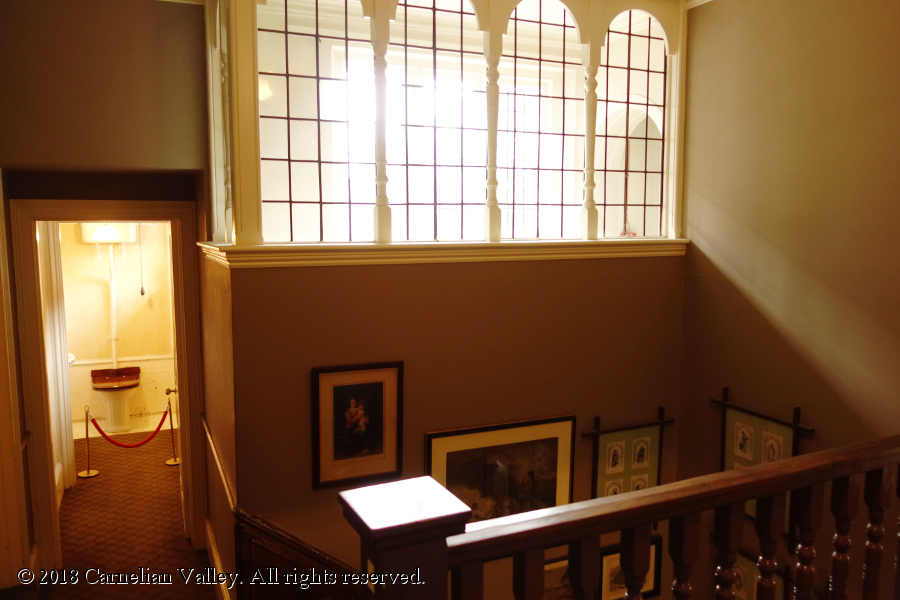
Max Gate is a stunning place. The outside is pretty grand in terms of size but once inside it’s rather like a homecoming – if you’ve ever been into a modest English house built in the Victorian period, or even just a fairly large house from the early to mid 20th century, you’ll likely find Max Gate to be a bit like ‘coming home’. It is very much a bog standard home – walking around it feels so normal it’s almost as if you’re looking at it from the perspective of moving in.

The house doesn’t have all that many windows, and the long-ish corridors mean it can be difficult to see, certainly it’s hard to take good photographs! The decor in the hallways is dark and gloomy, and who knows what Hardy’s original design choices were, but the current one is very Victorian.
The dining room is set up on to the left of the entrance hall (I didn’t get a photo of it because that’s where people mill around and where the till is, but it’s gorgeous in a historical way, all dark greens and wood). Yeats, Rudyard Kipling, J M Barrie, all came to dine here on various occasions. The dining room was extended after it’s original build – the addition is to the far end, shown by the frame that goes round it.

To the right of the entrance hall is the drawing room, packed with furniture and leading invitingly to the conservatory which is the sort of size conservatory we’d nowadays more likely turn into a utility room. Copies of literary magazines are spread over the table and a lovely little upright piano stands behind the door ready for visitors to play.
The hallway past the stairs leads to another that the Trust use as the public toilet – it’s a single room with a shower, which completes that feeling of mooching around someone’s house – and the kitchen from which you can serve yourself coffee and scones.
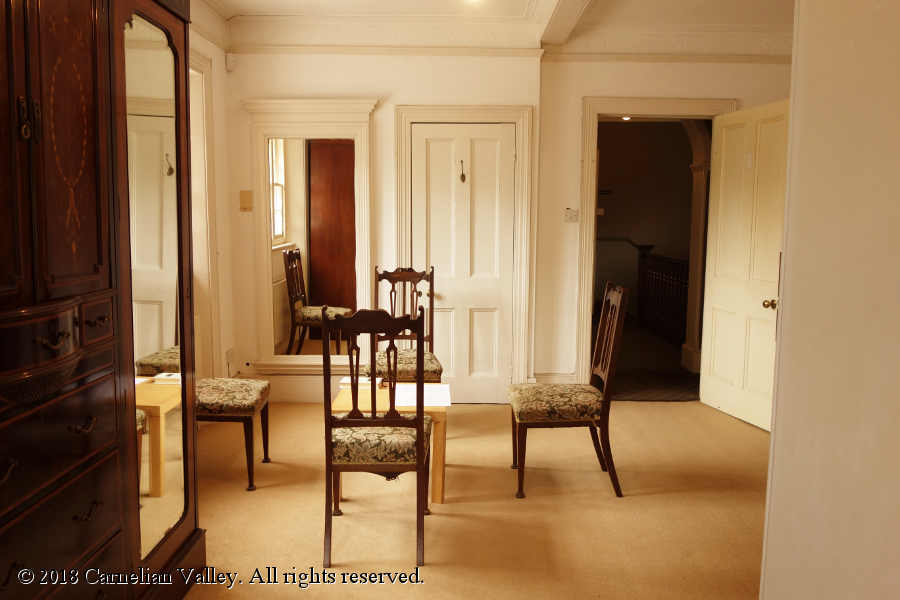
Back to the entrance and up the stairs, left takes you to Hardy’s dressing room/first study – a wonderfully light room – and his bedroom (not pictured – a couple of visitors had taken the ‘sit down wherever you want’ directive to heart and were reading by the window… I may still be envious of their time).

Back across the hallway and you reach the second bedroom/study, a room with one window facing trees that I couldn’t wait to leave. The space you see in the photo is over half the room. It’s evident that Hardy wanted more light – there’s an alcove with windows on either side – but it wasn’t happening.
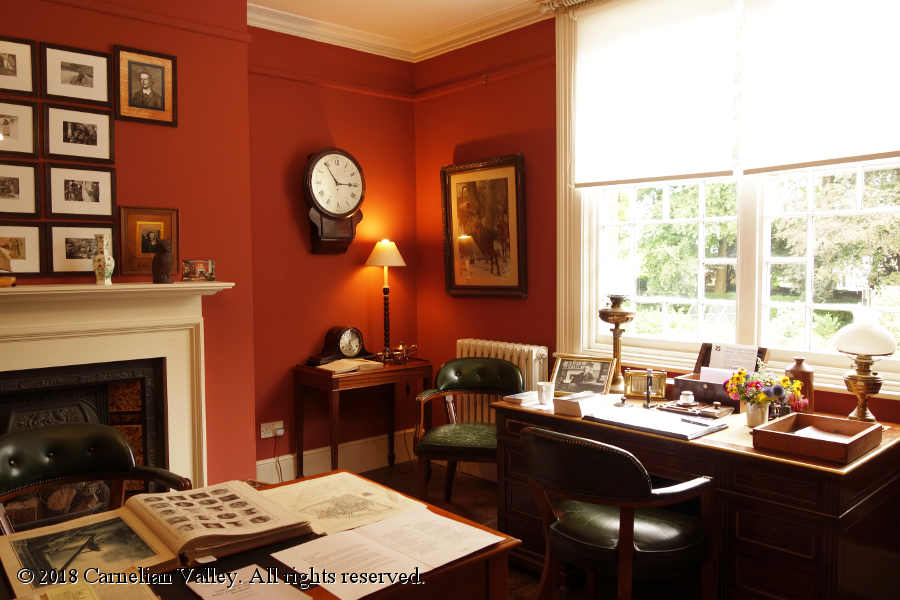
Walking out of the study and into Hardy’s writing room is like day and night. The room is sumptuous, with a large desk in the place he surely set up his own. It looks out onto the back garden (there are two – there’s also one to the side of the house, beyond the conservatory) and the amount of light the windows let in must have aided Hardy a great deal. It was another part of the extension, effectively his third study.

Emma’s attic rooms are accessed by a narrow staircase between the two studies that goes up to a big window ledge before the last step. It’s dark and dingy, more so than the rest of the house and I think that even if it weren’t for the story about Emma’s seclusion here, it would still feel… horrible. Being there reminded me of how I’d felt walking round the Bronte Parsonage when I was far too young to know what it was all about, and noting only how dark and spooky it was. I couldn’t help but feel a true connection existed – Emma was, in historical terms, quite literally the ‘mad woman in the attic’. You would think she had been sent to live up here by her family rather than made the decision herself.

In the second room a typewriter has been set up, along with a copy of her poetry. Her picture is everywhere; whether true to Hardy’s choices or not it is an apt representation of the way Emma must have haunted the house, her shadow hanging over Hardy and Florence.
I was unable to properly visit the garden and so missed the grave of Hardy’s dog, Wessex, spending a while in conversation with a volunteer whose knowledge I have used in this blog – a lot of what I’ve written about Emma Gifford is thanks to him, and the information about Hardy’s life before marriage is thanks to the volunteer at the Cottage.
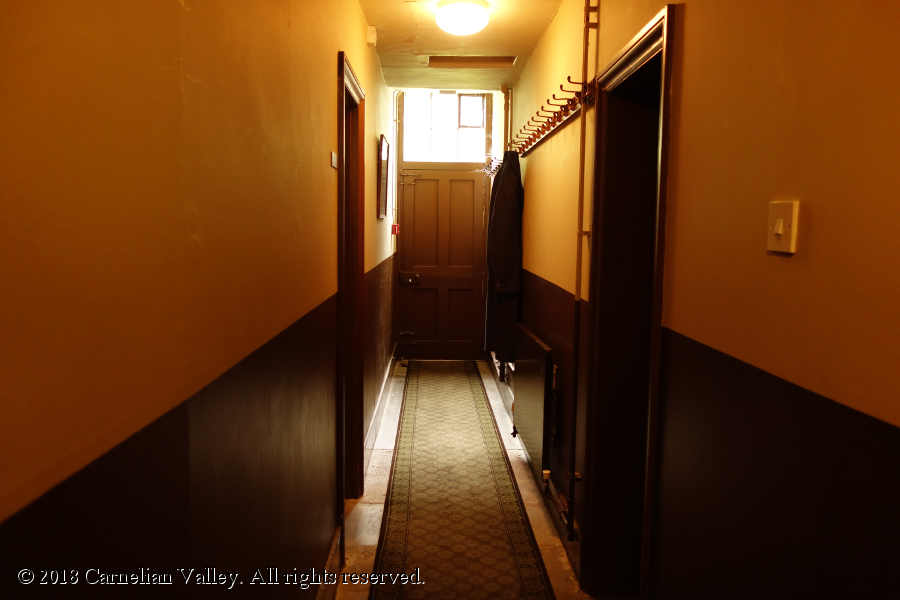
As said, there is a feeling of something missing in these homes; that’s because if the National Trust made it all original you’d be walking round empty rooms; but if you visit both on the same day and add on a trip to the churchyard, it’s time well spent. If you go on the ‘right’ day, you could also fit in a visit to Virginia Woolf’s house.
What you do get from Hardy’s houses is a journey through a life, from relative poverty to fame and relative wealth, and you get a working knowledge of Hardy’s architectural knowledge that you would miss out on otherwise. And it just stands out from other historical houses, its relative modernity being pretty special.
For what it is, it’s expensive, but at the same time it’d be hard to say it isn’t worth it.
The rest of my photos – Hardy’s Cottage


The rest of my photos – Max Gate


Book References
Gibson, James (ed.) (1975) Chosen Poems of Thomas Hardy, Macmillan Education, London, p.9


