




The Reception Of Lewis Carroll’s Alice’s Adventures In Wonderland From Contemporary Reviewers
Posted 18th May 2020
Category: Further Thoughts Genres: N/A
1 Comment
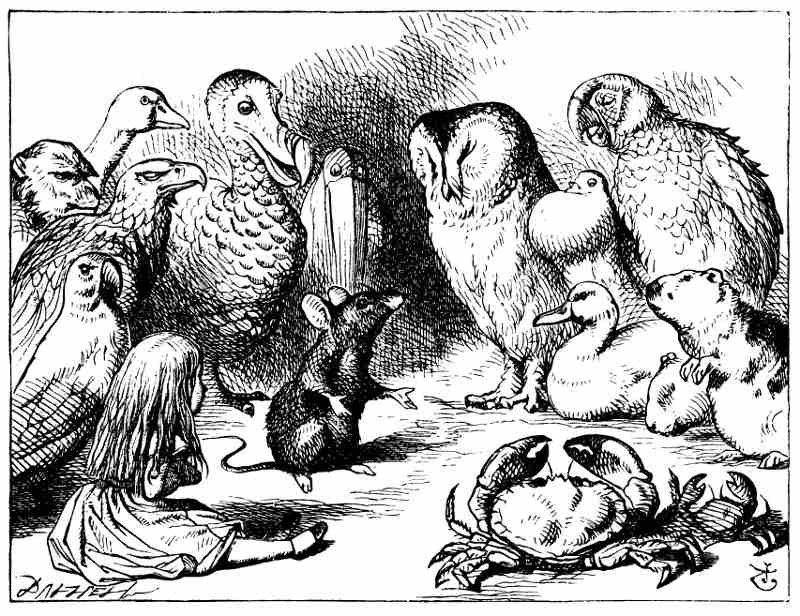
When I first started looking at this subject, I saw ahead of me a fairly short post mostly composed of quotations with some analysis after each one; let the primary sources do the talking. During the course of my research, however, for reasons related below, this had to be changed. I therefore decided to structure this post in the same way I did last year when looking at the Brontë sisters and Jane Eyre. There is a lot more background context in this post than I ever imagined including.
Table Of Contents
Abbreviations
Introduction
Reviews and Analysis
Conclusion
Appendix A: Oscar Wilde’s Opinion
Appendix B: On the Rumour About Queen Victoria
Notes
References
Abbreviations
Alice – Lewis Carroll’s Alice’s Adventures in Wonderland, first published in 1865.
LG – The same author’s Through The Looking-Glass, given a publishing date of 1871 but in fact published in 1872. The editions of newspapers and magazines in which reviews are included provide evidence for this.
The Ath – The Athenaeum, a past British weekly periodical.
Introduction
This post came about as I looked through my previous work on Alice, and various web searches on the same, and came to the conclusion that if the various questions and commentaries on Alice that arise in our present day are interesting, then the questions and commentaries of our peers from history would likely offer similar; the commentaries there, by the nature of cultural evolution, being different, there must be a lot more out there for us to muse on.
This interested me in particular because the contents of Alice, as anyone who has read the book or seen any number of film adaptations of it knows, are quite extreme compared to anything published for the target age group today1. Therefore the understandable questions I see in web searches each day as to this, and as to comparisons of childhood then and now (the former a subject I cannot claim to know much about), naturally led to my interest in further opinions.
It was perhaps inevitable I’d be wondering about my ‘fellow’ reviewers.
Prior to the publication of Alice, Lewis Carroll was unknown. The writer, real name Charles Lutwidge Dodgson, had only published a few works: La Guida di Bragia, a Ballad Opera for the Marionette Theatre, which, Wikipedia (n.d.a) states, released around 1850; Miss Jones, a comic song from 1862; and one or two (the same Wikipedia page gives two dates for one of them, whose title begins ‘the fifth book’) publications on mathematics. Alice was his first novel2, after which it’s evident he simply added children’s books to his category list and continued on.
The citation of ‘poor reviews’ is used fairly widely across articles on the Internet that discuss the book (most often ‘X things you didn’t know about’ articles) which, given their general shortness, suggests the information has simply been parroted from Wikipedia (see reference to n.d.b) or another site that has copied the information.
The statement, I have found, is mostly untrue. In the two long afternoons I spent scouring the Internet for contemporary reviews I only found one that is negative. Whilst it is quite likely that the popularity of Alice was increased by the publication of LG (as says Wikipedia n.d.b, though only in the context of the reception of Alice being ‘poor’) there is nothing to suggest the second book had a bigger impact than the first, indeed the very fact that there was a second book, and published later on (Carroll took his time – it was in the works from 1866 [de Rooy n.d.b]), suggests by itself that Alice was popular.
It took me a while to find sources; after initial success with a couple of reviews, I finally found extracts of others – like all good extracts that involve opinions, the main point was included – in The Ath3, a British literary magazine that was published weekly between 1828-1921. The original sources may be out there but given many are citiations by The Ath of newspapers still in production today (or since amalgamated into others) they are likely to be in the publisher’s archives, in other words not easily accessible to the layman. Where the remaining reviews are cited to belong to publications that have since ceased production they are hopefully in the British Newspaper Archive. (Some reviews about Alice are indeed in the British Newspaper Archive; I found a couple of mentions in newspapers I’d never heard of, however the site requires a subscription to view more than the briefest descriptions and the number of reviews currently uploaded to it didn’t warrant it; I copied the notes I could under the ‘3 free articles’ offer.)
I will note in advance that the various discovered extracts almost all relate to LG; they are reviews of LG that simply, by fact of the book being a sequel, involve snippets or simply concepts of what would have been each individual publication’s prior opinion of Alice.
During my research I discovered an additional reason for the difficulties in finding reviews of Alice – whilst officially first published in November 1865 (and that’s the date you’ll find noted everywhere), the copies of the first print run were found by illustrator John Tenniel to be inferior; the print bled. So the first copies were recalled with the result that the ‘actual’ publication date was 1866 [de Rooy n.d.a]. (Incidentally, copies of LG, despite being published in 1871, bore the date 1872.)
Reviews and Analysis
Here is the review of Alice in Aunt Judy’s Magazine, June 1866, p.123, ellipses and bracketed notes mine:
FOURTY-TWO illustrations by Tenniel! Why there needs nothing else to sell this book one would think. But our young friends may rest assured that the exquisite illustrations only do justice to the exquisitely wild, fantastic, impossible, yet most natural history of “Alice in Wonderland”. For the author… has a secret, and he has managed his secret far better than any author who ever “tried on” a secret of the same sort before, that we would not for the world let it out. [Detail here about how the reader will have to find out about the secret for themselves.] …of Mr. Tenniel’s illustrations we need only say that he has entered equally into the fun and graceful sentiment of his author, and that we are as much in love with little Alice’s face in all its changes as we are amused by the elegant get up of the white rabbit in ball costume…’
This review written for children (Aunt Judy’s Magazine was a monthly magazine for young people) is completely positive. The review naturally focuses on elements that will most intrigue children, and even adds a particular element of persuasion in its note that there is a secret but that if you want to know what it is, you’ll have to read the book to find out. (One can assume the idea was for children to read this and start requesting their parents buy a copy of it.) Note also the emphasis on John Tenniel (Carroll’s name is included in the details redacted); Tenniel was well-known; it’s likely many would have seen this as the selling point, the ‘way in’ for Carroll.
It’s also interesting to note that as we can see from the review (and those following), from the very start of Alice‘s publication the title was shortened. The more popular name, undoubtedly easier to remember and quicker to write (and quicker to print in the days of letterpresses), has always been around4.
A brief sales note from the John Bull (1866, p.872), a London Sunday newspaper, later a magazine:
From the same publishers, too, we have to welcome a beautiful copy of that old favourite, Alice’s Adventures in Wonderland.
John Bull‘s positive words are technically more of a nod to the wider popularity.
Review of Alice in The Ath, 16th December 1865, p.844, ellipses mine:
This is a dream-story; but who can, in cold blood, manufacture a dream, with all its loops and ties, and loose threads, and entanglements, and inconsistances [sic], and passages which lead to nothing, at the end of which sleep’s most diligent pilgrim never arrives? Mr. Carroll has laboured hard to heap together strange adventures, and heterogeneous combinations; and we acknowledge the hard labour… We fancy that any real child might be more puzzled than enchanted by this stiff, over-wrought story.
It’s safe to say that the reviewer for The Ath did not like the book; he (or she – by this time there were a number of female critics in the industry) disliked it so much they kept their first sentence going on, with words that have negative connotations, for far longer than necessary. Though they do at least ‘acknowledge the hard labour’. The Ath was written for an adult audience, so this review would be to suggest adults not buy the book for children. It makes this idea its final point; you wouldn’t want your child to be ‘puzzled’ by this ‘stiff over-wrought story’; by this time in history, childhood was more about being ‘enchanted’.
Is this review the reason we have the notion of ‘gained poor reviews’ running riot on the Internet? The Ath‘s historical popularity and the relative ease with which we, now, can hunt through it for information, could be the reason for the idea.
According to City, University of London, The Ath was ‘a highly influential periodical’5. It is interesting to consider the review in light of the others.
In later issues of The Ath, there are multiple text-based adverts for publisher Macmillan (who remains Alice‘s publisher to this day) which naturally include quotes from positive reviews. These adverts are where the following few extracts are from. Perhaps understandably, whilst the adverts are printed by The Ath, their own review is not included.
The following is from a review of Alice by the Pall Mall Gazette, an evening newspaper (cited in The Ath, 1873 [1872]a, p.831):
One of the cleverest and most charming books ever composed for a child’s reading.
And another extract from the same newspaper (cited in The Ath, 1873 [1872]b, p.757):
Beyond question supreme among modern books for children.
From an edition of The Ath (1866, p.548) printed around Alice‘s second print run (after that disastrous first), we have the following two reviews:
From The Times (ellipses: The Ath):
An excellent piece of nonsense… Illustrated with extraordinary taste.
And from the London Review6 (not to be confused with the London Review of Books, a current popular publication founded in 1979):
A piece of downright hearty drollery and fanciful humour.
Extracts from reviews of LG, used to advertise the second edition of the book, sometimes indicate each publication’s thoughts of Alice. The Ath‘s own in 1871 (pp.787-788), for which the full text is available, is rather lovely. Let’s look at it in full, square brackets mine:
Through the Looking-Glass, and What Alice Found There. By Lewis Carroll. With Illustrations. (Macmillian & Co.)
IT is with no mere book that we have to deal here,-to borrow the idea expressed by Dr. Johnson [Samuel] when the inventory of Mr. Thrale’s [Henry]7 brewery was being taken,-but with the potentiality of happiness for countless thousands of children of all ages; for it would be difficult to over-estimate the value of the store of hearty and healthy fun laid up for whole generations of young people by Mr. Lewis Carroll and Mr. John Tenniel in the two books which they have united to produce. In the first volume, Alice won the affections of a whole child-world as she wandered through Wonderland; in the second, that now before us, she will be sure to add fresh troops to the number of her unknown friends, besides retaining her place in the hearts of her old admirers.
Before many days have elapsed thousands of bright eyes will be watching her as she glides through the drawing-room looking-glass, which suddenly softens before her, and passes into the land of reflections which lies on the other side, where animated chessmen and walking and talking cheerily, and finds herself as a White Queen’s Pawn playing across a chessboard earth, and striving to arrive at Queendom at its farther end. Many a little head will puzzle – children like to be puzzled – over the people who thought in chorus; and the wood in which names got lost; and the Red King’s dream of which Alice was told she was a mere feature, her existence being absolutely subjective; and the land in which events took place backwards, like a sentence in Hungarian, so that a criminal was sentenced first, and tried afterwards, for a crime he was going to commit. Much young blood will run cold with fright – children dearly love to be frightened – at the awe-inspiring portrait of the Apolloyon-like Jabberwocky, which
Came whiffling through the tulgey wood,
And burbled as it came!And many a heart both old and young will be stirred with wholesome laughter at the quarrel of the Tweedledum and Tweedledee, the arithmetical genius of Humpty Dumpty, the vagaries of that King’s Messenger who was as mad as a Hatta [sic], and the metamorphosis of the Red Queen into a kitten, which synchronizes with Alice’s own return from her eighth-square queendom into her old life on this side of the looking-glass.
Even the face of a reviewer, of one whose heart has been rendered heavy within him by the involuntary study of our comic literature, may be dimpled by a smile of admiration as he watches the skill with which both the author and the illustrator have worked in the difficult atmosphere of nonsense. Many of Mr. Tenniel’s designs are masterpieces of wise absurdity. We may refer, for instance, to that in which the Oysters, incarnations of old-womanishness, are listening to the dulcet speech of the Walrus and the Carpenter, or those of Humpty Dumpty shouting to “Someone’s” ear, of the White Knight shaking the aged man who sat upon the gate, and of the Messenger expiating in prison the crime he was going to commit; not to speak of some drawings which deserve still higher and more serious praise, such as that in which Alice is rowing the boat along the stream which is half river and half grocer’s shop. The skill with which the dream-like blending of the one with the other is rendered is worthy of Wonderland itself.
Before parting with this charming book, for which such bands of children will deservedly feel personally grateful to both author and illustrator, we must call attention to the touching address to his “child-readers” which “Lewis Carroll” has appended to his book,-thanking them for the interest they have taken in his “dream-child,” telling them how pleasant it is to him to think of “the many English firesides where happy faces have smiled her a welcome,” and ending with wishing that to them each recurring Christmas-tide may be “more bright and beautiful than the last – bright with the presence of that unseen Friend, Who once on earth blessed little children, and beautiful with memories of a loving life, which has sought and found that truest kind of happiness, the only kind that is really worth the having, the happiness of making others happy too!”
The original text is in columns so it seems particularly lengthy. But no matter the visual effect of the columns it’s a fact that a great many more words were afforded LG here than The Ath‘s review of Alice we saw earlier.
There are no names ascribed to the magazine’s reviews, but this adds an intriguing question to our study. Note the sentence ‘Many a little head will puzzle itself – children like to be puzzled – over the people who thought in chorus’. Is this a jab from the reviewer of LG towards the reviewer who had said of Alice ‘We fancy that any real child might be more puzzled than enchanted by this stiff, over-wrought story’? It’s quite possible that that is the case. Or, perhaps, it’s the same reviewer, begrudgingly agreeing with something that someone else has argued for. (Note, too, the use of Carroll’s full name – he has surely moved up in the world.) Of course it could also simply be the reviewer’s style – they later use the same ‘children like to be…’ again. (This usage of the style is interesting in itself – some children today like scary stories; it would seem Victorian children did too. Stories in those days, even if we look solely at Alice and LG, could be incredibly scary.)
It is wonderful here to get a glimpse of the reception of contemporary children: ‘In the first volume, Alice won the affections of a whole child-world as she wandered through Wonderland’. Not so wonderful is the summary of a lot of the plot but if we consider any parent reading it out or passing the paper over to children, it makes more sense.
We now return to extracts. From the Illustrated London News, the world’s first illustrated weekly news magazine (cited in The Ath, 1873 [1872]a, p.831):
Quite as rich in humourous whims of fantasy, quite laughable in its queer incidents, as loveable for its pleasant spirit and graceful [next word illegible] as the wonderous [sic] tale of Alice’s former adventures.
From The Standard, now the Evening Standard (cited in The Ath, 1873 [1872]b, page unknown8):
If this had been given first to the world, it would have enjoyed a success at least equal to ‘Alice in Wonderland,’ and now every child who possesses the original should demand the sequel as a matter of right.
From The Guardian (ibid.):
Little Alice herself is as sweet as she ever was, and her companions in the new Wonderland are just as quaint and odd and surprising as they were in the old one. Mr Tenniel’s illustrations are simply exquisite. To be without this book in any household where there are children young enough to be amused by sheer absurdity, or old enough to be charmed by graceful fancy, would be an act of high treason.
A separate advert for LG, published in an edition of The Ath a couple of weeks before the edition containing the above reviews, cites a print run of 36,000 copies. This is shown in a ‘new books’ section9.
There are a couple of extracts that don’t mention Alice in any specific way, but do give us further knowledge of the general reception. From the Morning Post, a daily newspaper since acquired by The Telegraph (cited in The Ath, 1873 [1872]b, page unknown):
Let us inform the children that the story is one of the most captivating and delightful they have ever read, and that the pictures are beautiful.
The words indicate the reviewer would have likely found in its favour. Similarly, from The Times (ibid.):
The nonsense is far more charming than half the literature bought and sold as solid sense. Child’s book as this is, a man whose childhood lies sunk below the horizons of many decades, whose life is in the second hemisphere, may read it and be the better for having done so. The illustrations are capital. Never was artist so thoroughly at one with his author.
This rather wonderful review suggests adults will get just as much – if not more? – enjoyment from LG than will children. And it is by the same writer as The Times’ review of Alice – notice the use again of ‘nonsense’ within the context of something superb.
Conclusion
From the above extracts and the various information discovered, it can safely be concluded that Alice (and LG) was received with much happiness and admiration, and that was extended towards its author. Whilst there is only one review that has categorically been written for the target audience of the book (and that is available online), the other reviews, most likely written for parents and other interested adult-age parties, allow us to see the further reception, the general reception.
Thus it must be noted that no matter how prevalent the phrase ‘to poor review’ is in modern-day articles (never used with any reference) it is incorrect. Perhaps the term has morphed – perhaps it originally related to John Tenniel’s opinion of the first print run and the subsequent removal of those initial copies from sale and ‘Chinese Whispers’ are at play; this is a generous take on it – it’s not likely at all.
Appendix A: Oscar Wilde’s Opinion
Whilst researching the opinions of reviewers, I came across numerous references to Oscar Wilde’s having enjoyed Alice in his younger years, however I could not find any primary sources for this. (There may well be commentary in his letters but these require the consultation of a copy of them and with libraries closed at this time in Britain, and the collection of letters not in ebook form, I made the decision to go without.)
Away from this, there is at least one other primary source that points to Wilde’s admiration of Carroll’s work, which I have supplemented with a secondary source.
In Oscar Wilde’s article, A Note on Some Modern Poets, published in The Woman’s World magazine, December 1888, and found compiled in an edition from 188910 (p.110), Wilde looks at a poem by William Sharp; in so doing he draws attention to the ballad aspect it, saying:
Well, Mr. Andrew Lang, some months ago, signed the death-warrant of the ballade, and—though I hope that in this respect Mr. Lang resembles the Queen in Alice in Wonderland, whose bloodthirsty orders were by general consent never carried into execution—it must be admitted that the number of ballades given to us by some of our poets was, perhaps, a little excessive.
In his 2016 article on Oscar Wilde and Lewis Carroll, Ray Dyer notes the following (ellipses mine):
Wilde had opportunities to observe Carroll, his reputation, and his literary works whilst he was up at Oxford, where he attended Magdalen College between October 1874 and June 1878.
[…]
The Lady Vice-Warden’s relevant phrases… seem to have a distinct resonance in Wilde’s later plays.
The Lady Vice-Warden is a character from Carroll’s Sylvie and Bruno stories. Carroll’s time teaching at Oxford’s Christ Church College included the years Wilde attended as a student.
Appendix B: On the Rumour About Queen Victoria
It was believed by many that Queen Victoria contacted Carroll to let him know she had enjoyed Alice and, then ‘To her great surprise she received his most recent mathematic [sic] book” (de Rooy, n.d.c). The following refutation is from Carroll himself, included by de Rooy in her commentary. It is from his mathematics textbook, Symbolic Logic Part I. It can be found in the ‘P.S.’ from the ‘Advertisement’ at the start of the second edition of the book (1896). The page is unnumbered by it is effectively page VII:
I take this opportunity of giving what publicity I can to my contradiction of a silly story, which has been going the round of the papers, about my having presented certain books to Her Majesty the Queen. It is so constantly repeated, and is such absolute fiction, that I think it worth while to state, once for all, that it is utterly false in every particular: nothing even resembling it has ever occurred.
For added context, David Mikkelson’s article on this subject (1999), citing the words of a Carroll scholar, includes this paragraph (ellipses and brackets Mikkleson’s own):
As Jean Gattegno pointed out, by the time Dodgson issued this denial, the rumor was thirty years old (having appeared shortly after the publication of “Alice in Wonderland”) and was unlikely “to injure Carroll any more, much less the Queen.” Perhaps with “the problem of his pseudonym … becoming more and more troublesome,” at that point Dodgson was more interested in “reaffirm[ing] the ban on identifying Carroll with Dodgson” than with contradicting a decades-old rumor.
Notes
1 I have looked at age appropriateness for modern day children in the past.
2 The creation of the novel came as a result of Dodgson’s relations with the Liddell family, in particular young Alice Liddell. For a comprehensive background, see Wikipedia’s page on Miss Liddell, which includes the speculation of controversy. See also the short piece on the website for the churches of the New Forest, which includes St Michael And All Angels, where the lady is buried.
3 If this post were to have an acknowledgements section it would include my posthumous thanks to The Ath; I have now used it for a few different subjects and it remains at least slightly useful, at most absolutely critical.
4 It’s interesting to consider that, as much as the alliteration is nice, ‘adventures’ is effectively extraneous.
5 City has a short page about the magazine in its archives and collection pages: see references section.
6 There have been many publications by this name – this is presumably The London Review and Weekly Journal of Politics, Literature, Art, & Society in circulation from 1862 to 1869.
7 The two were friends, having met ten years after the publication of Johnson’s dictionary.
8 This is an unfortunate circumstance – I noted down the citation but even with it cannot find the information anew.
9 The Ath, 2nd November 1872, No. 2349, p.554.
10 Wilde was the editor of this short-lived magazine (it ran from 1886-1890 and Wilde was editor from 1887). In taking on the job, he persuaded the publisher to alter it from a target audience of ‘middle-class lady readers’ to the emerging class of educated women (Clayton, cited by Wikipedia, n.d.c).
References
Books
Carroll, Lewis (1896) Symbolic Logic: Part I (2nd ed.) Macmillan & Co., Ltd, London
Newspapers and Magazines
The Athenaeum (16th December 1865) Review of Alice’s Adventures in Wonderland, No.1990
The Athenaeum (27th October 1866) Books for Presents, the Drawing-Room, or the Library, No.2035
The Athenaeum: Supplement to No. 2300 (18th January 1873 [21st December 1872, No. 2356]-a), Macmillan & Co.’s Christmas Books, No. 2300
The Athenaeum: Supplement to No. 2300 (18th January 1873 [14th December 1872, No. 2355]-b), Macmillan & Co.’s Christmas Books, No. 2300
Aunt Judy’s Magazine (1st June 1866) Review of Alice’s Adventures in Wonderland (scanned copy available from the British Library)
John Bull (29th December 1866) [Advertisements], available via British Newspaper Archives
Wilde, Oscar (1889 [compiled volume]), A Note on Some Modern Poets, The Woman’s World, Vol.2, pp.108-112
Websites
City, University of London (n.d.) The Athenaeum – Archives and Special Collections, City, University of London Website, accessed 17th May 2020
de Rooy, Lenny (n.d.-a) About the book “Alice’s Adventures in Wonderland”, Alice in Wonderland.net, accessed 14th May 2020
de Rooy, Lenny (n.d.-b) About the book “Through the Looking Glass and what Alice found there”, Alice in Wonderland.net, accessed 14th May 2020
de Rooy, Lenny (n.d.-c) Trivia, Alice in Wonderland.net, accessed 14th May 2020
Dyer, Ray (2016) Oscar Wilde and Lewis Carroll, Victorian Web, accessed 15th May 2020
Mikkelson, David (26th March 1999), Did Lewis Carroll Send Queen Victoria a Mathematics Text?, Snopes, accessed 18th May 2020
Wikipedia (n.d.-a) Lewis Carroll, accessed 15th May 2020
Wikipedia (n.d.-b) Alice’s Adventures in Wonderland, accessed 10th May 2020
Wikipedia (n.d.-c) The Woman’s World, accessed 18th May 2020
Analyses Of First Lines #8
Posted 15th May 2020
Category: Close Reading Genres: N/A
2 Comments
It has been a lot longer than I thought since I wrote one of these posts; I suppose I got confused, when looking, by the post on ending lines, which was recent. (Thank you again to Felicity and Kelly for your feedback on that; I’m still mulling over an alternative way of doing things there but it’s looking more and more unlikely I’ll continue it, which may be no bad thing.)
I’ve chosen today not to worry about numbers – I usually aim for five books – and instead to add that thinking time to refining the possibilities. As mentioned before, the books in these posts reflect what’s currently in my reading ‘sphere’ – new reads, reads just finished, review copies, and now podcast research – and there is naturally usually limited choice. With my recent letting go of reading ‘limits’ (I’ve currently about nine books on the go, but it’s still helping so I’m not changing it yet) there are plenty to choose from. I’ve opted for those that are most well-aligned to the concept of these posts. It’s been a lot of fun.
Diana Evans’ Ordinary People (2018)
To celebrate Obama’s election, the Wiley brothers threw a party at their house in Crystal Palace.

We have an exact time – I reckon we can say from the information in the first part of the sentence that it would be in the days following Obama’s election, a few days past 4th November 2008. With the election cited, we also know that the story will take place in our real world. Crystal Palace (south London) – this party is for British people or American ex-pats. We have a good idea as to the politics of the Wiley brothers, who are celebrating a historic moment; we have a good insight into these brothers and the people at the party.
Isla Morley’s The Last Blue (2020)
Thirty-five years ago, Havens would have opened his eyes and thought of the day ahead as lacking

A specific number of years – how old is Havens? I think we can assume he isn’t thirty-five; an incredibly young child isn’t going to recognise an adult’s day. It would be fair to suppose that Havens has got to be at least forty-five. Unless, of course, he’s comparing days in more of a historic, social, or/and cultural, manner.
That day that’s definitely not ‘lacking’ right now – something’s changed in those thirty-five years; changed in Havens’ opinions or in the world (certainly the idea of a day lacking or not has a bit more context right now with our ‘new normal’). In those years past, whatever Havens’ age, would this day that lies ahead be considered a routine one?
The line is a good one, pushing you to read further to find out what’s changed.
Nicholas Royle’s Mother: A Memoir (2020)
In my mind’s eye she is sitting at the circular white Formica-top table in the corner.
With the inclusion of the Formica, Royle sets the scene in terms of era. He’s also specific with his detailing; this amount of detail for a table and its placement suggests, perhaps, a defining role later whether in terms of general inclusion or a single moment. The way the sentence is written certainly looks back to a specific moment that we can assume may be explored further than the expected few sentences more on the subject to come.
The opening of the line also suggests a look back, which you would expect for a memoir.
Terri Fleming’s Perception (2017)
It is an opinion widely held, that a young lady lacking prospects must dream of defying expectations.
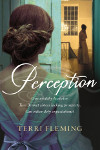
A line inspired by Austen (are we able to exclude the fact that this book is a sequel to the one the line is inspired by?) ‘Lacking prospects’ – a person without means; ‘defying’ – with a strength of character; ‘lady’… this woman is not wealthy but she has the spirit to become more.
Or so we assume – in fact, if it’s an opinion, even widely held, that doesn’t necessarily equate to the character herself, it is just that we know better, that a first line that is inspired by another first line that correctly infers what will happen is likely to be… likewise.
The use of expectations here – defy the expectation that she won’t marry well? After all, our man in possession of a good fortune was indeed in want of a wife. (I also like the simple fact of the word ‘expectations’ being used – when looking at this sentence for this post, studying it, it made me think of Pip and those great expectations. Fleming’s book is of course set in Austen’s period rather than Dickens’, but regardless the comparison may have something to it.)
Conclusion
Like last time there aren’t any links between these books. I’m not sure there will be going forward; my reading is necessarily more varied at the moment. Unlike last time and the times before, this will have to remain a short conclusion; creating this post has been pretty straight forward and, perhaps understandably, there is less to say on the subject itself. I suppose it will happen more and more as I continue.
What is the first line of the book you are currently reading?
April 2020 Reading Round Up
Posted 1st May 2020
Category: Round-Ups Genres: N/A
5 Comments
As discussed last week, I have a number of books on the go, so it’s not surprising that I finished very little this month; beyond a small reading slump that has coincided with the onset of rain (I’d been reading mostly outside) reading a number at once means I’m in right about in the middle of a few.
In unrelated news, I watched My Fair Lady on bluray yesterday and it was like I’d never seen it before. If it’s a film you enjoy, I very much recommend the bluray – it makes the theatrical aspect far more obvious and somehow brings more clarity to the slightly ambiguous (wholly ambiguous?) ending. It was like it was released yesterday.
The Books
Non-Fiction

Dan Richards: Outpost – The author travels to various buildings and locations around the globe that are isolated, seeking to discover why they draw us, and what their various roles in creativity are. Good stuff; some of it is unexpected but that does round it off well.
Fiction

Caroline Lea: The Glass Woman – A young woman in 1600s Iceland agrees to marry the leader of another settlement so that her mother will always have money, but the man seems to hide a secret, and they say he killed his wife. This one creeps up on you – the story goes along fairly steadily for a long time, with some Brontë/Du Maurier aspects before turning into something rather spectacular; it’s a well-written, haunting, last several chapters.
No thoughts of favourites; I’m looking at reading in terms of enjoyment – did I enjoy my reading, as an interest? Yes. The variety definitely helped and my laid back attitude to it all did, too. Looking forward, I’m going to continue as I have been [pauses typing as a massive booming firework goes off and after a shock I realise it’s 8pm on a Thursday in UK lockdown], just perhaps not add any more books to it until at least one is finished…
Due to our present situation, I’d like to note that Nicola Cornick’s The Forgotten Sister (link goes to my review) was released yesterday. On 14th May, Nicholas Royle’s Mother: Memoir, will be released (he wrote An English Guide To Birdwatching – awesome literary fiction with a lot of meta content). Finally in late May, Isla Morley’s The Last Blue will be published.
What kind(s) of stories are you drawn to at the moment?
Analyses Of Last Lines #1
Posted 24th April 2020
Category: Close Reading Genres: N/A
3 Comments
I’d thought about it for a while: what to do about last lines? Having started to look at first lines, as I currently do on occasion, the idea of looking also at last lines occurred to me but I didn’t know where to start. Should I go back to my first line beginnings and study the last lines of those same books? That would constitute quite an undertaking, be a very long post, and whilst I’d enjoy it, would my readers like it? Should I just start as I did the first lines, taking books that were currently in my ‘sphere’ and work from there? Or should I – this idea just in and I’m mulling it over – look at first and last lines of books concurrently?
The one thing about that last, latest, idea – it could get confusing. I was edging towards number two – starting at relative random.
But Covid’s come along and whilst I was struggling, the nice weather has arrived and it’s helped. The on-again-off-again break has done me good: I’m raring to go. And my head really likes the idea of going back to all those books, trawling through them, and comparing. So I’m going to look back at the books whose first lines I’ve covered, just not all at once.
It won’t be every book – some books were borrowed from the library and I don’t have access to them, and there are a few wherein the lines are either not stellar or (more often) too woven into the story’s context to make sense away from it. That is of course one big difference between first and last lines.
Anne Melville’s The Daughter Of Hardie (1988)
As the sun rose higher in the sky, there was nothing to suggest that 23 July 1932 was to be anything other than the most ordinary of days.

This is obviously setting up for a sequel, and it gives you an idea as to where the story might go (and, without concept, perhaps where the story has been, too). There’s a potential foreboding – or is it the complete opposite? Either way, whether read out of context or in it, it’s a good line; interestingly it’s more of a first line; it certainly works well as one.
Ben Fergusson’s The Spring Of Kasper Meier (2014)
And the ship groaned gently, rising and falling, rolling softly in the icy black water.
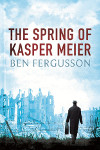
Minor interlude: this line reminded me of Fitzgerald’s “So we beat on, boats against the current, borne back ceaselessly into the past.” A comparison between Fergusson’s book and The Great Gatsby would, I feel, be of little merit; the one thing that can be said in our context is that Fitzgerald has his – or, rather, Nick’s – eyes on what has been, whereas Fergusson is potentially looking at the future. (The darkness and ‘groaning’ of Fergusson’s book is in the context of the story set in German WWII.)
Fergusson’s final line here offers both an ending and a continuation, ‘rising and falling’, and it must be said that the book is the first in a series. It offers something perhaps sinister, chilling, perhaps a bit more hopeful – a groaning ship, particularly one doing it ‘gently’ is not necessarily a bad thing. As a last line it is as gentle as the ship, it flows smoothly, and it leaves you with a potentially eerie image in mind, not being quite a completion.
Charlotte Mary Yonge’s The Heir Of Redclyffe (1853)
Still there was one who never could understand why others should think him stern and severe, and why even his own children should look up to him with love that partook of distant awe and respect, one to whom he never was otherwise than indulgent, nay, almost reverential, in the gentleness of his kindness, and that was Mary Verena Morville.
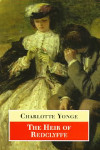
This line perhaps shows a lack of change of the person whose society confuses Mary. Or perhaps – likely, given the book’s title, this speaks of a romantic couple; a grouchy male heir who no one else understands?
In a vacuum, it’s easy to wonder at the true character of the man. Do his children love him? It seems this may be what Yonge is saying, and in this way the line, in a vacuum, can invite us to look closer.
Chigozie Obioma’s The Fishermen (2015)
I opened my eyes, cleared my throat, and started all over again.

Obioma takes us back to the beginning, be it the beginning of the book itself or a smaller story that’s being told within it. Does the way it goes back to the beginning suggest a thoughtful story?
Is the current situation difficult, those closed eyes, now open? It sounds an important situation that the character is in.
Conclusion
There is a second reason for going back – as I looked at the last lines, I inevitably compared the ‘success’, in its many literary definitions, of each book’s first and last lines and found a lot of merit in the comparison. Last lines are often more interesting than the first; whilst in many books both are good, those books where the start isn’t as strong do often have strong last lines, which is pretty fascinating. The opening of the book is where you first draw the reader in, so in a way it’s surprising. (The ending is sometimes read by potential readers – I do this sometimes – but in the strictest of senses, it shouldn’t be.) But of course by the last line you have far more reader knowledge to draw from to inform it, and tidying ends up is very important. Last lines are also more likely to be clever compared to first lines; for just one example, consider ending lines that in someway cycle back to the beginning of the book.
To me, the whole concept warranted doing what I’m going to do. I may not always compare, but the mere fact of it made me want to give the previously-used books a second innings. However, and this is a big however, this is still somewhat of an experiment as I work through the general ‘usability’ of last lines.
Does this concept work or should I stick to first lines?
Reading Life: 20th April 2020
Posted 20th April 2020
Category: Reading Life Genres: N/A
1 Comment

I have talked previously about being able to have two books on the go, and every now and then I’ll have three, which includes an ebook. With the Coronavirus causing concentration issues, I found taking on extra books to be helpful. And whilst I’ve gained more focus, I’ve still those books on the go, and I’m adding more. Although it’s not particularly sensible in terms of getting anything finished, starting a new book when I fancy has helped keep my spirits up.
I currently have… (seven)… books on the go. It’s a variety, which has been key, and I do have a small raison d’etre for each of them beyond the ‘want’.

Lillian Li: Number One Chinese Restaurant. I’ve been trying to get into this one for a while, so it is the book on this list I’m likely to finish last. I’m hoping the familial connections are better explained as the book moves on, because keeping track of who is family as opposed to friend or business associate is difficult, however I recognise that that confusion may be part of Li’s point, with the restaurant’s future and effective spin-offs centre stage.

Oliver Goldsmith: The Vicar Of Wakefield. A book that was wildly popular in its day (1766), this one is pretty funny, though at the moment the humour is all in the travel; a previously well-off family have to move elsewhere when they lose their money. The language is easy, it’s simply that I made the mistake of starting it when the news turned grim and so I haven’t followed the narrative as closely as I normally do – I may well restart it.
Caroline Lea: The Glass Woman. Lea’s book is incredibly different to her first; whereas When The Sky Fell Apart, was a devastating story of fictional residents of Jersey during the Nazi occupation, The Glass Woman is set in Iceland in the 1600s. The use of history is good; it’s very much character-driven and has few of them so it’s easy to keep a hold of even whilst there is lots of story detail. The social details are abundant. There’s a long-term woman in the attic atmosphere to the book; I’ve since gone past that part and as you’d expect, there’s a difference, but regardless the atmosphere of the Brontë novel remains and it’s incredibly interesting; 1600s Iceland is pretty different to 1800s Yorkshire but there are interesting similarities between her story of an isolated married woman (which, considering her first book, could well be based on facts) and the governess on a deserted moor.

Michael Wolff: Fire And Fury. In any other time the following would make no sense: I’m reading this for the escape. Given the presidential events of the past week, I should add that I started the book a couple of weeks ago; after finishing Dan Richards’ Outpost, and having thoughts of non-fiction at this time due to my spring-summer non-fiction reading last year, I picked it up. It’s to be a purposely slower read.

Shannon Stacey: Yours To Keep. My reasoning for this one is the good weather. It’s an enjoyable contemporary romance set in Maine and steeped in family that I first read some years ago. It’s my read for when the sun is out. I’m speeding through.

James Rebanks: The Shepherd’s Life. Bedtime reading was going well until I forgot to choose another book to follow my previous; I remembered. I’ve had Rebanks’ book sitting on my desk for a couple of years; it’s actually my Dad’s copy that I bought for him, he read it, then lent it to me. Dad said I’d like Rebanks’ book. Reviews and the general raving a few years ago said I’d like the book. I like the book. I’ve only just started but the introduction is great in itself, detailing a day at school when Rebanks was a child; a teacher waxed lyrical about the Lake District in romantic, tourist-like terms, which the pupils – born and raised there – cannot yet relate to.
Diana Evans: Ordinary People. Another ‘sun’ read. It’s different enough to all the others, and it’s very good – a promising beginning and a lovely, somewhat relaxed, literary style. I’d been interested in Evans’ work since last year’s Rathbones Folio Prize; I’m happy to have gone for it.
As I’m speeding through the Stacey re-read and am mostly through the Lea (68% – ebook) I should at least have some content for a round up at the end of this month. I highly recommend breaking at this time previously-imposed reading rules.
Are you reading differently at the moment?


