





A Visit To Anne Of Cleves House
Posted 11th September 2019
Category: Photo Posts Genres: N/A
2 Comments

On the day I went to Monk’s House, I stopped for an early lunch at Anne of Cleves House in the nearby town of Lewes, the place Virginia and Leonard had bought an unconventional, windmill, home, before quickly moving on to Rodmell.
As part of her annulment settlement, Anne of Cleves received a number of properties. She never stayed at the house in Lewes; she lived at Bletchingley Palace in Surrey. I’d say it’s possible her house in Lewes seemed a bit too small and potentially out of the way compared to her other homes. It wasn’t as grand, either.

The Sussex Archaeology Society own the House and have kitted it out both authentically and in view of their own interests.
My original intention had only been lunch; my penchant for historical sites has to stop somewhere so I decided that the lack of Anne should be a deciding factor. The cafe’s garden, grown in accordance with Tudor ideas and bearing our modern wooden picnic tables, is small but beautiful. Lunch was similar, a super coffee and panini with salad. The interior of the cafe is in the left-most front room of the house.

Here I of course went inside.
Through the porch, and the ticket office/shop takes up the first room on the left (just before the cafe), a stunning room of Tudor goodness. There are two doors towards the back; the left takes you to a small vestibule from which you can access other rooms; the right goes up a different staircase to the bedroom. (There’s also another room to the right of the porch in which the Society have set up tables – pictured above.)

There’s no linear way around so first up I went to the bedroom, a space that was originally split into three, now split into a semi-open two. It’s a magnificent room, certainly if it could have looked like it does now back in the day -sans radiator – Anne might have loved it. The ceiling extends up into the eaves. There is are two fireplaces – now bricked up – and, as the Society’s design choices show, plenty of room for a number of people to bustle about. Most of the furniture is old and includes a tester bed headboard. The windows look out over road, sideway, and back garden.

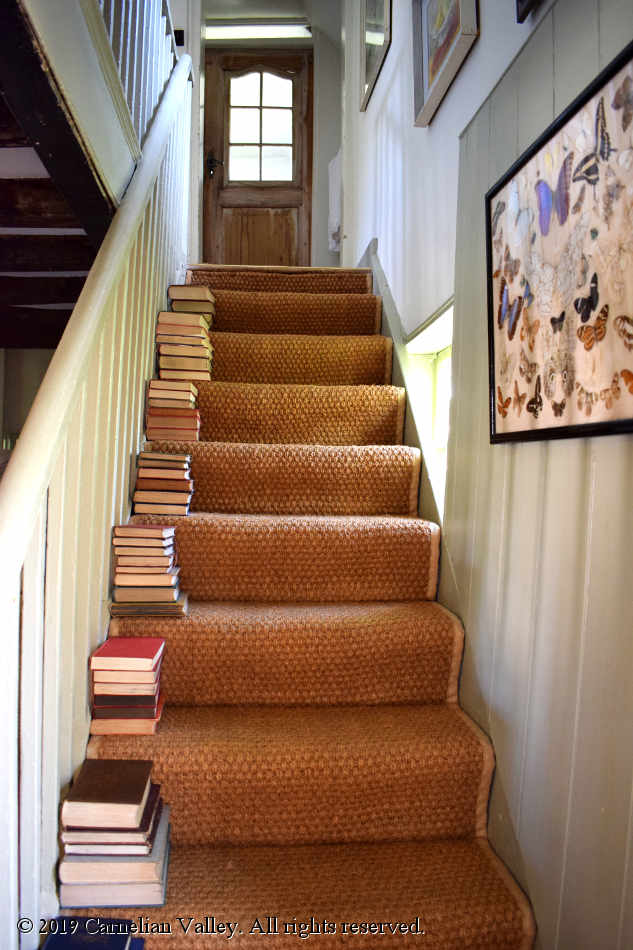
Back down the stairs which have been reinforced (the original staircase goes a bit further but it’s open to the room – probably the reason it’s roped off), through the shop to the vestibule. Downstairs in the kitchen and a cellar that has been turned into a museum room for examples of iron forgery, mostly fire backs. The upstairs room is dedicated to vehicles, grandfather clocks, and small items (pictured above).
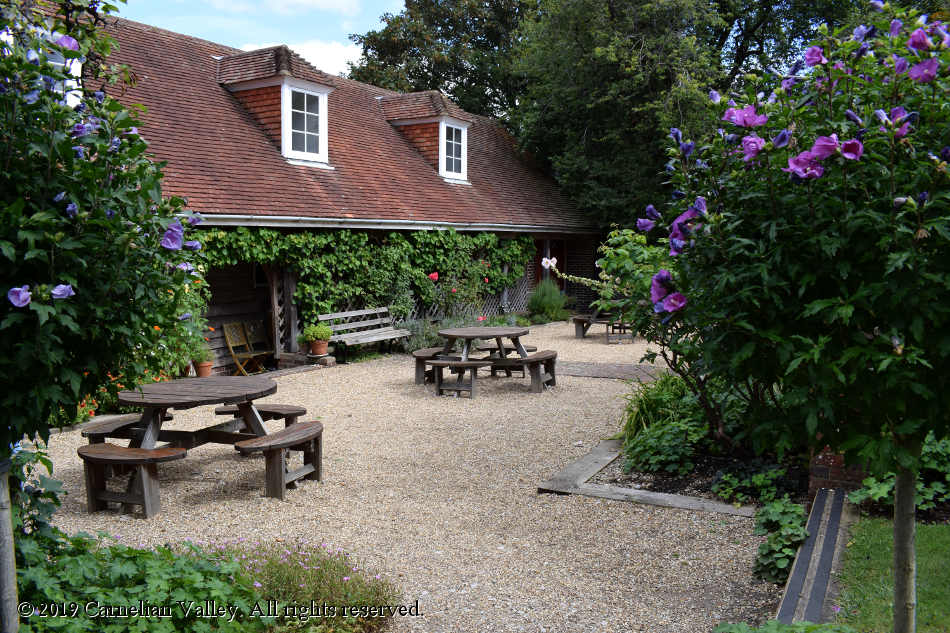
The back garden, accessed via the vestibule, is smallish and peaceful. The gardeners have made a wonderful job of making it colourful and productive – berries hung along the barn eaves.

Looking around the house and having lunch took about an hour in total – you could make it longer but it’s definitely a casual sort of place, not requiring any planning beyond getting there. This makes it quite special – an easy site to add to you list, so long as you don’t live far or are staying nearby. Certainly if you’re visiting other sites in the area and have a lot to pack in, stopping here for lunch is a very good idea as not every site has a cafe and the food is ample.
To sum up my time there, an unplanned venture turned into a memorable experience.

Reading Life: 9th September 2019
Posted 9th September 2019
Category: Reading Life Genres: N/A
Comments Off on Reading Life: 9th September 2019

At about 1/3 of the way through This Must Be The Place, I’m finding it a lot of work, mentally, but still enjoying it; it changed rapidly with the introduction of new subplots which O’Farrell is exploring concurrently and via various characters. A lot of it has to do with different periods of time and ‘clues’. Aside from the requirement to keep up, the book is satisfying in its complexity. The various voices are intriguing, with characters from different places; O’Farrell’s staying in tune with the dialects.
Conversations With Friends, begun very belatedly (it won the Young Writer of the Year Award in 2017), is going well. It’s not caught my interest quite as much as the O’Farrell simply because the plot is more simple and the book overall more usual, more of what I’ve read before. It’s also not due back at the library in a few weeks, like the O’Farrell. The conversation in it is definitely the best part, at least for now. The narrator is an interesting choice – the character who is the most open, most talkative when it comes to others, less likely to hide things, and more reliable simply due to the seeming honesty in her words and obviousness in her actions.
I’m in an accidental Irish author phase.
Somewhat in tandem with my trip to Virginia Woolf’s house last week, I’m going to be making my fourth attempt to read Mrs Dalloway. The book and Woolf’s life has been continually on my mind since last summer – I’d been wanting to visit Monk’s House for a year – and so I’ve decided there’s no time like the present. The catalyst for my actually going ahead is in fact my trip – a big reason why I struggled with the book is that I couldn’t work out how old Clarissa is meant to be; I thought she was middle-aged at least, but researching other reader’s opinions suggested she’s a lot younger. Well, whether it’s still one person’s opinion or one born of more extensive research I found the answer I needed in Leonard’s garage – the National Trust’s handwritten note of recommendation for Mrs Dalloway says she’s 52. Again, whether or not that’s right and whether or not I’ll find difficulties moving forward I don’t know but it’s enough to make a start. I’m taking having seen it there as a sign.
Have you read any books by Maggie O’Farrell or one of Sally Rooney’s two? What did you think of it/them?
The Present Past: Virginia Woolf’s Monk’s House
Posted 6th September 2019
Category: Photo Posts, The Present Past Genres: N/A
2 Comments

Monk’s House, in the village of Rodmell, near Lewes, in East Sussex, was Virginia and Leonard Woolf’s home for a few decades; they bought the house in 1919, a quick purchase after having previously bought a windmill a short distance away – the two preferred the Rodmell home so they moved in. Wikipedia dates the cottage to both the 1500s and the 1700s – the latter seems more likely, but regardless, it was altered during the Woolfs’ time. They bought some of the surrounding land. Virginia had an extension built for a bedroom and later a writing lodge. After the author’s death, Leonard remained at the House, often joined by Trekkie Parsons, a married artist who is believed to have been his chaste lover. Following Leonard’s death, Trekkie sold the house to Sussex University in 1972 and the National Trust bought it in 1980, turning it into the museum you see today.
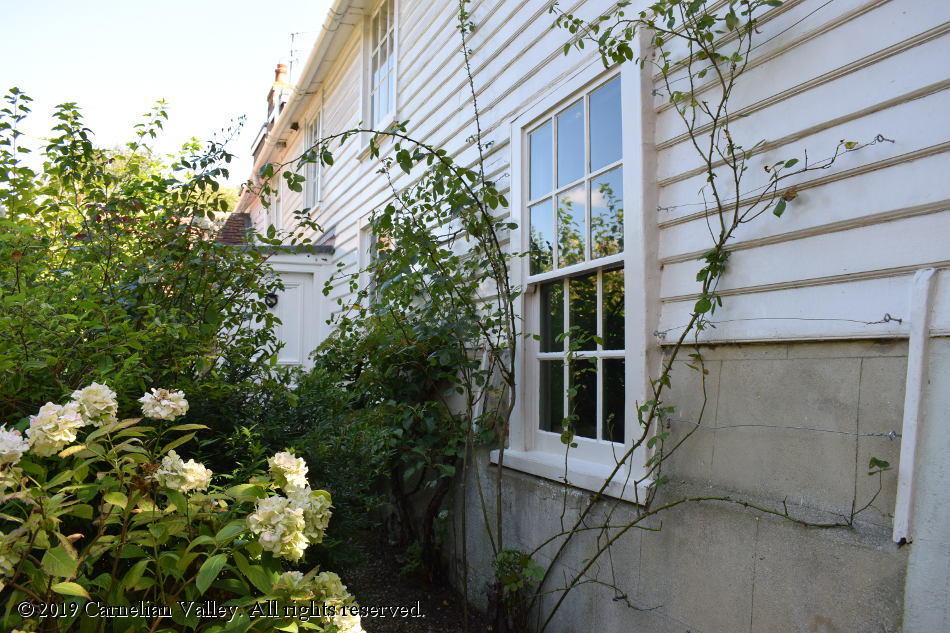
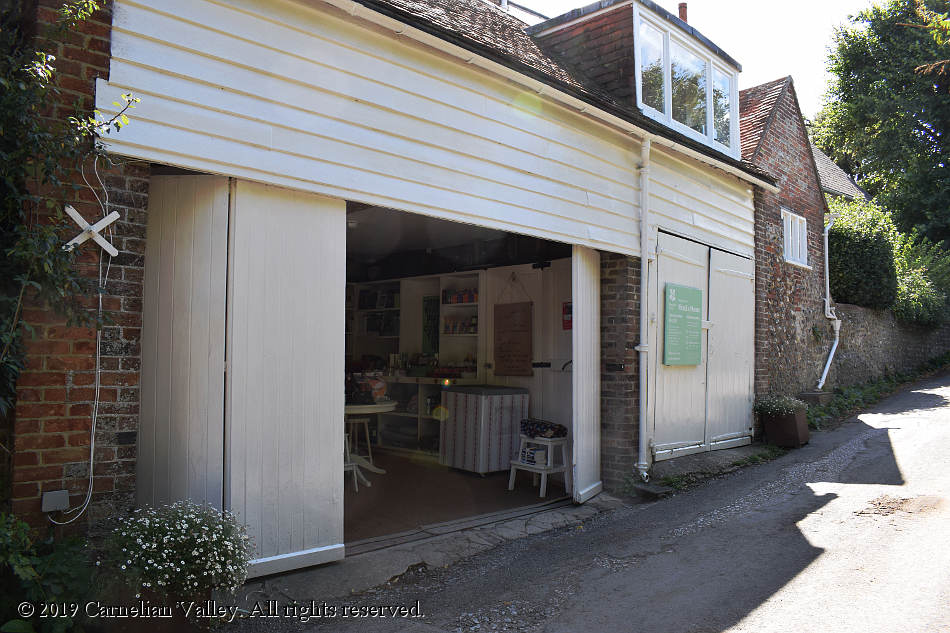
Arriving at Monk’s House, a white-washed half-hidden cottage down a gorgeous English country road, you find a space in the small car park and walk back to the entrance. The National Trust has set up their ticket office and shop in Leonard Woolf’s garage; the door-to-street environment, so different a choice to every other Trust property I’ve visited, gives you your first glimpse of what you’re about to experience. Once you’ve purchased your ticket, you exit back onto the road and head for the front garden gate. You pass the front door, surrounded by overgrown plants (another hint) and continue to the back garden, past the greenhouse which is effectively also a conservatory.
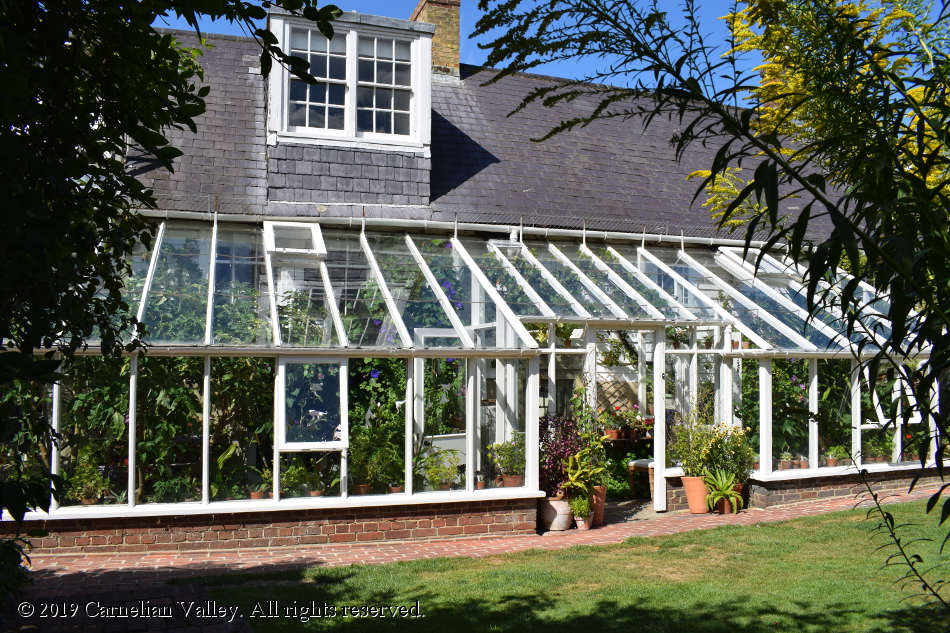
And there you are. The door to the house is in the greenhouse, and in front of you stretches a number of small garden areas which, if you visit during the hotter months (there’s likely also some overgrowth in autumn) cover… everywhere. The Trust have kept the property close to the way it was when Virginia and Leonard owned it, and they have let the laid-back atmosphere remain. At Monk’s House you can sit in the garden, lay on the lawn, play bowls, relax on a bench, have a picnic, and take your time. The House itself, its rooms very small, is limited to a certain number of people at any one time so that you can properly enjoy it, and even when busy remains a casual experience. I’ll start with the House.
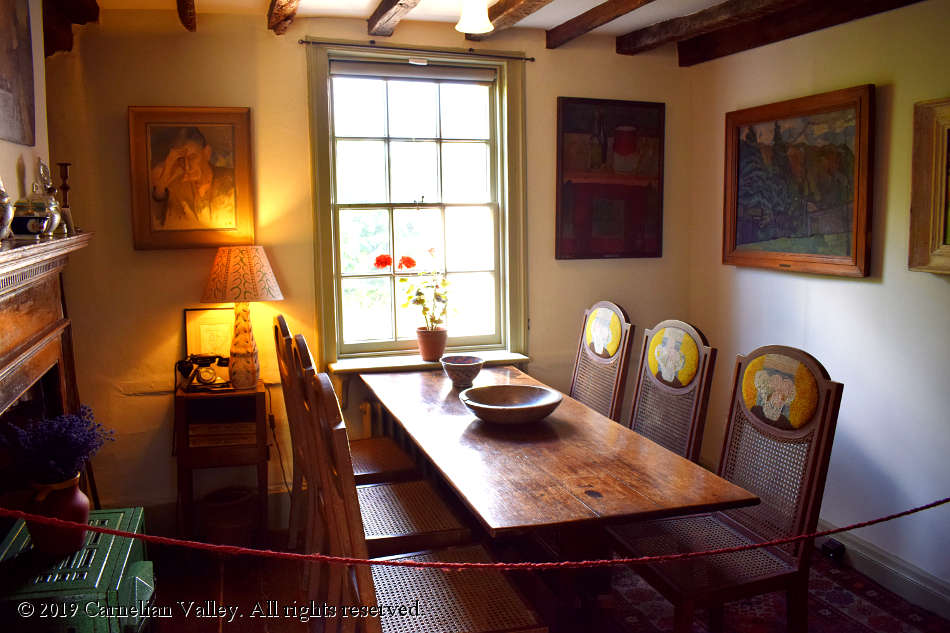
You walk in through the greenhouse door into what is now the dining room; its function changed from bedroom to dining room when Virginia extended the house. A staircase directly to your right holds books; it’s closed off, likely due to space. Presumably the first floor holds the room that was Leonard’s – certainly there is a balcony on which the Trust have placed deck chairs and a few other windows. The dining table is roped off because the furniture is at least partly original – the decoration on the chairs was created by Virginia’s sister, the artist Vanessa Bell. The painting of Leonard you see to the left was done by Trekkie Parsons. To the right, not pictured, is Vanessa Bell’s famous painting of Virginia. The room also houses Leonard’s bowling balls.

To the left of the dining room is the living room, shown in the opening photograph to this post. The fireplace above is the other end of the room. You can probably tell from these just how small the house is. Due to the smallness I didn’t take a photograph of the kitchen, which is at the far right side of the dining room. It’s tiny; it holds a dresser and a cupboard that was painted by Trekkie (the Trust says whilst she was waiting for food to boil), and a few other kitchen items.

From the kitchen you return outside. Then you take a left turn into the extension built to house Virginia’s bedroom. The author had this room built so that she had a place to write, and it’s indeed inspiring, light shining through the windows, the walls painted a bright colour. On the shelves stand her self-bound volumes of Shakespeare. Virginia soon found that the bedroom wasn’t quite what she was after in terms of her concept of a room of one’s own, and so she and Leonard built a writing lodge.

This is the view that awaits you as you turn to leave the room. I couldn’t not include it.
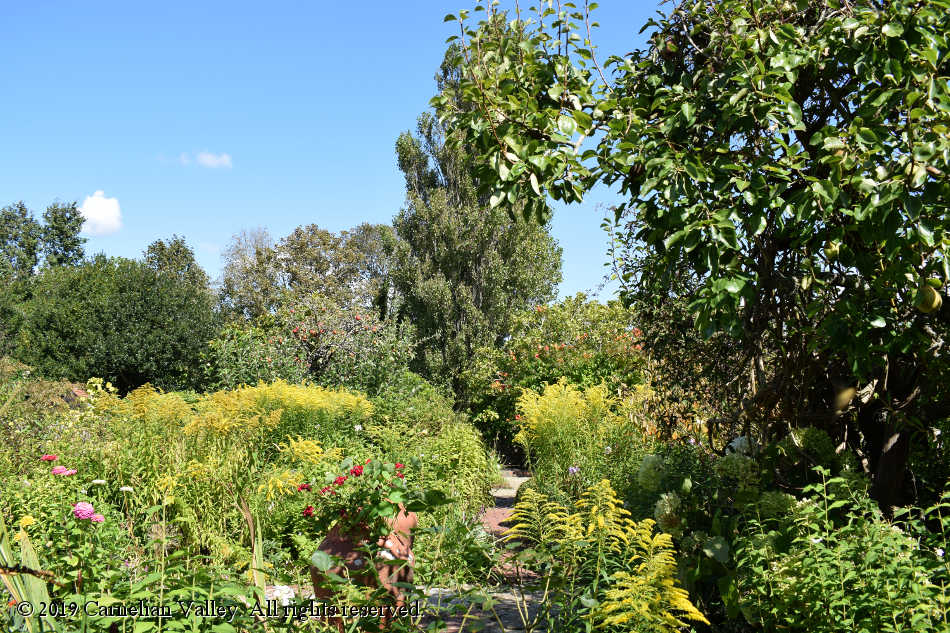
Here’s the view from further right. It’s hard not to fall in love with this place. If you’ve ever seen the garden that inspired Frances Hodgson Burnett you’ll know that it was quite average apart from its walls. I can’t help but wonder if Virginia and Leonard decided to create their own homage to the book.
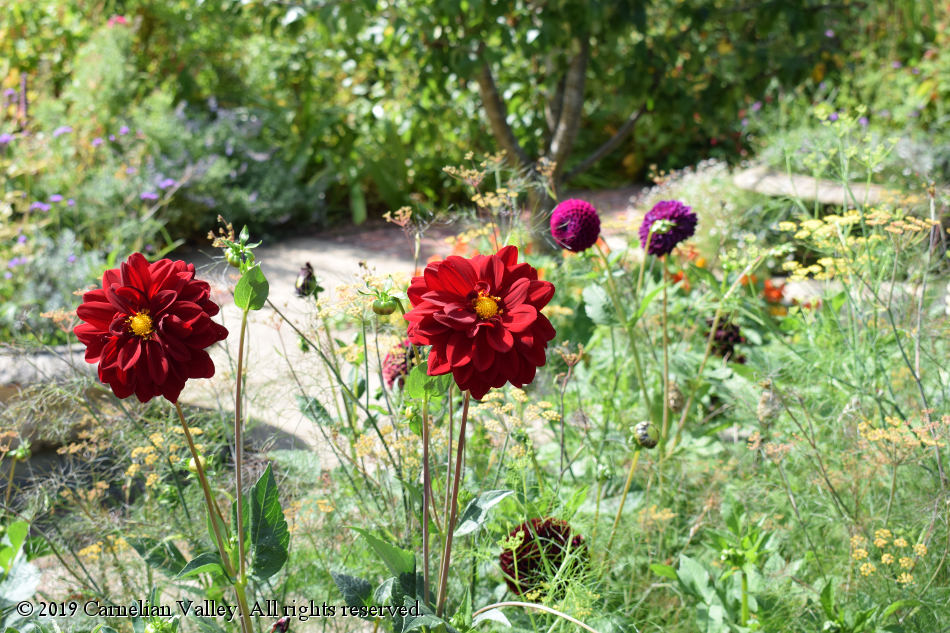
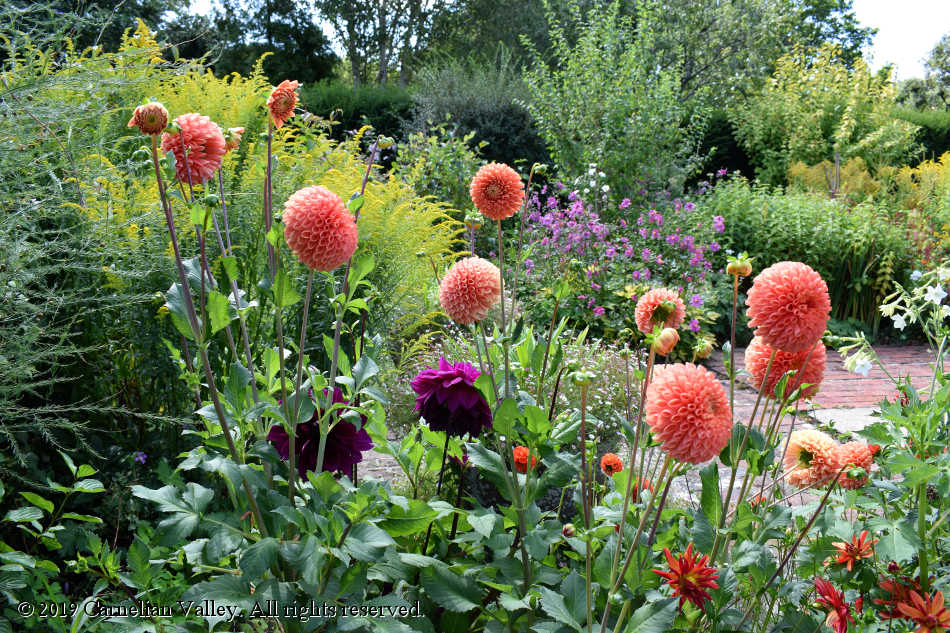
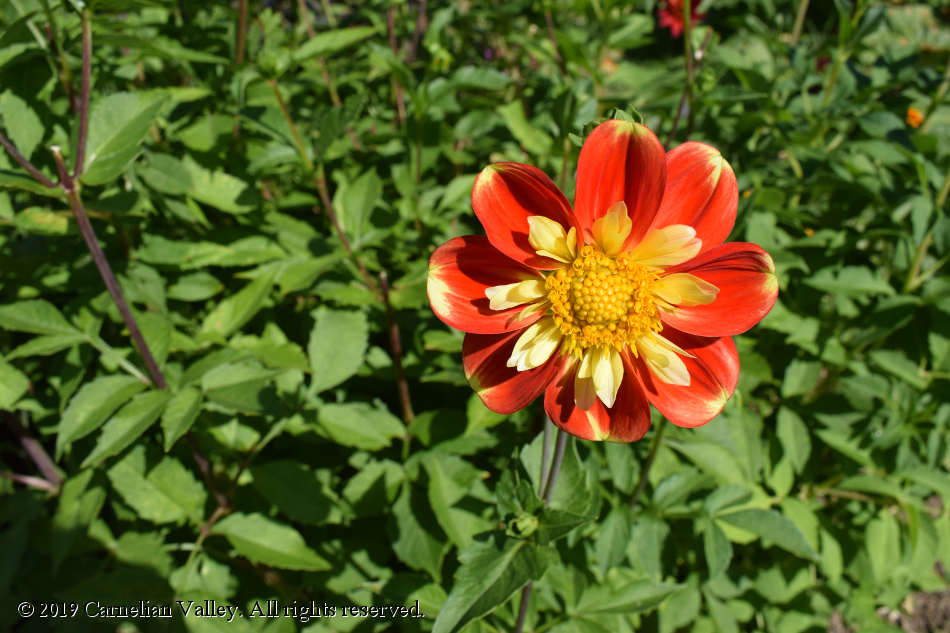
Leonard was the gardener of the pair and he designed the space to be atmospheric and inspiring. The garden to the right of the greenhouse, the first garden you see as you step onto the property, contains a sunken pond (photo below this post). The path shown just above, purposefully overgrown, that’s parallel to the one from the bedroom door, takes you to a few side-by-side flower gardens which continue on to a couple of lawns, one which holds the burial places of the couple’s ashes.
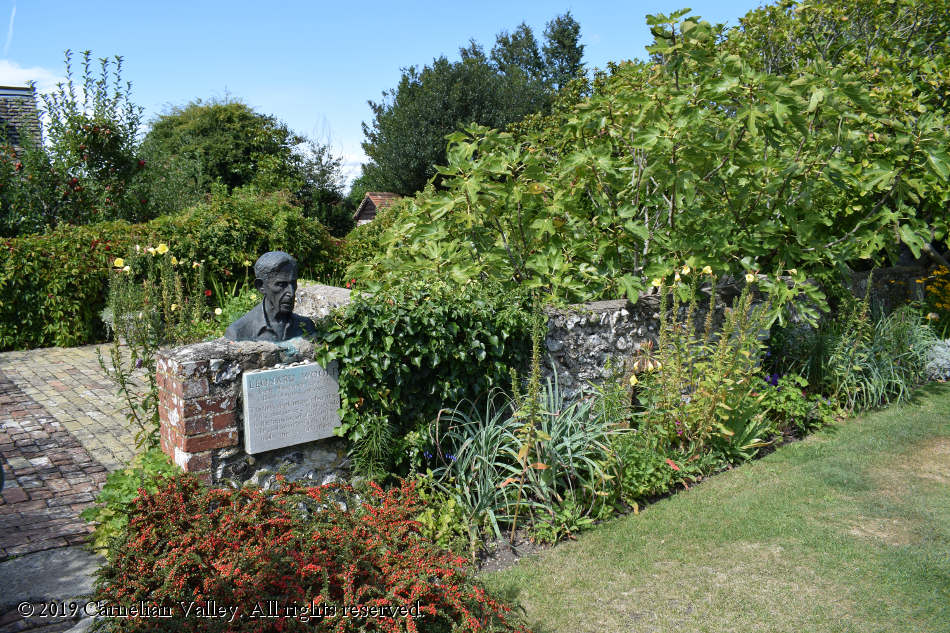
Virginia’s spot has a similar plaque and bust to Leonard’s; there was a group picnicking beside it so I didn’t take a photograph, but you can just about see the plaque at the right edge of the photograph. The burial spots were chosen for their elm trees, which have unfortunately both since died; Leonard’s was blown over in the wind, Virginia’s had problems with mold.

As you move on further, part of the garden opens into a wild area where the Trust have a shed and green house they use for upkeep. The village church is this garden’s neighbour. Beyond that is Virginia’s writing lodge. The lodge has been split into two sections via a windowed wall, allowing you to see the room as it might have been set up whilst not having to worry about knocking things over. The section in which you stand has a collage of copies of A Room Of One’s Own on the wall, different covers and pages from many different languages. According to my research, the fairly tidy desk is fantasy; Virginia kept her space less organised. It was here she wrote almost all her novels. (You can find a photograph of the outside of the lodge at the bottom of this post.)

Out of the door and to the other side is the lawn on which the Woolfs invited their friends to play bowls; the view is stunning; it’s easy to see why it was so favoured. On this lawn is also a pond, currently the host to water-boatmen, dragonflies, water fleas, and lotus flowers. On one side of the lawn, near the lodge, is the allotment. The other side takes you back to the House, your longer-than-it-first-seemed walk around now complete.
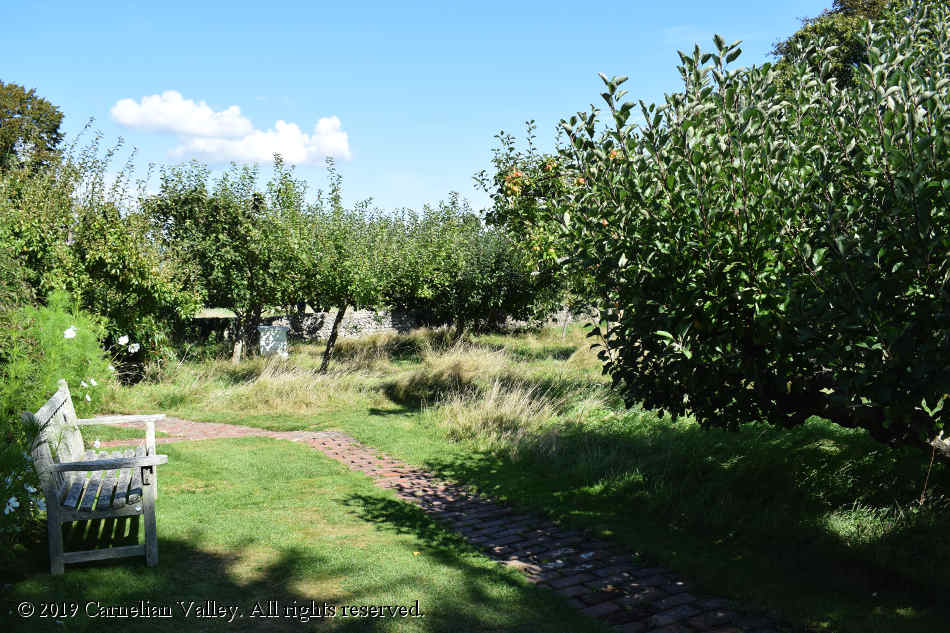
Whilst I may have visited on a glorious day, I would say that you could visit whatever the weather or season (besides winter when the property is closed for all-round maintenance) and enjoy yourself. The experience of the place is such that it’s going to inspire you no matter what.
The rest of my photos



Analyses Of First Lines #7
Posted 4th September 2019
Category: Close Reading Genres: N/A
1 Comment
Five years ago I wrote about not being able to truly engage with a book until a couple of pages in. Back then I attributed it to both excitement and being overwhelmed but now I can say that whilst overwhelm is always present for some reason – a lengthy book, a highly-rated author – excitement isn’t always a factor. I can, now, also say that it’s less of a problem with ebooks. Reading an ebook, whilst you have page numbers available, you haven’t that stack of pages on the right hand side, and you can’t feel the heaviness that a stack of pages creates. I think the overwhelm is also trepidation, most often to do with an author you’ve not read before. ‘What am I getting into and will it be fun?’ This has been a factor in my reading of Maggie O’Farrell’s This Must Be The Place. It took four pages, then I noticed the writing, the attention to making the American character read as American, and the overall atmosphere of the book. I knew that O’Farrell is a favourite of many. But I hadn’t known why.
The book inspired this edition of my close reading series. It’s actually my third attempt at reading it, spanning almost a year, but with good reason – a reader who unfortunately still needs a fair bit of quiet, my attempts to read at the library, once when waiting for others and a second time during a busy period, meant that I took very little in. I had considered moving on but I was drawn a third time; this time I borrowed it and the third time, complete with a different environment proved to be the charm.
Maggie O’Farrell’s This Must Be The Place (2016)
There is a man.

O’Farrell begins on the page with a name, location, and year (Daniel, Donegal, 2010); the first line follows. So, in effect, her first sentence is bolstered by extra information. But many authors do this – it’s used to tell you where you are, and with whom, most often when there is more than one narrator or focus character. A regular first name, a place in Ireland, and the year – six years before publication – simply gives you a briefing for what you’ll find out very soon.
Read without any context, the first line is still useful. In fact it’s fantastic. Are we reading first or third person? Maybe it’s second. We’ve only four words to go on and a full stop that is objectively very normal but subjectively, here, almost a word in itself. There is a man… and nothing else. There’s a man – cool? There’s a man – so what, men make up roughly half of humanity. But what is definite is the ominous tone, a tone that says there could be something to worry about here, four words and a full stop alone on a line.
Leaving the vacuum and considering the stage setting, if the man is Daniel then O’Farrell is narrating in that particular manner perhaps best known as a children’s literature device, description written in a specific, immersive, way. If it’s not Daniel, then Daniel is probably telling a story.
Michelle Obama’s Becoming (2018)
Preface: When I was a kid, my aspirations were simple.
Chapter One: I spent much of my childhood listening to the sound of striving.

I’ve included both first lines in this case as it’s hard to decide exactly which ‘should’ be the absolute first. I’ve also included them because there is a highly literary aspect joining them: the preface sentence makes a statement and – though perhaps this is subjective, certainly it’s less definite – Chapter One’s sentence back that statement up. This was no accident. Moreover, both sentences set up who Obama is and was, and it also gives you a good idea of what her book will be about beyond her time as First Lady. (This is likely going to be more the case if you’re not American.) Chapter One’s sentence puts Obama in the position of hard worker, which you would have expected already, but the Preface’s sentence suggests in addition (though coming first) that her path to the White House still surprises to her. At the same time, the construction of the Preface’s sentence, with that pause after ‘when I was a kid’, allows you to assume change – she may well have evolved her aspirations as she got older.
It’s no surprise the book opens with a strong statement, but the detail involved… I wouldn’t mind analysing a few more snippets from this book because when read in a regular fashion the whole extent of the nuance is missed, as it can be in any book. Is it perhaps better in audiobook form, with Obama reading? That’s likely.
Charlotte Mary Yonge’s The Heir Of Redclyffe (1853)
The drawing-room of Hollywell House was one of the favoured apartments, where a peculiar air of home seems to reside, whether seen in the middle of summer, all its large windows open to the garden, or, as when our story commences, its bright fire and stands of fragrant greenhouse plants contrasted with the wintry fog and leafless trees of November.
Very much of its time, this lengthy sentence provides both more and not enough information; there is nothing to tell us what the book is about beyond the class status of a/some characters and the season. It tells us of the House, which may be the main setting, and the characters’ love of the drawing room. The sentence sets a scene but it’s scenic rather than functional, all description; it works in the context of the easy-going lengthy books of the period.
Anne Melville’s The Daughter Of Hardie (1988)
On a day of Indian summer in 1898 Richard Beverley, Marquess of Ross, travelled to Oxford to see his great-grandchildren for the first and last time.

In terms of details, everything is here, including a glimpse of the social standing likely in play. There’s a note on the domestic situation – whilst this book is a sequel and thus you probably know about the family already, the fact it’s children rather than child suggests the Marquess waited a while to see them. Readers of book one know the answer. New readers don’t but could make a good guess.
The use of ‘Indian summer’ is interesting: it doesn’t appear to have a ‘proper’ reason for being there, but can we presume a use of pathetic fallacy, despite the Marquess’ noted demise, that suggests something good to come?
Sally Rooney’s Conversations With Friends (2017)
Bobbi and I first met Melissa at a poetry night in town, where we were performing together.

In her usage of ‘we first met’, Rooney presents a possible conflict or thriller-esque point to be handled later in the form of the consequences of meeting Melissa, but the main takeaway here is that the author provides us with a who, what, where, and a specific ‘where’ at that. That it’s a poetry night performance – most often small and local if my experience is anything to go by – suggests that this book is going to be a book about books or, if not, at the very least literary. Also of note is the use of ‘Bobbi and I’, grammar that has fallen out of favour as incorrect. It could simply be how Rooney talks – certainly the mainstream shift is recent – or it could be an illustration of the way the narrator speaks.
We have a Bobbi, who the narrator knows, and a Melissa, but we’re yet to know who is talking.
Conclusion
Often there is a link, however small, between the books I’ve selected for these posts, but this time there isn’t. (I select books that are in my sphere at the time so any similarities are just a reflection of what I might by studying.) Beyond the fact that two are set in the 1800s (one contemporary, one historical) and that two are award winners, there is nothing to really compare. What does stand out, purely from the vast difference in dates between the Yonge and the others, is the fact that preferences and trends for first lines have changed and evolved – but we knew that anyway. I think there is a lot to be argued in favour of the way first lines were written in decades past but Yonge’s example here is an argument against them; it’s got that easy-going atmosphere, as said above, but it lacks further points of interest.
What these books have done, particularly the first two, is make me even more interested in looking at other lines; I’ve considered end lines (I’d like to go through the books for which I’ve studied first lines and look at how they end so long as the ends are not spoilers) but I’m also starting to like the idea of the middle lines or lines from a certain page number. But it could be the most tedious thing ever. It needs more thought.
What lines from recent reads have stayed with you?
August 2019 Reading Round Up
Posted 2nd September 2019
Category: Round-Ups Genres: N/A
4 Comments
This month I finished two books and began two more. In terms of available reading time, I’m calling this a success. I also went back to using the library which I had effectively forgotten due to having lists of other books; I started a new book yesterday and it’ll be on September’s list. One book-related thing I did this month was visit the grave of Alice Liddell, the (likely, if you go by the amount of evidence) muse of Lewis Carroll for Wonderland – it’s in a church graveyard in Lyndhurst, New Forest. It’s a bit of an ‘icky’ story as Carroll was quite taken by Alice and later asked her parents for her hand, but it’s still interesting for its literary value. I decided to go inside the church, too, which proved a good idea; they’ve a lot of information currently on stands and there was a lady there who welcomed me and told me even more. (I wouldn’t say to go out of your way to visit, but if you’re passing Lyndhurst it’s worth it, and I recommend stopping for a cream tea at the Mad Hatter’s cafe, too. I’ll see about writing a slightly longer report and including photos.)
Both books are works of fiction.
The Books
Anne Melville: The Daughter Of Hardie – continuing the saga that begun with two pairs of siblings, book two follows the children of the one marriage that resulted, with a fair-sized focus on the youngest child of the house who, with the onset of the First World War, finds more options available to her than the women of the previous generation. A solid continuation: a few bumps but well worth reading.
Elizabeth Chadwick: The Irish Princess – A fictionisation of the life of medieval royal, Aoife McMurchada/MacMurrough, this story looks the Irish politics of the day, the constant warring between rival rulers, the Norman-British influence, and Aoife’s relationship with Richard de Clare of Chepstow (then Striguil). The history, where factual, is interesting and well accounted for but the book drags a lot.
I enjoyed reading the Melville a lot – I was worried for a while that it wouldn’t at all match the previous book but given a bit of time it really did. In terms of the Chadwick I enjoyed the history lesson but it took me a while to get through it all; I tend to find her books either excellent or not so good and this is one of the latter, more developmental editing needed.
For September I’m continuing the two books already begun. I’ll then work from there; I want to keep my options open.
Do you have any authors you find hit or miss?


