





Guest Post: Wilhelm Grimm – The Quintessential Romantic Hero?
Posted 9th August 2013
Category: Further Thoughts Genres: N/A
2 Comments
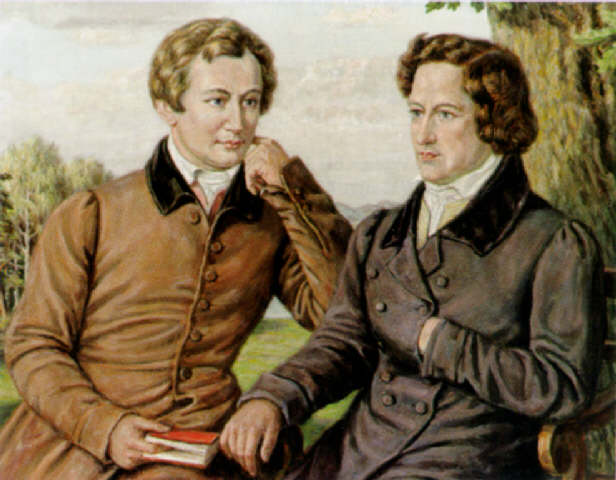
One of the problems of writing historical fiction which draws on the lives of real people is that, well, they’re real people. And if you are trying your best to be true to their life, you can’t go mucking round with known facts. Well, at least, I can’t. It’s important for me to be as historically accurate as I can, whilst still weaving a vivid and compelling story.
My latest novel The Wild Girl tells the story of star-crossed lovers Wilhelm Grimm and Dortchen Wild, drawn irresistibly together by their love of old half-forgotten stories but kept inexorably apart by parental disapproval, poverty, and war.
Yep, that Wilhelm Grimm. One half of the famous Grimm brothers, whose collection of fairy tales is one of the famous books of all time. Most people do not know that his one true love, the woman who would become his wife, was one of the primary oral sources of the tales. Dortchen Wild grew up next door to the Grimm family and was best friends with the only girl of the family, Lotte Grimm. Dortchen told Wilhelm such famous stories as Rumpelstiltskin, Hansel and Gretel, The Frog King, Six Swans, and The Singing Bone, when she was just nineteen years old, and Wilhelm in his mid-20s. They fell in love, but many obstacles stood in their path and it would be another fourteen years before they could marry.
Well, that’s the first thing I’d have changed, if I could. Fourteen years is a long time to maintain suspense and narrative tension in a novel (though luckily lots of other interesting things happened, like Napoleon’s disastrous march on Moscow, his defeat and imprisonment, and then his dramatic escape to gather another army and wage war on Europe again.)
Another problem I had is that Wilhelm Grimm is not most women’s idea of a heartthrob romantic hero. Most illustrations of him are stern and unsmiling, and quite a few of them show him in his dotage, a grumpy old man.
The truth is he was strikingly handsome as a young man, in a pale and poetic sort of way. He had suffered asthma as a child, and in his 20s was ill with a frightening and painful heart condition that may have been caused by panic attacks, or by mercury treatments for his asthma, or may have been a condition such as paroxysmal auricular tachycardia, which basically means an abnormally fast heartbeat that comes without warning. He was also devout and driven by a strong sense of duty to his family.
So Wilhelm was not your usual Alpha male.
Luckily for me, I’ve never been a fan of those big, brutish thugs you see bare-chested on romance novels. I’ve always preferred a more Byronic hero. You know, with pale hollow cheeks and tousled dark hair that you just long to stroke away from his dark eyes that are fixed intensely on your face, your mouth.
A man who loves books and music and art, and wants a woman who can match him for wit and ardour.
A man that talks of poetry and passion, not huntin’ and fishin’.
Wilhelm was the poet of the two brothers. It was Wilhelm who rewrote the fairy tales with such aching beauty that they have been read and re-read for the past two hundred years.
Wilhelm wrote of the fairy tales: ‘in the myths which tell of the golden age, all Nature is animate, and the sun, moon and stars are approachable, give presents, or let themselves be woven into clothes, while in the mountains the dwarves dig metal, the water nymphs sleep in the water, the birds, plants and stones speak and know how to express their sympathy, blood itself calls out and speaks.’
And Wilhelm wrote of his love for Dortchen: ‘I have never ceased to thank God for the blessing and happiness of this marriage. I had known my wife ever since she was a child, and my mother loved her like one of her own, without ever guessing that one day she would be.’
Now that’s my kind of man!

Kate Forsyth is the author of The Wild Girl and Bitter Greens, and she has written many novels for children. Kate is studying for a doctorate (her subject is fairy tales) and she regularly blogs about the research for her books at her website. Her Twitter handle is @KateForsyth.
Explaining The Conclusion Of Before Ever After By Samantha Sotto
Posted 19th July 2013
Category: Further Thoughts Genres: N/A
Comments Off on Explaining The Conclusion Of Before Ever After By Samantha Sotto

Recently it’s come to my notice that people are finding my site when searching for variations on “explain the ending of Before Ever After”, “conclusion of Before Ever After”. As far as I know, Samantha Sotto hasn’t received all that much publicity, and this is why I think so many people land at my site. I can understand these visitors – the ending of the book is a little ambiguous, even if there are hints as to what has happened – and whilst it’s nice that people are coming to my site, I know that my review does not answer their question.
So, because of the number of searches there have been, please find below my interpretation of the conclusion of Before Ever After. It is one of my favourite books, so even though I read it last year, I remember a lot of it. Due to the nature of interpretations of conclusions, what I say could be considered spoilers. That said, at the same time I realise what I have to say may intrigue potential readers for Sotto’s subject matter and handling of it.
What you have to remember is that in the fantasy version of earth that Sotto creates, there have been very few people who have survived dying to become immortal. It takes a particularly strong person – strong in will – to survive death, and indeed Max only knows of one other person who has managed it. This other person is accounted for by Sotto, so I won’t take this point further.
When Shelley arrives at Max’s home, after having realised the truth of his life and gone searching for him, she has already taken the poison that will kill her. But she doesn’t make that the first thing she says to Max, presumably because she wants to explain things before he has an opportunity to become anxious. Shelley has taken the poison in an attempt to kill herself with the intention of getting through it, like Max did, and becoming immortal. She is willing to kill herself for the small chance (and it is small given that it is a difficult thing to accomplish) of succeeding and joining Max in his immortality. She does this even though Max tells her of his past girlfriend who failed and died.
This is, at it’s heart, Sotto’s way of explaining love conquering all. Shelley’s death is a test – if she fails she did not love Max enough, if she succeeds then she is “the one”, so to speak. However this is not to say that Sotto is advocating such methods or concepts of love in general; this is of course a fantasy novel and her ideas rest firmly on the page. And given that Shelley and Max’s relationship has never fallen into the realms of general angst, that they have always been mature and more or less realistic, this part of the book is surely quite acceptable.
Sotto ends the chapter without telling you what happened after Shelley died, and when you turn to the last page there is just a quick description of a breakfast table set for two the next morning. This could mean that Shelley died the previous evening and Max is remembering her, but it makes far more sense that it refers to Shelley’s success in becoming immortal – in dying and then coming back to life, as immortal now as Max.
And if this is so then Sotto is inferring that Shelley loved Max enough, that she truly loved him and they were meant to be together, literally forever. Max lost his blood relations as history took its toll, but he now has a chance to start afresh with Shelley.
If you’ve read the book, what do you think of this interpretation? If you haven’t read it, have I intrigued you?
Subscribe to this site via email and you’ll receive 3 posts a week. If you use Gmail, you may find the posts are stored in your ‘social’ or ‘promotions’ tab.
Identity In Daphne Du Maurier’s Rebecca
Posted 11th February 2013
Category: Further Thoughts Genres: N/A
5 Comments

Screen shot from Rebecca, copyright © 1940 Selznick International Pictures.
I’ve been wanting to discuss identity in Rebecca for some time, but as it is such an obvious theme I wasn’t sure if it was of any interest. A couple of people have said there is always room for discussion, however, so I’ve decided to just post my thoughts to get them out of my mind. You will find what I’ve written to be a stream of ideas. I haven’t edited it much because I think I’d end up losing half of what I wanted to say, but I reckon it should be coherent enough.
Identity is so important in the novel, and the biggest sign of it is du Maurier’s decision to never name her heroine. If she had a name for her then one would believe she would’ve provided it, perhaps at the end of the book where the character finally comes into her own. But du Maurier says nothing, and it makes sense that it was a case of choice rather than a writer having no inspiration before she realised it made for an interesting style. The unnamed heroine does come into her own at the end of the book and yet still she is relegated to being called Mrs de Winter. And since Mrs de Winter was always Rebecca, even after the re-marriage, continuing to use that name suggests that the heroine might never quite be an individual. Until, perhaps, Mandeley burned down and the traces of Rebecca truly left.
Of course the very usage of Rebecca’s name as the title emphasises who this book is about and makes it clear that in death a person can still be the strongest character. The heroine is pushed into a corner and never earns herself a name of her own; we hear of Rebecca constantly. Indeed is the heroine’s role in the book to aid the remembrance of Rebecca, in more ways than the obvious role of new wife dealing with the affects of the old? That is surely what Mrs Danvers’s role is about, to remind the house of Rebecca through the heroine, causing the heroine to be Rebecca’s ghost somewhat, even whilst the housekeeper hates her.
And what is it about those who care for our heroine – they don’t use her name either. Of course this is a device by du Maurier and in real life they likely would have used her name. This non-usage diminishes the heroine’s place in the house, in the story, ever further. To bring in the film adaptation, the performance by the actress suggests someone who is truly never called by her name. It may be an adaptation but it appears that Hitchcock has focused on this and used it to show the emotional turmoil even further. The film is a fantastic adaptation that is true to the spirit of the novel and its characters, and through the use of visuals it would appear that the heroine is never known by anything other than “darling”. There would surely be a difference in the attitude of the heroine, both in the book and in the film, if she was called by her first name, no matter if the reader knew or if it was confined to subtext. The very thought of a name being included somewhere down the line makes you think there would be a difference in nature and attitude, as the heroine acts very much like someone truly lost, lost in a world where no one knows who she is, in a very literal way.
Or does the fact that no one calls the heroine by her name reflect how a person can be accepted for who they are without special treatment? Beatrice certainly likes the heroine and the heroine is a different person around her. Indeed it could be said that the omission of a name allows du Maurier to more fully explore for her readers the idea of self, position, reputation. Without a label, a person can be who they want. And indeed once the label of Rebecca’s successor is gone, once Max tells her he never loved Rebecca, the heroine is a different person and able to defeat Rebecca.
After the wedding, upon arriving at Mandeley, the heroine says ‘And now I belonged here, this was my home’. She continues by listing all the things she can now do, for example walking in the gardens and talking to the gardener. The word ‘belong’ is everything here, because one of the overriding feelings the heroine has is of not belonging. The heroine’s strength relies on her having not yet entered the house, having not seen that everything is the same as it was when Rebecca was alive, having not met Mrs Danvers. It is interesting to compare the implied strength and feeling of commandment in this moment with the later weakness and submission to Mrs Danvers, the lack of will to change the house to suit her [the heroine]. Comparing the heroine’s thoughts before and afterwards, her dreams and wishes are influenced by the house. Though of course this is not to suggest that the heroine is ever truly strong, indeed if she were strong, self-assured and confident, she would have changed the house to her liking and ignored the hatred of Mrs Danvers from the start, which we can assume would either have led a stubborn Mrs Danvers to quit, or else to bow to her new mistress’s wishes instead of growing ever more powerful herself. (It is interesting to contrast the downfall of the heroine, who should have had the power, with the rise of Mrs Danvers who should have been courteousness if not welcoming.)
Consider the phone call from Mrs Danvers in which the heroine responds that Mrs de Winter is no longer alive. The heroine is so overtaken by the idea and ‘memory’ of Rebecca that she only sees the dead woman as the holder of the title. Yet you could also say that the heroine’s response could be applied to herself – the heroine, who is rightly Mrs de Winter, too – is no longer an individual, or independent in any way. Rebecca has consumed her, her new life has taken over, and she is no one.
Looking back at the way Mrs Danvers uses the heroine to remind others of Rebecca and the way the heroine gets so caught up in worrying that she brings Rebecca to the forefront where really Rebecca should have been forgotten by everyone except Mrs Danvers, the heroine’s identity appears to become as one with Rebecca’s as she obsesses over the woman. In a way, the heroine is Rebecca, or at least could be called Rebecca, for the way in which she submits to being the second wife, the runner-up to the winner so to speak, and the way she fails to do anything to change Mandeley to suit her own needs and person. Of course the heroine’s background precedes her – she worked as a servant and comes from a different background to Max – but given Max’s attitude there is no reason the heroine ought to have been so submissive. The book is a lesson in being strong, which the heroine is not. Being Rebecca’s successor surely renders her own name irrelevant.
Mandeley and Rebecca are one and once Rebecca has gone, so too does Manderley; the heroine and Max are free to be themselves. What made Max his own person was surely his striving to live with the awful wife he had and to submit only where he had to, to confront her when he could.
Rebecca owns the book without truly existing. The book begins after her death, thus she has never actually been alive and there are no flashbacks in either book or the film adaptation (how would the story have changed if Hitchcock had created a flashback from Max’s monologue in the boathouse?). This shows just how powerful memories can be. It is only the heroine (and Mrs Danvers, admittedly – would she have been so wretched if the heroine had been strong?) who thinks of Rebecca. The references to the woman make her seem as important as anyone else. She isn’t really, and yet she is the catalyst.
Rebecca the book is, in name and subject. And our heroine is surely somewhat Rebecca herself.
What is your take on this subject? What do you think about my ideas?
Subscribe to this site via email and you’ll receive 3 posts a week. If you use Gmail, you may find the posts are stored in your ‘social’ or ‘promotions’ tab.
Further Thoughts On The Murder Of Halland
Posted 15th August 2012
Category: Further Thoughts Genres: N/A
Comments Off on Further Thoughts On The Murder Of Halland

I wanted to discuss the themes and nature of this book, and wrote the following paragraphs for my review of it. Noticing that I was giving away much of the plot as well as giving away what I myself had found fascinating to discover, I realised that I ought to keep this information out of the review and instead to post it later. Therefore you should note that this post may spoil the book for you if you haven’t read it. As this post was written as part of a review, the written structure may seem peculiar.
Central to The Murder Of Halland is the seemingly misplaced sadness of Bess. The woman appears to be suffering from depression, and from what she says at first you’d be forgiven for thinking she is upset with the hazy nature of her relationship. But what develops is a situation where the reader understands, better than the character, how she, Bess, feels, and why she is feeling that way. To Bess, who had fallen in love with Halland, leaving her ex-husband and the child she didn’t care for was the best idea. Why, after all, would anyone stay with someone they couldn’t love when there was the option to leave? Yet as the story moves on it becomes apparent that Bess may have misjudged her feelings, misjudged the way she felt about everyone, except perhaps Halland.
You may be thinking that Halland was a bad influence, and in a way that is surely correct, but the purpose of his character, and the purpose of his death, is to lead Bess to slowly understand the choices she made and the feelings she has. It could be said that as much as Halland was a negative aspect for having been the reason Bess left her family, he was a positive aspect also for having aided, through his death, Bess to see her life in the way she ought to have before. If Bess thought that leaving her husband for Halland gave her life more meaning, then the reader sees the death of Halland as doing the same and with an enhanced quality.
There is a lot about Bess’s grandfather, the way she didn’t see him and the way he didn’t particularly mind, that illustrates how negative traits can get passed down a family. If Bess doesn’t care for her daughter, isn’t she simply emulating the grandfather who in turn treated Bess badly? If you are brought up in a particular way, knowing the way your family treats you and others, you will surely match their actions with your own in future unless something happens to help you see another way of being.
Whose love does Bess need? She would tell you Halland every time, but is she right?
Then again, looking at it from another perspective, is Bess right – did she indeed need Halland’s love? Halland provided the space she needed for reassessment. We see in Halland someone who loved Bess very much, but who recognised her personality and let her live as she would. He gave her the space she needed to work things out, which is interesting in itself because it involved pulling her away from what she needed in order to realise it all. Halland is surely no more a home wrecker as Bess was his murderer.
Further Thoughts On Northanger Abbey
Posted 24th April 2011
Category: Further Thoughts Genres: N/A
Comments Off on Further Thoughts On Northanger Abbey

Catherine is ignorant of the ways of the social world. As Austen so obviously explains to us that Isabella is a complete flirt and isn’t really in love with James Morland, so she shows the opposite of Catherine’s belief that Isabella doesn’t understand the “pain” she is causing men.
What is interesting is how Isabella conducts herself. There is a brilliant section in Lian Hearn’s Across The Nightingale Floor in which the main character is told that people who are little respected often gain the most knowledge because those who don’t respect them see no problem with letting them know the bad things they do. This is essentially what Isabella does to Catherine. Although Austen presents Isabella as a good friend of Catherine, the obvious subtext is that Catherine is deluded – Isabella does not truly value the friendship, she sees it as a trifle, a holiday friendship if you will. Therefore she has no qualms about Catherine seeing her flirt with other men, even if the person she [Isabella] is engaged to is Catherine’s brother. Isabella is a contradiction and where she says she doesn’t care for money, in flirting with Captain Tilney she shows that she actually does.
It’s interesting that while demonstrating Isabella’s true character, Austen also uses her for specific comedy in the way that some of the things Isabella says she won’t do and then does do invite humour, such as her saying she has no interest in a couple of men and then being anxious to get out of the building when she sees them leaving. Austen is in on the story, the readers are in on the story, and Isabella has a lot of information. But Catherine is made clueless. It’s an interesting effect.
“Is it my brother’s attentions to Miss. Thorpe, or Miss. Thorpe’s admission of them, that gives the pain? […] I think Mr. Morland would acknowledge a difference. No man is offended by another man’s admiration of the woman he loves; it is the woman only who can make it a torment!”
Although that last statement may not be completely true, I felt a poignancy in Henry Tilney’s words. Doubtless a lot of women at that time, and men, were like that, as they can be nowadays, and Austen is effectively issuing a warning. Incidentally she is also pointing out, at a time when men were everything and women the domestic pets, that women hold a lot more power than was credited to them.


