





Going For (Austen) Gold Part One
Posted 24th June 2010
Category: Chit-Chat Genres: N/A
1 Comment
Winchester. Once the capital city of England and a place full of history and tributes. The cathedral itself holds a great many of them, all on it’s own. Mary I was married to Philip of Spain here but perhaps more importantly to us in our modern day Jane Austen is buried here.
I see you’ve noticed the tone of my voice – I am indeed writing this in the building itself. When I heard about the Jane Austen Exhibition my newly-made admiration for the author was nudged and this, along with the fact that it’s historic overall, lead me to drive all the way to Winchester.
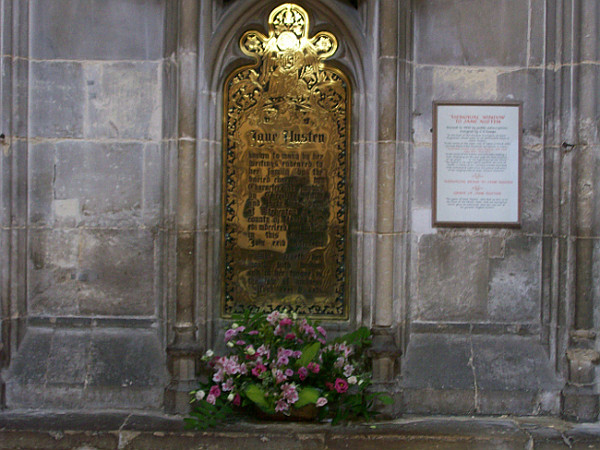
I’ve taken photographs, how could I not? But the quality of them leaves much to be desired. I know that I felt a bit anxious over the fact that I was taking photographs in a church, but the blurring suggests I was in a rush, which I wasn’t. And I’m afraid I don’t know what happened when I took the photo of the grave itself, I thought I’d got all the text in. There’s no photo of the cathedral’s exterior. All in all a very bad day for me and pictures.
I have seen Austen’s handwriting – very neat and with good spacing between lines. The grave is small, one of those on the floor, easily miss-able but for the gold plaque on the wall near it. But for the gold you would likely walk straight past the grave stone and be none the wiser unless you were scanning the floor as you went.
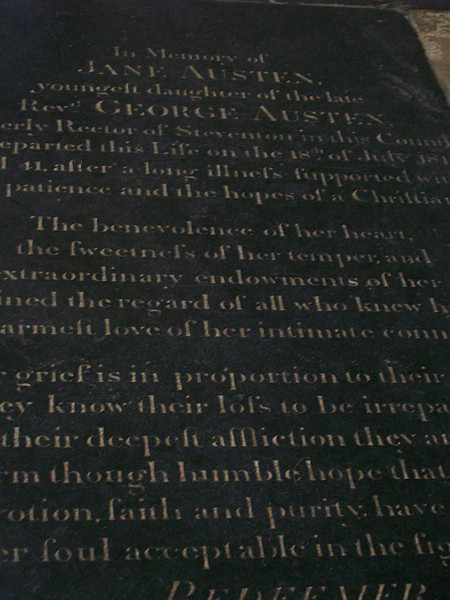
I wove my way about the gravestones. Do you ever find yourself doing that? It’s a bit like the superstitious idea of missing the cracks in tiled floor; perhaps it’s respect gone crazy as after all in some places it’s practically impossible to walk past without stepping on one, but I had this strange thought that I would look better if I was seen to be making an effort. And not to the patrons mind you, the dead themselves.
In addition to the gravestones there are a couple of tiny “chapels” which are basically tiny (really tiny) rooms holding large tombs. They are surrounded by pillars, a kind of mini cloister, and house statues above the tombstone, I guess to represent an altar. The men buried within are clergymen.
This is a very poor post, I’m all too aware of that fact, so I hope to put it right in part two.
On Ages And Readers
Posted 15th June 2010
Category: Chit-Chat Genres: N/A
Comments Off on On Ages And Readers
Opening The Times’s “The Saturday Review” a few weeks ago I flicked through the pages on music, film, theatre and games, finally to confront the book section. I love all the other types of entertainment included but why are books always placed at the end?
The double spreads focus was a large photograph of an older-than-middle-aged woman, and I’m afraid that for the second time in that same moment I thought “why?”
This is, I believe, a big reason why we’re having trouble getting young people to read. Most of the time the book sections in papers are full of literary books and older readers, there is little attention given to younger writers, people who kids would identify with more. Now you could say that this is fulfilled online – Alex Bell comes to mind with her blog and huge photo of herself looking fashionable and accessible – but articles online have to be actively searched for whereas papers are quick to flick through.
This is not to say that we should stop conversation with older readers, of course we shouldn’t, but there needs to be a good balance. Half the time you don’t even find thirty-or-fourty-something readers featured. Another thing is the age of the reviewers, they’re all older people too, and to have a look at the internet and the number of younger reviewers there are I can’t help but think that there’s a “positive” discrimination going on against young reviewers in papers. Of course many book bloggers don’t want to write for papers but if there are people who like writing blogs there are bound to be people interested in writing for print.
If we’re to get young people reading more we have to make sure we include their interests in the publications.
Finishing Fantasy – A True Fantasy
Posted 13th May 2010
Category: Chit-Chat Genres: N/A
1 Comment
For a long period of my life I was under the impression that historical fiction was my favourite genre – but having read a lot of fantasy lately I’ve come to realise I was wrong. The ability of my imagination to be creative peaks when I’m reading about made-up worlds. But do you know what’s odd? Until earlier this year (unless you count the Twilight saga last year) I’d never once finished a fantasy series. Stand alone novels yes, sagas no. It’s peculiar really because a lot of my favourite books are from these sagas (namely the first books of course), but I digress.
His Dark Materials: 2. Harry Potter (of which I have the first four): 2. The Chronicles of Narnia: 6. David Edding’s The Belgariad, consisting of 5 books, which I read in the first few months of this year is that first series I said I’ve finished. Heck knows, I’m in my 20’s – this paragraph makes me depressed!
Today I realised exactly why I had this trouble and it is thus: the endings of the majority of series are comprised of battles. In battles there are a lot of different things to remember, different legions etcetera. I also had trouble accepting the simultaneous death of many characters. A lot of authors like to kill off their characters in battles at the end of a book. Then there’s the fact of the actual battle itself: why do authors always fall back on the battle idea?
As a child I just didn’t want that. Reading became a chore. As a child I would end up with many books on the go to lessen the burden, but I rarely finished any of them, tending to keep adding instead. I had 10 books on the go at one stage. In The Chronicles Of Narnia‘s case it was a little different, I became bored of the ever-changing line up of characters and the afore unimportant cousin and his friend didn’t appeal.
I will finish all the series I’m currently reading (there are four), it’s my mission, but even today it’s a crazily difficult task!
Reading Placement
Posted 4th May 2010
Category: Chit-Chat Genres: N/A
2 Comments
Where do you most like to read?
For me it’s the toilet.
Now before you turn away in disgust let me explain.
I don’t read while using the toilet.
Our toilet in generally the only place in the house that is quiet. Each member of my family like their own respective brand of entertainment: music, television, and while I love music and sometimes watch television I am the only real reader. There is always some sort of noise around and I’m one of those people who can’t read without silence. I ask for your pity, ye who can read against a backdrop of noise, as mine is a frustrating situation. Why thank God it’s Friday when you can thank God for libraries?
Anyway, I digress. I do not always read in the toilet though there have been numerous occassions where people have wondered if I’ve fallen in or got sucked down the sink plug hole. When I take my book in the toilet you can naturally assume I’ll be there a while. If I’m a while in the toilet I’m either reading or really ill and if I’m really ill I’d hope to have taken myself to hospital in advance, such is the length of time I’ve been doing this.
The toilet offers me an escape from the bustle of my household, and no distractions. It has a bath tub I can sit against and often comes with a cat courtesy of the “Feed Me” Society. The toilet is my literary haven.
What’s yours?
On Small Bookstores And Random Books
Posted 24th April 2010
Category: Chit-Chat Genres: N/A
2 Comments
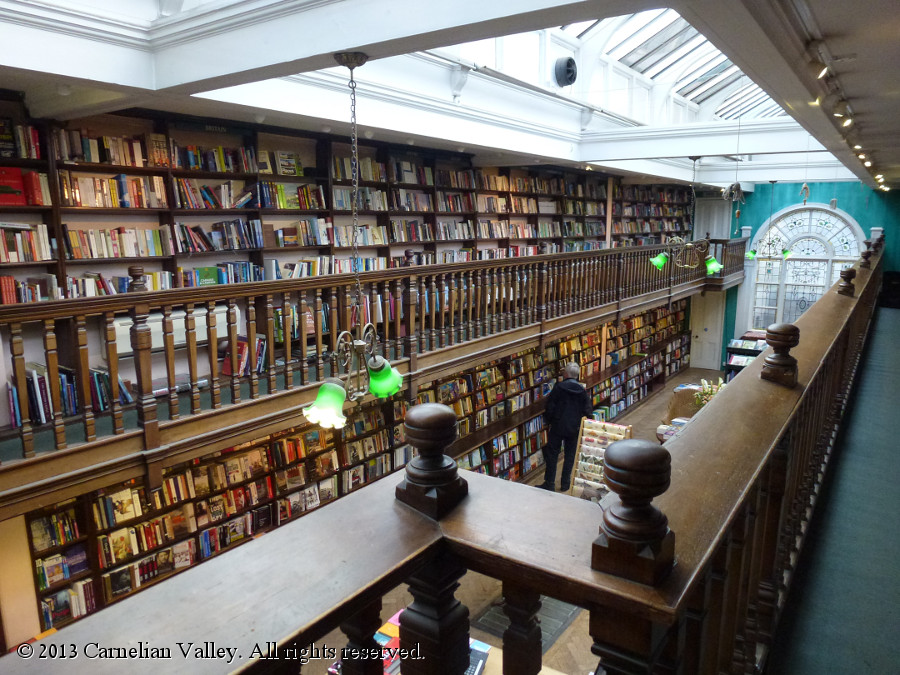
Something that I absolutely love, nowadays (I’ll get to that in a minute), is going into a small bookstore, in other words not a chain store that is most likely to hold only recent and famous novels, and buy random books. There was an offer on in a store I visited a few weeks ago, a 3 for 2, but I hadn’t realised it; and having picked up two books of interest had no idea what else I should choose.
Because that was always the problem I used to have with small bookstores – you’d rarely recognise any of the titles or authors. My parents may have found it interesting but I always assumed it was an element of their generation and left them to browse while I day-dreamed about bigger stores, better books, and, as I got older, no books at all.
My two choices were The Luminous Life Of Lilly Aphrodite which I’ve been wanting to read ever since it came out, a bargain at £3.99, and Lisa See’s biography of her family tree, On Gold Mountain. You may have noticed that I reviewed See’s Peony In Love not long ago. Well that was a book I’d had for a long time and finally got to reading it because of the biography, I felt I was in no position to read On Gold Mountain if I’d not read her fiction work. Of course it was only after finishing the fiction that I found out I’d read them in reverse order anyway despite my good intentions.
When I got to the counter and was told I should pick up another book because it was free I wandered round the piles of books on tables, looking for something that would hold my attention while knowledgeable of the fact that my boyfriend had already been waiting around for me to finish browsing the first time. I finally came across a small book, and although I can’t say the cover drew me in the fact that it was a small book overcome by the mighty mass of two other piles on either side, caught my interest. “Certainly” I thought it read. I took this as a sign I was meant to have it.
Later, on reading the title again without a towering shadow of books obscuring it, I found it to be called Certainty, by Madeleine Thien. I’ve never heard of it, but the blurb sounds interesting. It’s a few years old which means it has the benefit of not having been reviewed lately. There’s something about this discovery that makes me feel happy. I’ll let you know how it goes.
I’ll tell you one thing now though, even if I end up disliking it I will definitely be making a completely random purchase again.


