





A Short Exploration Of Ratings Summing Up Enjoyment
Posted 25th June 2014
Category: Chit-Chat Genres: N/A
7 Comments

When we use a number to supplement our reviews we are summing up our enjoyment, thoughts, objectivity, and so on (depending what we focus on). It sounds shallow almost, to use a number as a defining value of an author’s work, but it is often the quickest and most obvious indicator as to whether or not we recommend the book, especially when our review is vague for whatever reason.
However we all have different ideas as to what the different numbers mean. Despite a general concept that we share, the specifics will often be different. Fir example, I see a 2/5 as a book not really worth reading, but another may use it to say it just about is worth reading. Not too different overall, but different enough. Once you ‘know’ the reviewer it becomes easier to work out their ratings, but I still think there is a tendency for us to project our own individual values onto another’s review, away from the fact that their words would obviously make us think twice.
As to the actual worth of ratings, words are always more detailed than a number, unless of course you’re simply describing your rating. I would argue that without words a rating is meaningless unless you really know the person well.
There is a big element in favour of ratings, and that is that they help with clarity and that they are their own summary. Yes, I say that second clause even after suggesting ratings by themselves are not useful. In a way ratings are more exact than words, in the way that they limit you and force you to be more strict in your view – except perhaps when we’re gushing or ranting non stop.
I know that ratings help me a lot (this, even when I’m considering dropping them). If I’m ‘vocally’ on the fence, setting the rating in stone gives me the angle to work with, something that’s more specific than themes, in my case. It helps me choose the right words, for instance. And I know that it can swing the other way, too, in that sometimes I’m unsure of what the rating will be until I’ve finished writing, but that defining the rating afterwards concludes and completes my thoughts. It rounds them off.
I think there is a case to be made about whether ratings fit the reviewer’s writing style and whether they might be most useful when you’re reviewing a book of which you’re incredibly conscious of the negative impact spoilers may have.
I believe that ratings are important if the individual believes they are. They have to describe books in the way that suits them, the reviewer, best.
What do you think about ratings – are they useful in all/some/no cases? And, if you review, why did you choose to use/not use ratings?
In Which I Reiterate The Experience And Context Issue
Posted 23rd June 2014
Category: Chit-Chat Genres: N/A
7 Comments

I had the most amazing English teacher. Once, when we were watching an adaptation, she paused the video, telling us to look at the brooding eyes of the handsome actor. I think she realised we weren’t really watching. On my last day of school I told her that my dreams were just dreams and she told me that I shouldn’t let go of them.
But it was her unapologetic admission in class that made her memorable to me. The inevitable day came when a student asked how we could be so sure an author had meant to say such-and-such through their book, how we could know for certain that what we were being taught was correct. Our teacher simply said we didn’t, and that we could only ever assume and suppose, no matter what other teachers said. Our future classes were better for it.
At that age it was impossible to truly appreciate that what you were being taught was the result of many years and many opinions – the compilation of the studies undertaken by those who have gone before us and who know the text better than we do, maybe better than we ever will. Indeed in my case it was only through blogging – studying the texts for myself and for discussion – that I came to recognise themes and hidden meanings. And maybe we can’t say for certain that we are right, but we can say we’re pretty damn close.
It’s interesting, and I think this applies whether you’re actively writing about books or not, how we mature in our interpretations to see all those meanings. In this way it’s sad that so many classics are introduced to people at school, before they are old enough to truly understand them, because they might then miss the wonders that dissecting a text, for study or leisure, can bring. I know that my writing here surpasses anything I ever thought at 15 years of age, simply because I know more about the world.
And it’s this, our knowledge, that allows us to understand themes, and see what our teachers saw in the books. We can know we’re right about being a theme in Rebecca because we can empathise with the heroine’s need for love and to fit in. We can understand why Jane Austen’s work doesn’t require a lot of action because we can appreciate the social context in which she was writing.
Knowledge is important, but even more than that, surely caring is paramount, too. We can know a lot of facts but if we don’t care about them, we won’t be inclined to study and again I think that’s what can set us apart from our younger years. I’m looking at this from one, biased, perspective of course; in my ‘time’ in my year group there were no passionate advocates of literature (or if there were they were silent about it), we were yet to reach the appropriate maturity, and I know that grades were everything, the actual lesson of no lasting importance.
How reflective of your own experiences is this? What do you think about the teaching of classics at school?
Reviewing The Kobo Mini
Posted 18th June 2014
Category: Chit-Chat Genres: N/A
5 Comments

I had the opportunity to use a friend’s Kobo Mini recently and I thought that given my post on the Glo has proved useful to many, I’d write about the smaller device, too.
(My guess would be that since WHSmith were recently selling the Kobo Mini for £30 – a bargain even given the software – Kobo is likely phasing their Mini out of production, if they haven’t already.)
Like the Glo, the Mini is very slow and the sensitivity is hit and miss. Page turns are acceptable enough, but annotations remind you of why pen and paper have been in use for centuries. The internet connection is at times akin to dial-up. In buying the Kobo Mini you are getting something between average and good, a few steps in front of ‘fair’ in the specifications league.
The Mini is an inch smaller than the Glo and Touch – at 5 inches it’s much easier to carry around with you. A comparison could be made with print books in this case. The Mini is the mass market paperback you squeeze into your carry-on luggage whereas the Glo and Touch are the regular paperbacks packed into your suitcase. The Mini doesn’t quite fit your shirt or jeans pocket, but it may fit in your coat pocket. Like any ereader it requires a fair amount of padding when in transit – as yet I haven’t seen any cases that will fit it.
Obviously the smaller screen means that the ever-present Kobo page count leaves even less space for words, but in choosing the Mini you’ll have something very easy to hold, and those with smaller or less dexterous hands will appreciate the lesser strain that accompanies the product. Ereaders have generally been advertised as easy to use with one hand, but only the Kobo Mini truly keeps to this word.
The Mini hasn’t got a light so you won’t be reading during a night power-cut, but as a travelling library you can’t really go wrong. What it lacks in luxury it makes up in portability.
All in all, the Kobo Mini does what it says it does. It just takes its time.
Pros:
- Easy to hold and use in one hand
- Good clear screen
- May fit in some pockets
Cons:
- Slow
- Too sensitive to the touch when you wish it wasn’t; not sensitive enough when you’re trying to use it
- No light
Would you like a smaller ereader? Have you tried/got a Kobo?
Getting Back Into Asian Literature
Posted 16th June 2014
Category: Chit-Chat Genres: N/A
12 Comments
This is very much a trail-of-thoughts post, and to avoid any confusion, I’ll say that by ‘Asian literature’ I mean books set in and about (East) Asian characters, by both Asian and non-Asian authors. (You could create a drinking game from the number of times I say ‘Asian’…)
My interest in Asian lit pre-dates my love of Japanese music and Chinese film. It started rather by accident; looking for a book for a friend who didn’t read (I was a hopeful teenager), I instead left the store having bought the book that caught my eye for myself.

I read the totally fictional – Arthur Golden’s Memoirs Of A Geisha. I read the based-in-fact Empress Orchid by Anchee Min and Empress by Shan Sa. I read historical fantasy – Lian Hearn’s Tales Of The Otori and Alma Alexander’s The Secrets Of The Jin-Shei, series I never finished.
I think the reason I stopped reading Asian lit, or at least stopped making it a priority, is that blogging has changed the way I find books. (It’s also due to ARCs, but to a much lesser extent.) I like the change in general, but it has significantly lessened the ‘section’ of my reading wherein I chose books at the store randomly. Where I wanted a book but didn’t know which to get and so chose those whose titles and spines I liked. When you choose books that way rather than by recommendation, your selections will naturally skew toward interests you already have.

And whilst that may usually hinder the broadening of horizons, I dare say that an interest in Asian Lit when I’d had no history lessons on Asia, means that such a focus later isn’t a bad thing.

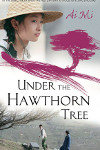
Recently I was drawn to the table of books in an otherwise book-less store, and something told me there was one in there for me. There was something specific that fit me that I had to find. I dismantled the books pile by pile and knew it when I found it. Chinese fiction and published by Virago. I’ve discovered that Under The Hawthorn Tree was adapted for film, and that it’s received mixed reviews. I don’t know if I’ll like it, but seeing it on the kitchen table where it’s left so that I notice and read it soon, I feel the old joy in my choice-at-random. I’m happy to have more Asian lit.
Regardless of whether I like the book, I’m hoping this jump-starts a trip back to my pre-blogging days. I want to incorporate Asian lit back into my reading life beyond the rare book. It will start with Ai Mi, and hopefully continue with the last empress of China. I suppose you could consider this a mission statement.
Has becoming a blogger affected the amount of time and space you give to your favourite type(s) of literature?
The Scaling-Back Book Blogging Stage
Posted 11th June 2014
Category: Chit-Chat Genres: N/A
13 Comments

It is a thing seeming to be universally acknowledged, that a blogger in need of respite after a fair few years, should be in want of a few less books.
And, where I’m concerned, possibly some inspiration, too!
Today I’m thinking about ARCs and the interesting way that, no matter how much you think ‘that will never happen to me!’ (complete with a look of horror on your face), at some point in your blogging career you, like those who started long before you, find that the idea of saying ‘no’ more often is a very good habit to adopt.
Given that most book bloggers seem to come to this conclusion as their blog matures, I’m not going to discuss the last four years or speak as an advisor for those who have been blogging for less time. I’m simply going to agree with the concept.
I’ve reached the book blogging age at which less is more. I can’t say I never saw the value in reviewing my own books, or in reviewing older books, because I have always reviewed them. But it takes reaching that point, wherever it may be for you, at which you find you want as well as need to cut back a bit (‘want’ and ‘need’ blending together is more important than just needing in this respect). When you realise that your blog is just as good with a better mix of owned and requested/sent, and, crucially, when you truly madly deeply understand the concept that blogging about exactly, specifically exactly what you want to write about, is the best way forward.
I always knew it, but I didn’t know it. And I think no matter how many blog posts you read advising you that the time will come and that perhaps you’re better off not requesting all those books even though you’re understandably excited and honoured to read them, you have to experience this feeling for yourself for it to really take effect. In this way even though reading a ‘senior’ blogger’s post might make you feel you’ve a long way to go, I feel that despite the general need for a change later on, that excited requesting-everything-saying-yes-to-all stage is important to go through. There’s a general life lesson in there somewhere.
I know I’ve mentioned it in my (few) latest acquisitions posts so I won’t go into it other than to say, I’ve now been doing this ‘no’ thing for a while. And whilst I did wonder at the start if I was loosing my love of blogging, what I realised was that I was actually loving it more, and that was why I was becoming so selective. I love blogging and writing about books so much I want to invest the time in reading books I can give my all to writing about, no matter if I end up disliking them. Accepting a book just because you feel you should all too often leads to a passionate-less response, not to mention more blogging slumps.
It’s quality over quantity.
Suffice to say that writing more about books already published increases conversation, which in turn increases your own interest. And writing about new books that you’re truly interested in is gold.
I am by no means saying no to ARCs. I love to review books for publishers and it broadens my horizons as much as other bloggers’ recommendations do. But I am being very selective, and saying ‘no’ even to books I know I would enjoy.
You need time to read and write about books, and you need to remember to give yourself that time.
Have you reached this stage yet? Did you manage to skip the all-the-books stage? Or, for those of you who have always mostly reviewed ARCs, have you ever felt the desire to change?


